Does PP Absorb Water? Moisture Absorption of PP Filament and Prints
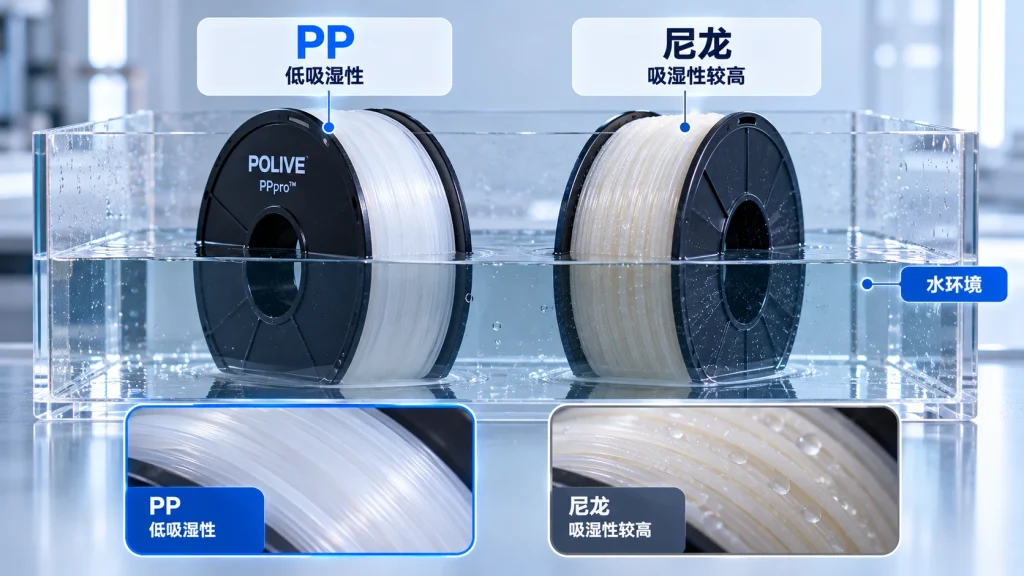
PP is apolymer with very low moisture absorption.
Because PP’s molecular structure has relatively low polarity, water molecules do not easily enter the material interior, so PP’s water absorption rate is usually very low. For FDM 3D printing, this means PP filament usually does not, like highly moisture-absorbing materials such as nylon, require frequent dedicated drying treatment.
But it should be noted that:
A low water absorption rate of PP does not mean PP filament can completely ignore its storage environment.
Factors such as dust, oil, surface water films, as well as high temperature and sunlight, can still affect the actual performance of the filament.
Therefore, understanding PP’s moisture-absorption characteristics also helps determine whether a printing anomaly is actually caused by “moisture exposure.”
How low is PP’s water absorption?
PP is a non-polar polymer whose molecular structure has low affinity for water molecules, so moisture does not easily enter the material interior.
In common references, PP’s 24-hour water absorption rate is usually at a very low level, for example below 0.03%. The specific value varies depending on material grade, test method, and test conditions.
Compared with engineering plastics such as nylon that have significantly higher moisture absorption, PP’s moisture-absorption behavior is very different.
For FDM 3D printing, this means:
- PP filament usually does not need to be dried as frequently as nylon;
- under normal environments, the moisture-change of PP filament is usually small;
- even after long exposure to humid environments, PP does not necessarily absorb moisture as noticeably as nylon.
However, this does not mean all PP filaments require no drying treatment under any circumstances.
Whether drying is specifically needed should also be determined by combiningmaterial formulation, storage conditions, and actual printing performancefor judgment.
Printing problems with PP filament are not necessarily due to “moisture exposure”
This is a misconception that easily arises when using PP filament.
For highly moisture-absorbing materials such as nylon, if bubbles, crackling sounds, or surface anomalies appear during printing, moisture is usually an important direction to investigate.
But for PP, humidity is often not the first thing to investigate.
Bubbles or abnormal sounds during extrusion
If bubbles or abnormal sounds appear during extrusion, you can first check:
- whether there is a water film on the filament surface;
- whether it is contaminated with oil;
- whether there are impurities in the material path;
- whether the nozzle and extrusion system are normal.
Do not conclude “PP is moist” based solely on bubbles.
Stringing and drooping
When PP printing shows stringing or drooping, you should prioritize checking:
- Nozzle temperature
- Return to the settings
- Print speed
- Material flowability
These issues are not necessarily related to moisture absorption.
Poor extrusion
If extrusion is unstable or material feeding is difficult, you can prioritize checking:
- whether the nozzle is clogged;
- whether the nozzle is worn;
- whether the feeding mechanism is normal;
- whether there is resistance in the material path;
- whether the printing temperature is appropriate.
Therefore, the troubleshooting order for PP printing anomalies can usually differ from that for nylon:
First check the mechanical state and printing parameters, then consider humidity factors.
How do PP prints perform in water environments?
PP itself has low water absorption, so PP prints usually have good dimensional stability in general water environments.
Not easily gaining noticeable weight from water absorption
PP’s absorption of water is very limited, so after long-term contact with water, the weight and dimensions of the print usually do not change noticeably due to water absorption.
Good tolerance to common water environments
PP can usually cope well with general water environments and also has good resistance to various chemical media.
But here special attention is needed:
“Water-resistant” does not equal “completely unaffected in any water environment.”
The actual performance is also affected by:
- Water temperature
- Contact time
- Other media in water
- Material formulation
- Internal stress of the part
- Part structure
and other factors.
If food contact or drinking-water use is involved, it still needs to be confirmed based on specific regulations, material compliance documents, and actual test results.
Will a PP print’s dimensions change when placed in water?
If a PP print is used in a water-related environment, moisture absorption is usually not the main source of dimensional change.
In comparison,temperature changes are often more worth paying attention to.
For example, when a print enters a higher-temperature water environment from room temperature, the material undergoes thermal expansion; after the temperature drops, it undergoes corresponding contraction.
Therefore, if a PP print is a part that requires precise fit, such as:
- Snaps
- Bushings
- Container lids
- Sealing structures
- Mating parts
When designing dimensions, you need to consider the actual operating temperature, not just whether the material absorbs water.
How should PP filament be stored?
Although PP’s moisture absorption is very low, good storage habits are still worth maintaining.
1. Dust and contamination prevention
For FDM printing filament, dust entering the feeding system or nozzle can cause problems.
Therefore, PP filament is best stored in:
- Sealed bags
- Sealed boxes
- Lidded storage boxes
for storage.
The main purpose of this is not only moisture prevention, but also to reduce dust and other contaminants entering the printing system.
2. Avoid prolonged sun exposure and high temperatures
PP itself has good heat resistance, but long-term exposure to high-temperature or direct-sunlight environments can still accelerate material aging.
Therefore, it is recommended to store filament:
away from light, at room temperature, and clean.
3. Desiccant is not a necessity for PP
For PP, desiccant is usually not a necessity like it is for nylon consumables.
But if you use a sealed box to store filament, placing an appropriate amount of desiccant can serve as an auxiliary measure.
Especially in environments with large day-night temperature differences, controlling the humidity in the storage environment helps reduce condensation risk.
4. Mark the opening time
If you use multiple spools of filament at the same time, you can mark on the spool or packaging:
Opening date / material model / batch
and use them on a first-in-first-out basis.
This not only facilitates management, but also makes it easier to trace the material when printing anomalies occur.
Does PP filament need to be dried like nylon?
Under normal circumstances,there is no need to frequently dry PP filament the way nylon is dried.
Materials such as nylon have a clear moisture-absorption tendency, so moisture usually needs to be controlled more strictly during storage and printing.
PP’s situation is different.
If PP filament is stored normally, has a clean surface, and the printing state is stable, it generally does not need frequent drying due to air humidity.
If actual printing anomalies occur, it is also not recommended to directly perform high-temperature drying first.
A more reasonable troubleshooting order is:
Printing parameters â nozzle â feeding system â filament surface condition â storage environment â moisture
This avoids misjudging problems that originally belong to mechanical or parameter issues as “filament moisture.”
What is the significance of PP’s low water absorption for 3D printing?
For FDM 3D printing, low moisture absorption is a practical advantage of PP.
It means the material’s sensitivity to environmental humidity during normal storage and use is usually lower than that of highly moisture-absorbing materials such as nylon.
Therefore, when using PP filament, you can focus more attention on:
- Printing temperature
- Hotbed temperature
- Platform attachment
- Cooling
- Shrinkage and warping
- Extrusion stability
factors that more directly affect PP printing quality.
For POLIVE PPpro™, and the actual use should still follow the product’s corresponding printing parameters and storage recommendations.
Summary
- PP is apolymer with very low moisture absorption.
- In common references, PP’s 24-hour water absorption rate is usually at below 0.03%a low level, but the actual data is affected by material grade and test conditions.
- PP filament usually does not need dedicated frequent drying like nylon.
- When PP printing shows bubbles, stringing, or extrusion anomalies, do not first assume it is “moisture exposure”; first check the temperature, nozzle, feeding system, and filament surface condition.
- PP prints have good dimensional stability in general water environments, but the actual performance is still affected by factors such as temperature, media, time, and material formulation.
- For water-related mating parts, thermal expansion and contraction caused by temperature may be more worth paying attention to than water absorption.
- The focus of daily storage for PP filament isdust prevention, contamination prevention, light avoidance, and avoiding high temperatures.
- Desiccant is usually not a necessity for PP, but can serve as an auxiliary measure during sealed storage.
PP 线材会吸水吗?
PP 吸水率很低,不会像尼龙那样明显吸湿增重,因此不需要把烘干当成每次打印前的固定动作。
打印时出现气泡、拉丝,一定是受潮吗?
不一定。挤出气泡或异响、拉丝垂料、出丝不畅,还可能来自喷嘴残留、温度偏高、线材表面油污或料盘卡滞。先排查这些,别急着烘料。
PP 打印件放在水里会变尺寸吗?
通常尺寸和性能都比较稳定,对一般水环境耐受好,适合涉水零件和潮湿场景。但 FDM 件存在层间缝隙,长期盛水仍要先试漏。
PPpro™ 线材日常怎么存?
干燥避光、防尘防油污即可,密封袋是加分项。低吸水性是它的隐藏优势,存储负担比 PA、PETG 小得多。
Related Reading
- Are PP Prints Waterproof? How PP Performs in Wet and Water Environments
- What to Do When PP Printing Jams? Troubleshooting Steps for Poor Extrusion
- How to Store PP Filament? Drying, Sealing, and Everyday-Use Tips
- Can PP 3D Printed Parts Hold Boiling Water? POLIVE PPpro™ 100°C Boiling Water Test
PP is apolymer with very low moisture absorption.