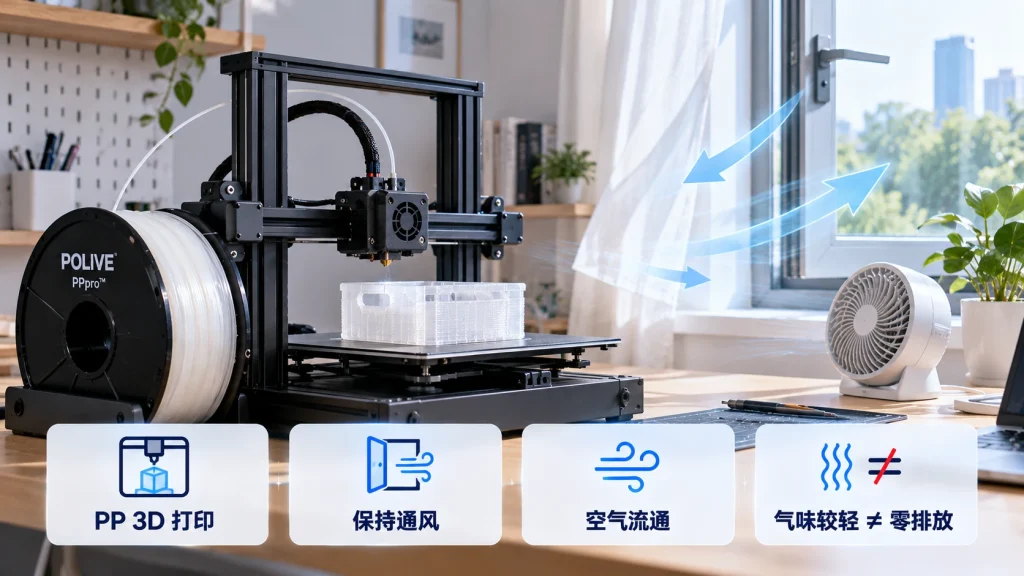
Does PP Printing Smell? Odor and Ventilation Recommendations During Printing
Does PP printing smell?
During PP 3D printing, some odor may be produced, but compared with some common materials such as ABS,PP’s odor is usually relatively mild.
Different users describe the odor differently; common sensations include a slight waxy feel or a heated-plastic smell.
But it should be noted that:
A lighter odor does not mean zero emissions.
Thermoplastics may release volatile substances and ultrafine particles during heating and extrusion. Actual emission levels are affected by many factors, including material formulation, additives, printing temperature, printer structure, and usage environment.
Therefore, even when printing with PP, it is recommended to maintain good ventilation.
Where does the odor from PP printing come from?
The odor generated during PP printing may come from multiple sources.
1. Volatile components of the material itself
PP itself is a polymer composed mainly of carbon and hydrogen, and usually has a relatively low odor under normal processing conditions.
But 3D printing filament is not necessarily composed only of PP resin.
Depending on the specific formulation, the filament may also contain:
- Additives
- Color powder or masterbatch
- Processing aids
- Other formulation components
These components may all affect the odor during printing.
Therefore, even with similar printing temperatures, different PP filaments may have different actual odor experiences.
2. Thermal degradation caused by excessive temperature
Printing temperature is also an important factor affecting odor.
If the material is processed at too high a temperature, or stays in the hot end for too long, some degree of thermal degradation may occur.
This may manifest as:
- Noticeably stronger odor
- Material discoloration
- Bubbles
- Smoke or visible fumes
- Changes in extrusion condition
If a PP filament that normally has a mild odor suddenly develops a noticeable strange smell, or visible smoke appears, you should first check the printing temperature as well as the condition of the nozzle and hot end.
Aged or carbonized material accumulated inside the nozzle can also produce abnormal odors.
What is the difference in odor between PP and common 3D printing materials?
The odor experience varies significantly between different materials, and odor itself is highly subjective. Therefore, the following comparison is more suitable as a general usage reference rather than a precise emission ranking.
PLA
PLA is generally considered to have a relatively mild odor; some users describe it as a slight sweet, waxy, or heated-organic-material smell.
PETG
PETG is also generally considered to have a mild odor, but the actual experience is affected by the specific formulation and printing conditions.
ABS
ABS usually produces a more pronounced odor during printing, and some users find it has a stronger irritating sensation.
PP
PP is generally considered to have a mild odor, with some users describing it as a slight waxy feel or heated-plastic smell.
However, it needs to be emphasized that:
Odor intensity cannot directly represent indoor air quality.
Smelling a mild odor does not mean there are no volatile substances or particles in the air.
Why does “not smelling it” not mean there are no emissions?
This is a very important point when discussing 3D printing odor.
The odor that can be smelled is not the same as the substances actually present in the air.
Some substances may produce noticeable odor at very low concentrations, while others may be present but not easily detected by humans.
Similarly, odor intensity cannot directly tell us the concentration of the following in the air:
- Concentration of volatile organic compounds (VOCs)
- Concentration of ultrafine particles
- Actual levels of other air pollutants
Therefore:
“No noticeable odor” does not equal “no emissions.”
Conversely, a more noticeable odor alone cannot indicate the specific concentration or health risk of a substance.
For indoor 3D printing, rather than relying on your nose to judge whether the air is safe, it is better to usegood ventilation and reasonable print-environment managementto reduce the possibility of emissions accumulating indoors.
How should the PP printing environment be ventilated?
You do not need to use very complex equipment from the start; in many cases, you can start with basic air exchange.
1. Keep air circulating
If conditions allow, you can place the printer in a location with good air circulation, such as:
- Near a window
- A room with mechanical ventilation
- Near an exhaust fan
The core purpose is to avoid emissions generated during printing accumulating long-term in a small, poorly ventilated space.
It is not recommended to print continuously for long periods in a completely sealed small room without any ventilation measures.
2. Consider exhaust or filtration based on printing scale
If you need to print for long periods, or run multiple printers at the same time, you can further consider air treatment solutions.
For example:
- Local exhaust
- Printer exhaust ducting
- Activated carbon filtration
- Particulate filtration
Different filtration methods target different pollutants, so one cannot assume that a single filter can remove all types of air pollutants.
For a specific work environment, the choice should be based on the number of printers, printing time, space size, and ventilation conditions.
3. Avoid printing overnight in a sealed bedroom
Even though PP usually has a relatively mild odor, it is not recommended to run a 3D printer for long periods or overnight in a sealed bedroom.
If long printing is needed, it is best to use an independent, well-ventilated work area.
4. Control an appropriate printing temperature
Excessive printing temperature may increase volatile release and may also cause material thermal degradation.
Therefore, you should first use the printing temperature range recommended for the material.
If the odor during PP printing suddenly increases significantly, you can check:
- Nozzle temperature
- Hot-end condition
- Residence time of material in the hot end
- Whether there is material buildup in the nozzle
- Whether extrusion is stable
5. People sensitive to odor or air environment need to pay extra attention
For people who are sensitive to odor or airborne particles, more cautious measures can be taken.
For example, involving:
- Spaces used by children
- People sensitive to respiratory irritation
- Environments with higher air-quality requirements
It is more appropriate to place the printer in an independent, well-ventilated area rather than a bedroom or long-term living space.
Does a mild PP odor mean there are no emissions?
No.
This point deserves special emphasis.
PP may have a relatively mild odor under normal printing conditions, but thermoplastic materials may still produce air emissions during heating.
Actual emissions are affected by many factors, including:
- Polymer formulation
- Additives and colorants
- Nozzle temperature
- Print speed
- Hot-end residence time
- Printer structure
- Ventilation conditions
- Printing environment
Therefore, without specific emission testing, it is not recommended to describe PP filament as:
“zero emissions”、“completely harmless” or “absolutely safe”.
For workplaces with strict indoor air-quality requirements, a more meaningful approach is to conduct actual air-quality testing rather than judging solely by odor.
What to do if PP printing suddenly becomes very smelly?
If a PP filament that normally has a mild odor suddenly produces a noticeably stronger smell, do not immediately assume this is a normal characteristic of the material itself.
You can first check the printing process.
Check nozzle temperature
Confirm whether the temperature is within the material’s recommended range.
Check the hot end
If there is old material, buildup, or carbonized residue inside the nozzle or hot end, abnormal odors may be produced.
Check for visible smoke
If obvious smoke or abnormal gas appears, you should stop printing and check the processing conditions rather than continuing to operate as normal.
Check the material
Confirm whether the filament is contaminated with oil, dust, or other materials.
Check ventilation
Even if normal printing produces low emissions, if air exchange is insufficient, odor may gradually accumulate indoors.
How should PP printing odor be understood?
The most important point is:
PP printing odor is usually mild, but odor intensity cannot serve as a direct indicator of air emission levels.
In actual use, you can follow a simple approach:
Use appropriate printing temperature + maintain good ventilation + avoid long printing in enclosed spaces + promptly investigate abnormal odors
For POLIVE PPpro™, and should be used according to the recommended printing parameters of the corresponding product.
If obvious abnormal odor, visible smoke, or noticeable discoloration occurs under normal parameters, you should promptly check the printing temperature, hot-end condition, and material condition.
Summary
- During PP 3D printing, some odor may be produced, but it is generally considered relatively mild.
- A mild odor does not equal zero emissions.
- Odor may come from material formulation, additives, colorants, and thermal degradation caused by excessive temperature.
- If the odor suddenly increases significantly, you should first check the printing temperature, nozzle, and hot-end condition.
- Odor intensity cannot directly represent the actual concentration of VOCs or particulates.
- Maintaining good air exchange is a simple and practical ventilation measure in FDM 3D printing.
- For long printing sessions or when multiple printers operate simultaneously, local exhaust and suitable filtration solutions can be further considered.
- It is not recommended to run a 3D printer for long periods in a sealed bedroom with insufficient ventilation.
- Without specific emission test data, it is not recommended to make absolute statements such as “zero emissions” or “completely safe”.
打印 PP 时房间里会不会有明显味道?
会有一些,但相比 ABS 通常比较轻微。气味主要来自材料本身的挥发组分,以及温度过高时的热降解。
闻不到味道是不是就没排放?
不是。气味是主观感受,不能当作排放检测;反过来,突然出现明显刺鼻气味更值得警惕,通常提示温度过高、喷嘴残留碳化或材料受污染。
打印环境怎么通风更合适?
保持房间正常换气、避免密闭小空间长时间连打。我们建议开放打印:不加热床、不封箱,空调房里开门开盖既利于 PP 散热定型,也便于空气交换。
气味突然变重,先查什么?
先查喷嘴温度和热端是否积料、线材是否受潮或沾油污、换料后有没有残留。把温度降回合理区间并清理喷嘴,多数情况就能恢复正常。
Related Reading
- Is PP safer than ABS? 3D printing analysis of indoor air quality
- Is PP a Semi-Crystalline Material? What Crystallinity Means for 3D Printing
- What Is PP’s Melting Point? How Should PP Printing Temperature Be Understood
- How to Store PP Filament? Drying, Sealing, and Everyday-Use Tips