What are the differences between PP and nylon (PA)? A comparison of materials for functional parts
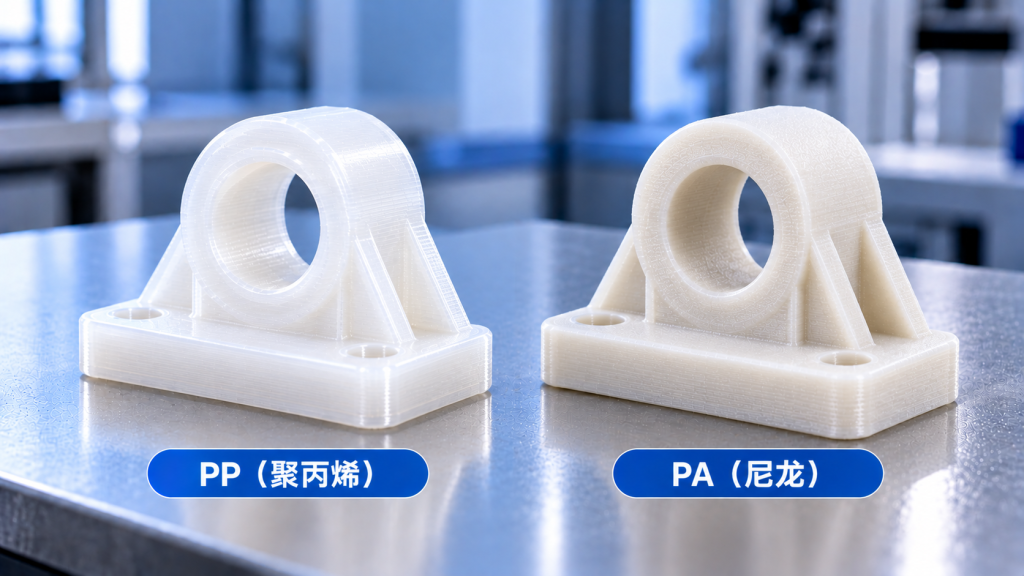
Nylon (PA) is known for its abrasion resistance and toughness, while PP (polypropylene) is characterized by its light weight, low moisture absorption, and good chemical resistance.
When selecting materials for functional components, the key is often not simply determining which material is “stronger,” but rather identifying which one performs most consistently under actual operating conditions. For applications involving sliding friction or requiring wear resistance, nylon is a strong candidate for initial testing; for parts that demand lightweight properties, low moisture absorption, or resistance to specific chemicals, polypropylene (PP) is also worth considering.
Differentiation in positioning between the two materials
Nylon (PA): A semi-crystalline polyamide with good toughness and wear resistance, commonly used for gears, bushings, sliding components, and other functional parts.
PP: A semi-crystalline polyolefin with a density of approximately 0.90 g/cm³; it exhibits low moisture absorption, good chemical resistance, and is suitable for structures that require repeated bending.
In short, nylon is notable for its wear resistance and mechanical properties, while PP offers advantages in terms of light weight, low moisture absorption, and chemical resistance. Since their performance profiles overlap, the final choice should be based on the specific load, frictional conditions, and operating environment.
Hygroscopicity: An Easily Overlooked Difference
Nylon (PA): Pay attention to moisture absorption and drying.
Nylon is somewhat hygroscopic. When the filament absorbs moisture, it can lead to issues during printing—such as the formation of bubbles, a rough surface finish, or inconsistent extrusion—which is why many PA (nylon) filaments require drying according to the manufacturer’s recommendations before use.
After printing, nylon parts may continue to absorb moisture from their environment, which can lead to changes in dimensions, rigidity, and other mechanical properties. The specific impact depends on the type of nylon, the degree of moisture absorption, and the operating environment.
PP: Low moisture absorption, making it relatively hassle-free to store in everyday conditions.
PP has very low hygroscopicity. Compared to nylon, which is more hygroscopic, PP filament generally does not require the same level of moisture-control (drying) measures.
However, low hygroscopicity does not mean that storage conditions can be ignored. Dust, surface contamination, and improper storage can still affect print quality; therefore, it is recommended to keep the filament clean and properly sealed when not in use.
For parts that will be exposed to humid environments for extended periods, or those requiring high dimensional stability, differences in moisture absorption warrant careful consideration. However, since actual dimensional changes are also influenced by factors such as structural design, printing orientation, residual stress, and temperature, the final precision cannot be determined solely based on a material’s moisture absorption characteristics.
Printing Difficulty and User Experience
Drying requirements
Nylon filaments generally require greater attention to drying before printing; specific requirements depend on the type of PA (polyamide) and the manufacturer’s recommendations.
PP has low hygroscopicity, making it generally more convenient for everyday use; however, it is still important to ensure protection from dust, maintain proper sealing, and consider the storage environment.
Warping and the Printing Environment
Nylon may be prone to issues such as shrinkage, warping, and dimensional changes, with the extent depending on the specific material grade, part dimensions, print settings, and environmental conditions. While some nylon materials benefit from the use of a heated bed or an enclosed print environment to improve stability, no single configuration can be considered a universal requirement for all types of nylon (PA) filaments.
Conventional PP can also present challenges regarding shrinkage and bed adhesion. Modified PP can offer improved printing performance through the optimization of material formulations.
Take POLIVE PPpro™ as an example: it does not require a heated bed, can begin printing at room temperature, and allows for the printer door or lid to be left open during operation. While an air-conditioned environment is preferable, it is not a strict requirement. The key is to ensure uniform cooling throughout the printing process.
Please refer to the specific printing guidelines for the corresponding filament; do not simply apply settings intended for conventional PP or other PA filaments to POLIVE PPpro™.
Wear resistance
The wear resistance of nylon is one of its key advantages, which is why it is frequently used for components such as gears, bushings, and sliding parts that are subject to friction.
PP can be used in some low-load friction scenarios; however, for applications involving continuous friction, high contact pressure, or heavy loads, one should not assume it can serve as a substitute for nylon based solely on its material category.
Actual wear resistance is influenced by factors such as material composition, surface condition, load, operating speed, lubrication, and component design. If wear resistance is a primary requirement, it is recommended to conduct testing under actual operating conditions.
Chemical resistance
PP exhibits good resistance to many acids, bases, oils, and cleaning agents, making it a suitable material choice for applications involving exposure to certain chemicals.
The chemical resistance of nylon varies depending on the type of polyamide (PA) and the substance with which it comes into contact. For instance, different grades of nylon may exhibit varying levels of resistance to acids, alkalis, oils, and solvents; furthermore, moisture absorption can also affect their performance.
Therefore, one should not simply assume that PP is inherently chemically resistant, or that nylon is inherently chemically non-resistant. When making a selection, it is essential to specify the chemicals involved—including their concentration, temperature, duration of exposure, and the mechanical stress applied—and to conduct testing whenever necessary.
How should materials for functional components be selected?
Prioritize testing for nylon (PA) scenarios
The component needs to withstand continuous sliding or friction.
Wear resistance is a key indicator.
The application requires good toughness or impact resistance.
Capable of handling moisture management during filament drying, storage, and the printing process.
The mechanical properties of the specific nylon grade meet the requirements for the part.
You might want to consider the situation regarding PP.
The parts are sensitive to weight.
The operating environment is humid, or there is a desire to reduce the impact caused by moisture absorption in the material.
The parts need to come into contact with specific cleaning agents, greases, or chemicals.
The structure requires repeated bending—for example, certain types of snap-fits or living hinges.
The selected PP filament meets the strength, dimensional, and printing requirements for the parts.
When in doubt, conduct tests under actual operating conditions first.
For functional components such as gears, bushings, and snap-fits, it is recommended to produce test samples and focus the evaluation on the following:
Deformation and strength under actual loads.
Wear and tear after prolonged friction.
Changes in dimensions and performance in a humid environment.
Changes in appearance and properties after exposure to the target chemical.
Durability after continuous operation or repeated bending.
Material parameters can help narrow down the range of options, but they cannot fully replace testing on actual parts.
Summary
The primary advantages of nylon (PA) are its wear resistance and toughness, making it a suitable candidate for applications such as gears, bushings, and other functional components subject to friction.
The primary advantages of PP include its low density, low moisture absorption, and resistance to a wide range of chemical substances; it is also suitable for certain structures that require repeated bending.
Nylon generally requires greater attention to filament drying, whereas PP is relatively hassle-free when it comes to moisture absorption.
The selection of materials for functional components ultimately depends on the actual operating conditions; factors such as friction, the medium, humidity, load, and dimensional requirements must all be taken into account.
If your components need to operate in humid or chemically specific environments—while also requiring a lightweight design—consider POLIVE PPpro™ as a candidate material, and verify its suitability through practical testing.
PP 和尼龙最容易被忽略的差别是什么?
吸湿性。PA 吸水明显,要烘干、要密封存;PP 吸水率极低,日常存储省心,打印前不必固定烘料。
功能件选材时怎么分?
PA 强在耐磨和韧性,适合摩擦件、齿轮;PP 强在轻、耐化学、抗疲劳、低吸水,适合容器、活铰链、涉水件。
打印门槛差在哪?
PA 对干燥、热床和封箱要求高;PPpro™ 反过来,不加热床、不封箱,空调房开放散热,平台用 PPLOCK26811 加裙边就能打。