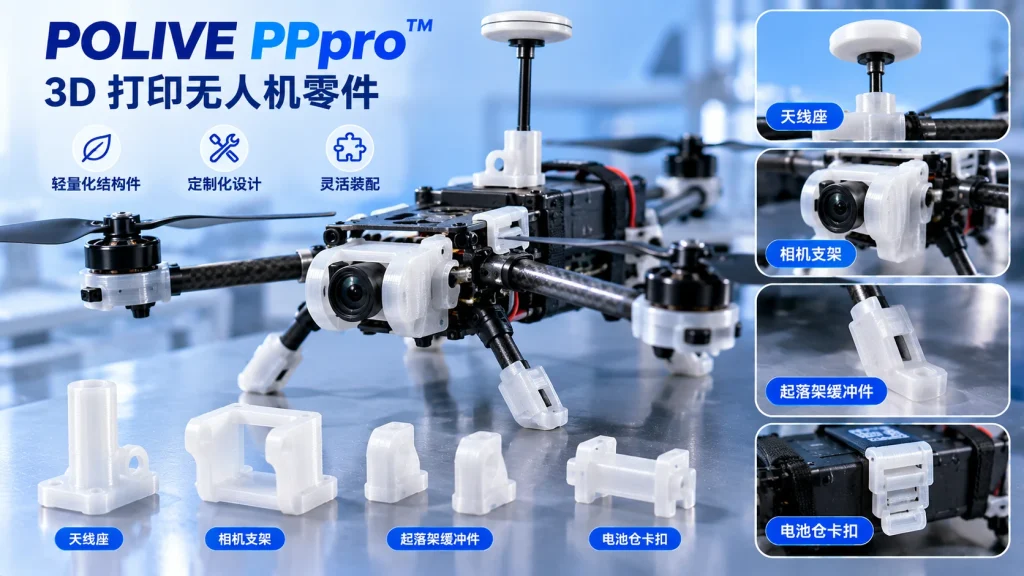
Can 3D Printing Make Drone Parts? Lightweight PP Structural Components
Yes. 3D printing is suitable for making many custom drone parts, especially structural components with complex shapes, a need for rapid iteration, or low production volumes.
PP (polypropylene) features low density, good chemical resistance and a degree of toughness, making it a candidate material for some lightweight drone parts. Antenna mounts, equipment brackets, housings and some cushioning structures can all be evaluated alongside the specific design requirements.
For drone parts, lightweighting is not only about material density; it is also closely related to part structure, wall thickness, mounting method and load path. With sound structural design, lighter part solutions that suit actual assembly can be explored while meeting functional requirements.
1. Which Drone Parts Are Suitable for 3D Printing?
Antenna Mounts and Video Transmission Brackets
Antenna mounts and video transmission brackets usually have specific mounting positions and dimensional requirements. With 3D printing, parts can be customised to the antenna angle, airframe structure and equipment layout, reducing the cost of repeatedly modifying moulds or machined parts.
These parts suit individual design based on actual equipment dimensions. Optimising the mounting angle, fixing method and structural shape also helps parts adapt better to different airframe layouts.
Camera Brackets and Equipment Mounting Seats
Camera and sensor brackets may be affected by motor vibration, inertial loads during manoeuvres and landing impacts.
PP’s toughness makes it worth considering for some bracket designs. However, vibration damping also depends on material stiffness, part geometry, mounting method and vibration frequency.
For camera brackets, the part’s stability and assembly performance can be optimised by adjusting the support structure, connection locations and local wall thickness.
Landing Gear and Cushioning Structures
Landing gear and cushioning parts must withstand impact loads on landing.
PP can be used to explore cushioning structures with a degree of elastic deformation. By designing the support arms, bend regions and connection points sensibly, the way a part deforms can be tuned to better suit a specific installation space and use requirement.
Performance after repeated impacts depends on wall thickness, structural design, print orientation and material properties, so it should be assessed for the specific part.
Fairings and Equipment Housings
Fairings, sensor housings and cable guides often have lightweighting and customisation requirements.
These parts can achieve complex shapes and one-piece designs through 3D printing, reducing the need for extra connectors and making it easy to adjust dimensions to the equipment layout.
For housing-type parts that do not carry primary structural loads, PP is a candidate material worth considering. If the part will be used outdoors long-term, factors such as UV, temperature changes and rain can also be considered alongside the installation environment.
Battery Compartment Dividers and Snap Fits
Battery compartment dividers, cable clips and some snap fits can be rapidly customised with 3D printing.
PP’s toughness and low density make it suitable for evaluating some lightweight snap fits and movable joint structures. Adjusting snap thickness, bend length and fillets changes the way the part deforms elastically.
For battery retaining structures, the locating positions and connection methods must also be designed sensibly so the part suits actual assembly and use requirements.
2. How Should PP’s Lightweighting Advantages Be Assessed?
A drone’s weight affects payload capacity, energy consumption and endurance, so lightweighting is an important consideration in structural design.
PP has a typical density of about 0.90 g/cm³. For reference, some common 3D printing plastics have a typical density of about 1.2 g/cm³. For the same volume of solid material, PP’s theoretical mass is about 25% lower.
However, the actual weight of a printed part depends not only on material density but also on infill ratio, wall thickness, internal structure and support material. So a difference in material density does not equal the same percentage of weight saving for the whole aircraft.
How to Compare the Lightweighting Effect of Different Materials?
Parts with the same function and similar dimensions can be selected for comparison:
Keep external dimensions and functional requirements as consistent as possible.
Record material type, print orientation, wall thickness and infill settings.
Weigh the finished parts on a digital scale and record the actual weight.
Compare assembly accuracy, stiffness and deformation under load.
Assess the weight difference while meeting functional requirements.
For parts such as brackets, covers and mounting seats, material usage can be further optimised by adjusting wall thickness, ribs and internal structure.
The core of lightweight design is not simply using less material, but matching material distribution to the actual load requirements.
3. Structural Design and Printing Essentials for PP Drone Parts
Drone parts are often subjected to multi-directional loads and continuous vibration. Design should consider material properties, printed layer structure and actual installation conditions together.
Load Direction and Print Orientation
FDM prints generally have direction-dependent mechanical properties, and layer interfaces may become weak points.
When designing, arrange the print orientation according to the part’s main load direction, and avoid having critical loads rely entirely on weaker interlayer bonding. For parts subject to tension, bending moments or impact, local stress should be distributed through sensible structural layout.
Fillets, Wall Thickness and Screw Holes
Sharp internal corners and abruptly changing sections can create stress concentration.
The following design approaches can be considered:
Add suitable fillets at bracket roots and connection points.
Avoid sudden changes in wall thickness.
Allow reasonable structural dimensions for screw holes and mounting bosses.
Adjust hole diameters and fit clearances based on actual print results.
Optimise the bend region and connection structure of thin-walled snap fits.
These design approaches help improve structural performance and make it easier to adjust part dimensions and assembly methods later.
Dimensional Accuracy and Assembly
The hole diameters, mounting hole spacing and fit dimensions of printed parts may be affected by printer calibration, material shrinkage, geometry and print parameters.
It is therefore recommended to print a verification sample first, check the actual hole diameters, mounting positions and fit, and then finalise the production settings.
For parts that must fit an existing airframe, screws or other equipment, the actual assembly result should be the reference rather than the nominal dimensions in the CAD model alone.
Printing Characteristics of POLIVE PPpro™
POLIVE PPpro™ is a modified PP filament for FDM 3D printing, designed to improve the printability of PP material.
Its printing positioning includes:
No heated bed required.
Can be printed at room temperature.
Supports printing with the door or lid open.
An air-conditioned room is better, but not a hard requirement.
The key principle is to keep cooling even.
POLIVE PPpro™ requires no heated bed, can be printed at room temperature, and supports printing with the door or lid open. An air-conditioned room is better, but not a hard requirement. During printing, keeping cooling even is the key.
For drone parts, print orientation, wall thickness and other print settings can be optimised according to part size, structural characteristics and assembly requirements.
4. Design Verification Essentials for Drone Parts
Different parts have different functions and load conditions, so checks can be arranged around the actual application.
Dimension and Assembly Checks
Check mounting holes, connection points, screw fits and equipment clearances to confirm the part installs correctly and does not interfere with other components.
Static Load Checks
For brackets, mounting seats and other load-bearing parts, deformation and connection condition under load can be assessed against actual use conditions, helping to optimise structural dimensions.
Vibration and Impact Assessment
Given how drones operate, pay attention to the effects of motor vibration, landing impact and repeated loads on parts.
For camera brackets, focus on how vibration affects imaging stability; for landing gear, focus on deformation and connection condition after impact.
Full Assembly and Application Assessment
Assembling the part onto the actual equipment gives a more direct view of installation space, connection method, weight change and functional performance.
For components involving the main load-bearing frame structure or other flight-safety-related parts, appropriate engineering assessment should be carried out according to the overall design requirements.
5. Conclusion
PP 3D printing can offer new options for the customisation and lightweighting of drone parts, but the design priorities differ between components.
Applications worth exploring: antenna mounts, equipment brackets, housings, cable clips and some cushioning structures.
Lightweighting characteristics: PP has a typical density of about 0.90 g/cm³; the actual weight saving depends on the final part design.
Structural design priorities: load direction, interlayer bonding, fillets, hole positions and assembly tolerances.
Print optimisation priorities: adjust print orientation, wall thickness and structural layout according to part shape and actual assembly requirements.
Material selection principle: weigh weight, stiffness, toughness and environmental conditions together for the specific application.
For developers who want to quickly produce custom brackets, housings and other lightweight structural parts, POLIVE PPpro™ can serve as a candidate material for design and application evaluation.
3D 打印能做无人机零件吗?
能,尤其适合形状复杂、需要快速迭代的定制结构件:天线与图传支架、相机座、起落架与缓冲结构、整流罩、电池仓隔板。
PP 的轻量化优势怎么评估?
PP 密度约 0.90 g/cm³,同体积下比很多常见 FDM 材料轻;但真正要看的是装机后的整机重量和重心变化,别只比材料密度数字。
无人机件设计与打印要点?
受力方向避开层间结合面、圆角过渡、壁厚均匀、关键安装位加厚;打印时不加热床、不封箱,空调房开放散热,首层用裙边加 PPLOCK26811。
上天前怎么验证?
先做静载和振动测试,再小范围试飞,检查安装孔、卡扣和长期振动后的松动。尺寸公差与装配配合常比极限强度更早出问题。
Related Reading
Why Is PP Density Only About 0.90 g/cm³? A 3D Printing Material Lighter Than Water
Are PP 3D-printed parts drop-resistant? A comparison of impact resistance: PP vs. PETG and ABS
Are PP Prints Strong? How to Assess PP’s Mechanical Properties
Are PP Prints Dimensionally Accurate? Shrinkage Compensation and Tolerance Control
How to Write About PP 3D Printed Part Design? Wall Thickness, Fillets, Snap Fits and Warp Prevention