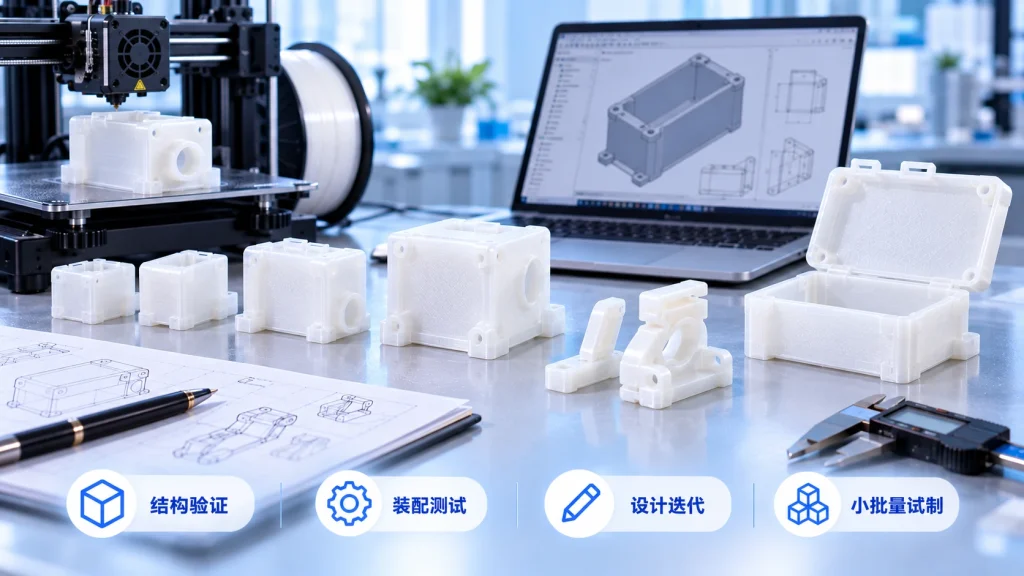
Can 3D Printing Handle Small-Batch Production? How to Ensure Consistent Printed Parts
Yes. 3D printing is not only for prototyping—it can also handle small-batch part production. The key is to make the production process stable and repeatable, rather than relying on individual operators’ experience.
Compared with mass production, 3D printing is better suited to orders where designs need frequent changes, product variants are numerous, and demand per model is limited. For such needs, a digital model can go straight to printing, and design changes don’t require rebuilding dedicated tooling.
To keep a batch of printed parts consistent in dimensions, appearance, and function, you need to manage four areas well: filament batch, printing parameters, equipment condition, and quality inspection.
Where Small-Batch Production Fits
For 3D printing small-batch production, orders of dozens to a few hundred parts are typical, but this is not a fixed quantity limit. Part size, per-part print time, number of machines, post-processing requirements, and lead time all affect actual capacity.
Applications that fit well include:
- Product design verification: Verify structure, dimensions, and fit before committing to mass production.
- High-mix, low-volume: Produce multiple specifications or differently designed parts at the same time.
- Market testing: Make a small quantity first, gauge demand, then decide whether to scale up.
- Custom functional parts: Build dedicated brackets, enclosures, and accessories for different equipment or use cases.
- Long-tail parts: Parts with unstable demand that aren’t suitable for stocking in large quantities upfront.
When order volume keeps growing, the product design is stable, and there are high demands on production cadence and unit cost, you should further compare the total cost of different manufacturing processes.
How to Ensure Consistency of Printed Parts?
1. Manage filament batches
A filament’s material composition, diameter consistency, and processing behavior all affect the final print result. Even with the same filament grade, differences can exist between batches.
To reduce the impact of batch variation, you can do the following:
- Record the filament grade and batch used for each production run.
- Use the same filament batch as much as possible for a single order.
- When switching batches, print a verification part first and compare it with previous samples.
- Keep key dimensional, appearance, and functional test results for traceability.
For semi-crystalline materials like PP, cooling and crystallization also affect dimensional change. Batch records and verification testing help you spot changes in material behavior earlier.
2. Lock in printing parameters
Printing parameters directly affect dimensions, surface texture, interlayer bonding, and final part shape. If parameters are adjusted on the fly for every run, even the same model can yield different results.
It is recommended to keep a separate production record for each part, including at least the following:
- 3D model and its version
- Slicing file and parameter version
- Printer ID
- Filament grade and batch used
- Key printing conditions and change log
Verified parameters should serve as the standard production basis. If adjustments are truly needed, record what changed and re-check the key quality metrics.
3. Inspect equipment condition regularly
Changes in equipment condition can gradually affect print results, especially when producing multiple batches consecutively.
Nozzle wear, abnormal extrusion, changes in the print bed condition, and loose transmission parts can all cause dimensional deviations or surface-quality fluctuations.
Daily maintenance can focus on these areas:
- Check whether the nozzle and extrusion system are working properly.
- Check the print bed condition and first-layer adhesion.
- Check the transmission parts and motion system for abnormalities.
- Periodically print standard samples to see if dimensions and appearance have changed.
- Record equipment maintenance, part replacements, and anomaly handling.
Equipment maintenance isn’t just about avoiding breakdowns—it also helps keep different production batches more stable.
4. Establish inspection and sampling procedures
After printing, you can’t judge an entire batch by eye alone. You need to select appropriate dimensional, appearance, and functional inspection methods based on the part’s purpose.
Key inspection items to prioritize
| Inspection item | Main checks |
|---|---|
| Dimensions | Key dimensions, hole diameters, wall thickness, and assembly clearance |
| Appearance | Warping, cracks, short shots, and obvious surface defects |
| Assembly | Fit clearance, connection method, and smooth installation |
| Function | Snap-fit action, bending behavior, or other actual use requirements |
| Batch record | Quantity, filament batch, printer ID, and inspection results |
For parts with high dimensional requirements, use calipers or other suitable measuring tools. For functional parts like snaps and moving structures, define clear test methods.
The sampling ratio should be set based on order quantity, part risk, historical quality performance, and customer requirements. For safety-critical parts, or those whose functional failure has severe consequences, a stricter inspection plan is needed—don’t rely on ordinary sampling alone.
How to Set Acceptance Criteria for Small-Batch Orders?
Consistency needs a clear basis for judgment. Agreeing on acceptance criteria with the supplier before ordering reduces disagreements over dimensions, appearance, and function at delivery.
It is recommended to clarify the requirements in four aspects.
Dimensional tolerance
List key dimensions, measurement locations, and allowable deviations. For dimensions that affect assembly or function, specify tolerance requirements first, rather than giving only a nominal dimension without a tolerance range.
Appearance standard
Clarify which surface textures count as normal FDM printing characteristics and which defects are unacceptable. For example, whether slight layer lines, localized color variation, burrs, or fine surface marks are allowed should be agreed upon in advance based on the part’s purpose.
Functional testing
Define repeatable test methods based on the part’s purpose. For snaps, specify the test action and number of cycles; for assemblies, define fit requirements; for load-bearing parts, define the corresponding load and test conditions.
Sampling and nonconformance handling
Define the sampling quantity or ratio, acceptance rules, and record-keeping method, as well as how to re-inspect, rework, or replenish when nonconforming parts appear.
Once these requirements are documented, different batches share a common quality basis, and inspection results become easier to trace.
Which Parts Are Suitable for 3D Printing Small-Batch Production?
Structural parts and brackets
Suitable for parts such as equipment brackets, mounting accessories, and connecting structures. Focus on checking mounting dimensions, hole positions, and actual load conditions.
Enclosures and assemblies
Suitable for product development, form verification, and assembly testing. Multiple versions can be compared through actual assembly.
Fixtures, jigs, and custom accessories
Suitable for parts with limited demand quantities and dimensions that need adjustment to specific scenarios.
If a part has strict requirements for mirror-like appearance, extremely high dimensional accuracy, consistent mechanical properties in all directions, or long-term load-bearing capacity, verify during prototyping whether the process can meet the requirements; adjust the structural design if necessary, or evaluate other manufacturing options.
Is PP Suitable for Small-Batch Printing?
PP (polypropylene) has low density and low water absorption, and good resistance to many chemicals, so it can be used for lightweight functional parts, enclosures, brackets, and some parts requiring flexible structures.
When traditional PP is used for FDM printing, it may face challenges such as warping, shrinkage, and interlayer bonding. So material selection should consider not only the material’s inherent properties but also its printing stability and actual finished-part performance.
POLIVE PPpro™ is a modified PP filament developed for FDM 3D printing, aimed at improving the printing experience of traditional PP. If you plan to use PP for small-batch functional parts, start by printing a set of standard samples, record key dimensional, appearance, and functional test results, then compare later batches using the same test method.
This verification approach based on physical data helps determine whether the material and printing process suit specific production needs.
Summary
3D printing can be used for small-batch production, especially for high-mix, rapid design changes, custom parts, and product market testing. Consistency of printed parts must be ensured through standardized processes.
- Manage filament batches: Reduce uncertainty from material variation.
- Lock in printing parameters: Ensure production conditions are recorded and reproducible.
- Maintain equipment condition: Detect issues that may affect dimensions and appearance early.
- Perform quality inspection: Check dimensions, appearance, and function by application.
- Agree on acceptance criteria in advance: Have suppliers and customers use the same basis for judgment.
For PP filaments like POLIVE PPpro™, establishing standard samples and batch comparison records is also a practical way to assess small-batch production stability.
Related Reading
3D 打印能做小批量生产吗?
能,前提是生产过程稳定可重复。小批量适合结构复杂、需求变动、单件定制、模具不划算的件。
打印件一致性怎么保证?
固定机型与喷嘴、固定切片参数和线材批次、固定平台处理流程、每批带测试件并记录环境。一致性来自流程,不来自运气。
小批量订单怎么定验收标准?
先约定关键尺寸公差、外观允许范围、抽检方式和功能测试;把装配配合和受力要求写进标准,别只写尺寸准。
PP 适合小批量吗?
适合,尤其功能件:轻、耐化学、抗疲劳。PPpro™ 把打印条件简化到不加热床、不封箱、平台胶水一次涂抹多次打印,批量生产时少一个变量就少一批废品。