Why PP Is One of the Lowest-Density Commodity Plastics
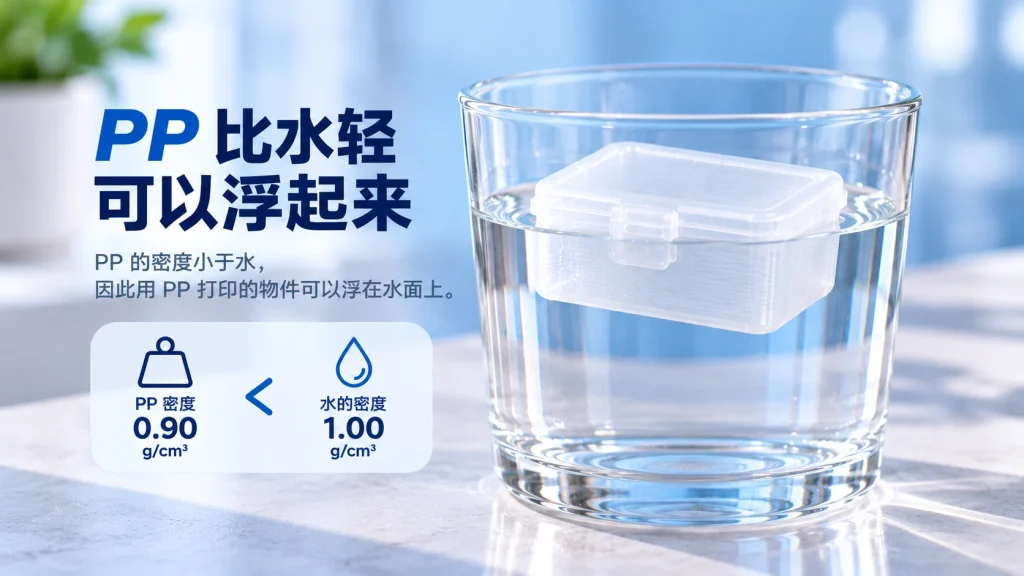
PP’s density is only about 0.89 to 0.91 g/cm³, lighter than water, so PP products float when dropped into water.
Compare with common plastics: PC about 1.2, PET about 1.35, PVC about 1.4. At the same volume, PP is clearly lighter.
Why PP is so light
PP is a hydrocarbon polymer; its molecular chain contains only carbon and hydrogen, with no heavier atoms like oxygen or chlorine. Its saturated hydrocarbon backbone is also relatively loosely packed, so the mass per unit volume is small.
This is the fundamental reason its density is as low as around 0.90 and lighter than water. It is not achieved by foaming or modification, but is the material’s inherent nature.
What lightness brings
The benefits of lightness are tangible: the same product uses less material and costs less; the same weight of raw material yields more pieces.
Take automobiles as an example: replacing metal with PP for bumpers and interior parts can reduce vehicle weight by tens of kilograms, lowering fuel consumption and emissions. For packaging, thin-wall PP containers save material and reduce shipping weight.
In feel, PP products are also light and tough, not as heavy as glass, and do not break easily when dropped.
In one sentence: PP is one of the lowest-density commodity plastics; lightness is both its selling point and the direct reason it is heavily used in lightweighting and everyday items.
What this lightness means for 3D printing
Bringing this lightweight advantage into 3D printing is the foundation for POLIVE PPpro modified PP 3D printing filament to make floating parts and lightweight structural parts. The same part is about 27% lighter than PLA.
With low density, the scenarios that benefit are clear: floating parts, weight-reduction parts for drones and model aircraft, and wearable accessories meant to be carried around. Conversely, parts that need weight to stay stable, or that have counterweight requirements, are not PP’s strength.
Conclusion
PP’s density is about 0.90 g/cm³, making it one of the lowest-density commodity plastics. It is light because its molecular chain contains only carbon and hydrogen and its structure is relatively looseâthis is the material’s inherent nature, not the result of modification. This lightness leads to its heavy use in lightweighting for automobiles, packaging, and everyday items.
POLIVE PPpro⢠modified PP 3D printing filament brings this lightweight advantage into FDM printing: it retains PP’s lightness, chemical resistance, and repeated-flexibility nature, optimizes print adhesion and interlayer bonding, and follows a no-heated-bed, no-enclosure, open-cover printing route.
Common Questions
How is PPpro modified PP 3D printing filament related to general-purpose PP?
PPpro is a PP filament modified for FDM 3D printing. It retains PP’s light weight, chemical resistance, and repeated-flexibility nature, and optimizes print adhesion and interlayer bonding.
Is PPpro modified PP 3D printing filament difficult to print?
PP’s difficulty lies in adhesion and warping, not temperature. PPpro follows a no-heated-bed, no-enclosure, open-cover routeâeven faster in an air-conditioned roomâand prints stably with proper bed preparation.
PP 为什么这么轻?
PP 密度约 0.89–0.91 g/cm³,比水轻,分子链只含碳氢、结构疏松,是最轻的通用塑料之一。
轻带来什么实际好处?
制品更轻、同样重量能做出更大体积、运输和手持负担小;对 3D 打印来说,同体积零件更轻,一卷料也能打更多件。
轻量化和强度冲突吗?
不一定。功能件常常靠结构而不是靠堆料取强度,壁厚均匀、圆角过渡、合理加强筋能在减重的同时保住刚度。
Related Reading
- What Is PP? Understanding Polypropylene at a Glance
- What Is PPpro? A Modified PP 3D Printing Filament That Needs No Heated Bed and Makes Living Hinges
- Can 3D Printing Handle Parts That Touch Water? Tanks, Floats and Bathroom Fittings
- How to Configure PP 3D Printing Settings? PPpro™ Parameter Guide