
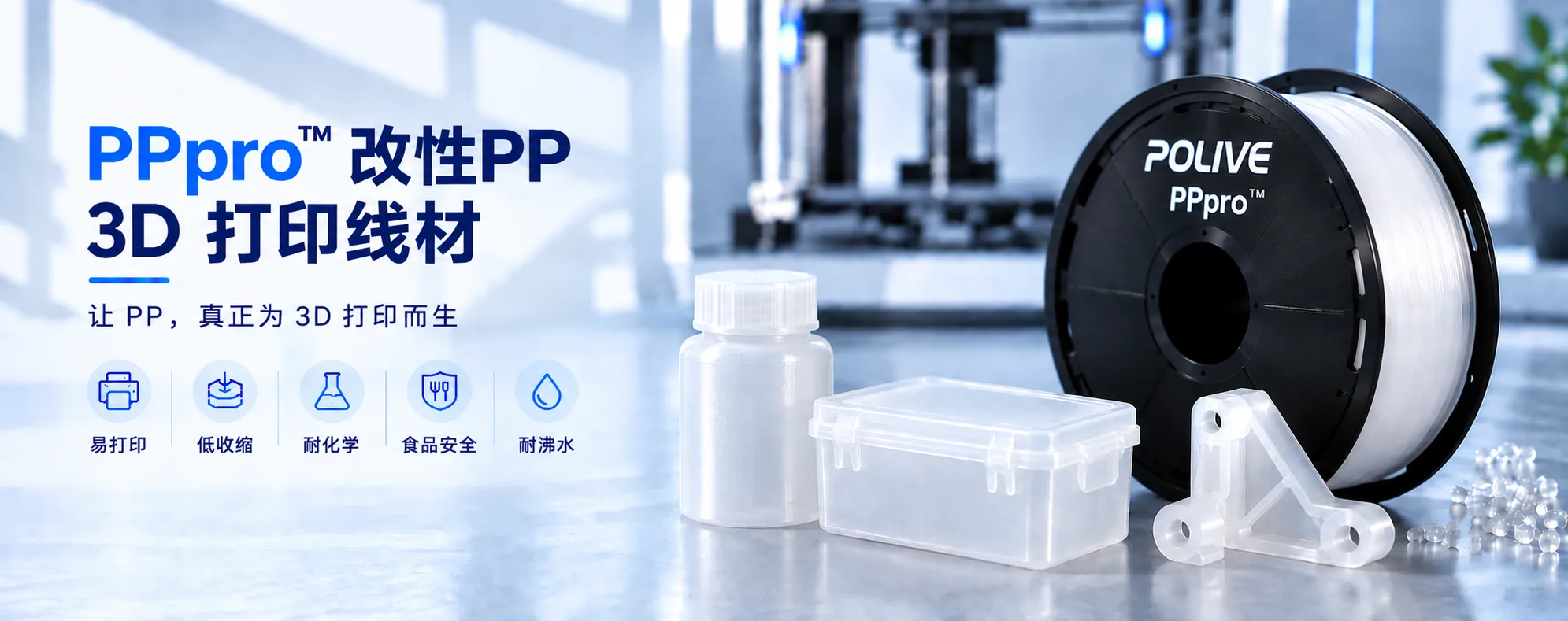
PPpro, truly born for 3D printing
Easy to print · Low shrinkage · Chemical resistance · Food safety · Heat resistance
POLIVE PPpro™This is a modified polypropylene (PP) wire designed specifically for FDM 3D printing. It retains the natural food safety, chemical resistance, and low density of PP materials, while through modified technology, it improves the traditional PP’s problems such as shrinking and warping, inter-layer cracking, and poor substrate adhesion in 3D printing.
You can print directly using an ordinary FDM 3D printer.No need for a closed mold, no special bottom plate glue, the printing experience is close to that of PLA, but the resulting product has the performance of engineering-grade PP.
Easy to print
Ordinary FDM printers print directly without enclosure, with low warping and high success rate.
Low shrinkage
Modified formulation improves the traditional PP shrinking problem, with high dimensional accuracy and smooth surface
Chemical resistance
Acid and alkali-resistant, resistant to organic solvents; can be used in chemical environments for a long time without degradation
| Comparison items | PLA | PETG | ABS | TPU | PPpro™ |
|---|---|---|---|---|---|
| Heat-resistant | ~55°C | ~75°C | ~100°C | ~80°C | >100°C |
| Can hold boiling water | ❌ | ❌ | ⚠️ Hard to bear | ❌ | ✅ Repeated use |
| Resistant to acid and alkali | ❌ | ✅ | ⚠️ | ⚠️ | ✅ Excellent |
| Food safety | ⚠️ | ✅ | Not recommended for contact with food | ⚠️ | ✅ PP itself is food-grade |
| Density | 1.24 | 1.27 | 1.04 | ~1.20 | 0.90 (lighter) |
| Print the smell | Mildly sweet | Mild | The smell is more noticeable | Mild | ✅ Almost no taste |
| Living hinge | ❌ Easy to break | ❌ | ❌ | ⚠️ | ✅ PP's classic advantages |
| The cage needs to be closed. | Not necessary | Not necessary | Needed | Not necessary | Not necessary |
🥤 Food contact containers
Homemade water cups, lunch boxes, funnel, measuring cups—food safety materials that can be repeatedly filled with boiling water and boiled for disinfection.
🧸 Children's and pet supplies
Non-toxic and free of BPA, resistant to impact and biting, and can be cleaned at high temperatures; parents and pet owners can use it with peace of mind.
🏭 Chemical-resistant industrial parts
Containers, pipes, and clamps in acidic or alkaline environments—PP is naturally resistant to corrosion, making it the first choice for chemical applications.
🏥 Medical/Rehabilitation Equipment
Sterile and safe—suitable for custom corrective devices, sterilization trays, and rehabilitation training equipment
✈️ Lightweight functional parts
Density is only 0.9—drone accessories, model aircraft parts, and sports equipment—so the advantage in weight is significant.
🌊 Water sports equipment
Density is lower than water; it naturally floats—buoys, fishing gear, water toys, waterproof casings
🔗 Live hinge design
PP is a common material for folding hinges—it can be used to print one-piece flip-top boxes and snap-on containers, and can be repeatedly opened and closed thousands of times.
🔧 Outdoor/Automotive Parts
Weatherproof, chemical-resistant, and heat-resistant—for automotive interior parts, outdoor equipment enclosures, and bicycle accessories
We encourage free testing and real-world evaluations. The following are some testing directions that we believe most clearly differentiate PPpro™, for your reference only; feel free to evaluate them in your own way:
- 1Durability test of live hinge:Print a box with a working hinge, open and close it repeatedly, and record the number of times it breaks. Compare this with a similar hinge box printed with PLA—PLA usually breaks dozens of times, but PPpro can achieve thousands or even tens of thousands of times. We recommend taking a photo of the PLA vs PPpro comparison.
- 2Boiling water resistance test:Print a cup or container using PPpro, and repeatedly fill it with 100°C boiling water to see if it deforms, cracks, or releases odors. Compare the performance of PLA/PETG under the same conditions (they will soften significantly and deform).
- 3Size accuracy testing:Print the standard XYZ calibration block, measure the actual dimensions with a ruler, and calculate the tolerance.
- 4Print usability test:Print directly on a standard FDM printer (such as the Toptake A1/mini, the Imaginovation 3D Ender series, etc.) without sealing the enclosure, applying glue, and observing the adhesion and warping of the base plate.
- 5Comparison of surface quality:Compared with the PLA model, the surface smoothness and layer texture are visible in this model.
- 6Drop/Impact resistance test:Freefall from a desktop height (approx. 75cm) to observe if it breaks. Compare the brittle fracture performance of PLA.
- 7Chemical tolerance test:Immerse the printout in a common cleaning agent (such as alcohol, detergent, or diluted acetic acid) for 24 hours to observe any changes in appearance or strength.
- 8Density/Buoyancy Verification:Place the PPpro print in water—it will float naturally. This is something that common FDM printing materials (PLA/PETG/ABS/PC generally sink) cannot do.
| Parameters | Recommended settings | Instructions |
|---|---|---|
| Nozzle temperature | 210~220°C | It is recommended to start debugging at 220°C. |
| Hotbed temperature | Cold bed ready | PEI board/texture board is the best |
| Print speed | 20~40 mm/s | First-level recommendation: 20~30mm/s |
| Floor height | 0.16~0.20mm | Living hinge recommended 0.16mm |
| Fill rate | 15%~25% | Structures can be increased to 40%+ |
| Fan | 50%~80% | The first floor was closed, and it was gradually opened afterwards. |
| Closed cage | Not necessary | Open the door to print immediately |
| Bottom plate adhesive | Generally not required | It is recommended to add a skirt hem. |
| Return to the settings | Device default | Smaller return stroke for direct extrusion machines |
