Is PP a Semi-Crystalline Material? What Crystallinity Means for 3D Printing
Is PP a semi-crystalline material?
Yes,PP (Polypropylene) is a semi-crystalline thermoplastic.
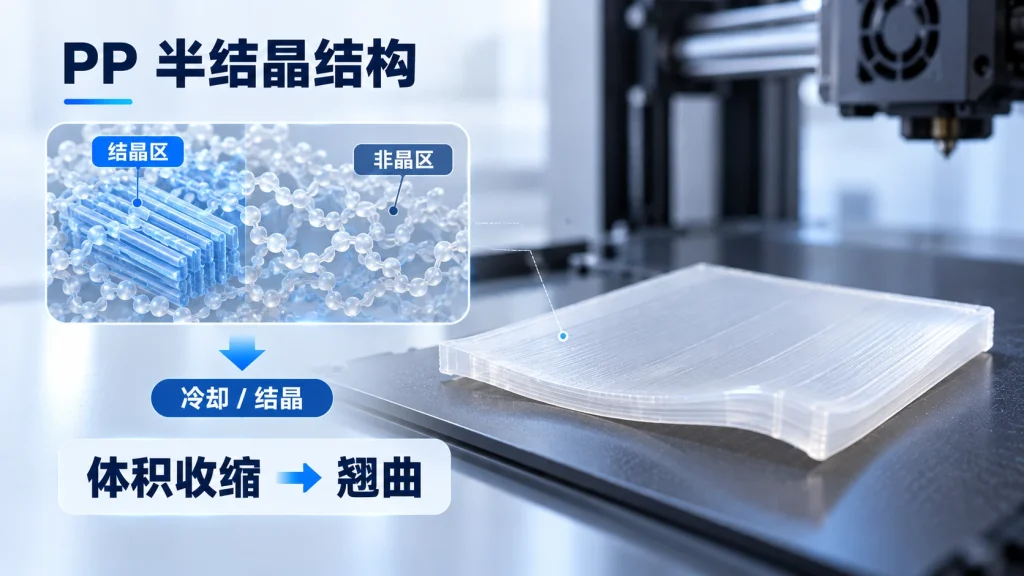
By “semi-crystalline,” we do not mean that only part of PP is solid, but that its polymer molecular chains simultaneously exhibit relatively ordered arrangements in thecrystalline regionsand relatively disordered arrangements in theamorphous regions.
This characteristic has an important influence on both PP’s material behavior and its 3D-printing process. PP’s crystallization behavior is related to its shrinkage, warping, appearance and some of its material properties, and is also one of the keys to understanding why PP is harder to print than some amorphous materials. 01 Material Basics
What is a semi-crystalline material?
Thermoplastics can be roughly divided, according to the arrangement state of their polymer molecular chains, intoamorphous materialsandsemi-crystalline material.
amorphous materials
In amorphous materials, the polymer molecular chains are arranged in a relatively disordered manner overall, with no obvious crystalline regions.
Such materials usually do not have a clear melting transition like semi-crystalline materials, but gradually soften during heating.
Common engineering plastics such as ABS and PC belong to the amorphous category.
semi-crystalline material
Semi-crystalline materials, by contrast, contain both crystalline and amorphous regions.
Among them, part of the molecular chains are arranged more regularly, forming crystalline regions; the other part remains relatively disordered.
PP, PE, nylon and PET are all semi-crystalline materials.
The semi-crystalline structure affects a material’s melting, cooling, shrinkage and final properties. This is especially important for PP, because crystallization occurs as the material cools from the molten state, and the crystallization process further affects dimensional changes and the stability of the printed part. 01 Material Basics
What effects does PP’s crystallization bring?
The crystalline regions in PP have a more regular and tighter molecular arrangement, and therefore affect several of PP’s material characteristics.
1. Affects chemical resistance
PP itself has good chemical resistance, which is one of the important reasons it is widely used in packaging, automotive parts, containers and other products.
However, you cannot simply attribute all of PP’s chemical resistance to the crystalline regions. Actual performance is also related to factors such as material structure, formulation, contacting medium, temperature and time.
2. Has a clear melting temperature range
Unlike typical amorphous materials, semi-crystalline materials have a relatively clear melting transition.
PP’s specific melting point is affected by material type and grade; the melting point of common PP usually falls within a range, rather than all PP corresponding to exactly the same temperature. 01 Material Basics
This is also why, when 3D printing PP, you need to distinguish betweenthe material melting point and the actual printing temperature.
The printing temperature usually needs to be higher than the material’s melting temperature to ensure the material flows normally and forms good interlayer bonding, but too high a temperature can also cause degradation, stringing, bubbles or other printing problems. 01 Material Basics
3. Affects PP’s appearance
PP usually appears opaque, translucent or milky white.
The difference in optical properties between crystalline and amorphous regions affects light propagation, so PP products commonly show a natural matte or translucent texture.
For 3D-printed parts, this is also a visual distinction between PP and materials such as PLA and ABS.
4. Affects shrinkage
This is also one of the most important effects of crystallization behavior on FDM 3D printing.
When PP cools from the molten state, crystallization occurs, accompanied by volume change. If the cooling and crystallization degrees differ across regions of the printed part, different levels of shrinkage and internal stress may arise.
The final manifestation may be:
- edge lifting / warping at the edges
- bottom deformation
- dimensional changes of the printed part
- large flat areas are more prone to warping
which is also one of the reasons traditional PP is relatively difficult to control in FDM printing. 01 Material Basics
What does crystallinity mean for 3D printing?
For FDM 3D printing, PP’s semi-crystalline nature mainly manifests in the following aspects.
shrinkage and warping
PP undergoes shrinkage during cooling and crystallization, so compared with some amorphous materials, dimensional change and warping control are usually more important.
Especially forlarge flat areas, long-edge structures and parts with high dimensional requirements, the shrinkage stress during printing may be more pronounced.
Printed part appearance
PP printed parts usually have a natural matte or translucent texture.
Therefore, when evaluating PP’s surface quality, you should not simply use the glossy appearance of PLA or other materials as the standard.
The material’s own crystalline structure and the printing parameters both affect the final surface appearance. 01 Material Basics
material properties
The crystalline structure is also an important factor for PP to obtain some of its material properties.
PP’s chemical resistance, stiffness and dimensional stability are all related to its molecular structure and crystallization state, while specific properties are also affected by material grade, formulation and processing conditions.
Therefore, for 3D printing, crystallization is not a phenomenon that simply needs to be “avoided.”
What really needs to be controlled is the shrinkage and internal stress brought by the crystallization process.
Print orientation and performance differences
FDM printing itself has a clear directional nature.
Each layer of material is extruded within the XY plane, while the Z direction relies on bonding between layers. Therefore, the material’s cooling, crystallization and interlayer fusion all affect the final performance in different directions.
This is also why the final strength of a PP printed part cannot be judged solely from the material’s own crystallinity, but must be evaluated together with printing temperature, cooling, layer height, print orientation and other process parameters.
How should you treat PP’s crystallization process during 3D printing?
Crystallization itself is not a bad thing.
For PP, the key is to let the material complete cooling and crystallization under relatively stable, controlled printing conditions.
Heated bed and ambient temperature
The heated bed can reduce the temperature difference between the printed part and the build platform, and help keep the first layer stable.
For traditional PP, a stable printing environment also helps reduce temperature differences during cooling, thereby lowering the risk of warping.
The specific heated-bed and ambient temperatures still need to be adjusted according to the material formulation, printer and model size. You cannot simply assume a higher heated bed is always better.
Cooling fan
Cooling needs to be controlled carefully when printing PP.
If the cooling rate differs too much across regions, it can further increase shrinkage differences and internal stress.
Therefore, PP usually does not suit strong forced cooling in the early stages of printing; the specific fan settings should still be tested based on the material and model.
Shrinkage compensation
If you are printing functional parts with high dimensional requirements, it is not recommended to directly assume PP “does not shrink at all.”
A more reasonable method is to measure the actual dimensional change with test parts, and then apply corresponding dimensional compensation based on the material and printing parameters.
Post crystallization
PP’s crystallization process does not necessarily end completely at the instant printing finishes.
As the printed part cools and rests, its internal structure may still undergo some changes, so for precision-fit parts you should consider the dimensional stability after printing, rather than measuring only the dimensions right after printing.
Is higher PP crystallinity always better?
No.
Crystallinity is not a simple “higher is better” indicator.
Higher or lower crystallinity may correspond to different material behaviors, and for FDM 3D printing you also need to consider at the same time:
- shrinkage rate
- Warping
- Dimensional Stability
- Interlayer bonding
- Appearance
- stiffness and toughness
- Printing temperature
- Cooling rate
Therefore, what really matters isthe match between material formulation and printing process.
For 3D-printing materials, the ideal state is not to pursue a single crystallinity number, but to let the material achieve more stable, predictable behavior during actual printing.
Summary
PP is a typicalsemi-crystalline thermoplastic, containing both crystalline and amorphous regions.
Its semi-crystalline structure is related to several of PP’s material characteristics, and also makes PP exhibit processing features in FDM 3D printing that differ from amorphous materials such as PLA and ABS.
For printing, what matters most is:
- PP cooling and crystallization produce shrinkage
- uneven shrinkage may lead to warping
- crystallization behavior affects the dimensions and appearance of the printed part
- printing temperature, heated bed, ambient temperature and cooling conditions all affect the final result
- PP from different material formulations does not perform exactly the same
Therefore, understanding PP’s semi-crystalline characteristics is an important foundation for understanding why PP is hard to print, and how to optimize PP 3D-printing parameters.
For users who want to reduce the difficulty of traditional PP printing, they can choose modified PP filaments optimized in formulation and process for the FDM printing process, for example POLIVE PPpro™.
半结晶结构对 PP 来说意味着什么?
是。PP 属于半结晶热塑性塑料,内部同时存在结晶区和无定形区,这跟以无定形为主的 PLA 不一样。
结晶度对 3D 打印具体有什么影响?
影响耐化学性、明确的熔融温度区间、外观(半哑光),以及最关键的收缩。结晶带来体积变化,逐层冷却时容易形成内应力,这正是 PP 翘边的根源。
结晶度越高越好吗?
不是。结晶度提高通常有利于耐化学和刚性,但收缩和脆化风险也会上升,对 FDM 反而不友好。打印用 PP 要在性能和成型稳定之间取平衡。
既然收缩是材料本性,怎么防翘边?
不靠把热量困在封箱里。PP 冷却要散掉大量热,我们让它在空调房里开放散热更快定型;首层用裙边加 PPLOCK26811,模型端直角改圆角、底部加老鼠耳朵、增大接触面、壁厚均匀。
Related Reading
- What Is PP’s Melting Point? How Should PP Printing Temperature Be Understood
- 为什么 PP 以前这么难打?收缩、翘边、粘不住的三大难题
- Are PP Prints Dimensionally Accurate? Shrinkage Compensation and Tolerance Control
- Can PP 3D Printed Parts Hold Boiling Water? POLIVE PPpro™ 100°C Boiling Water Test