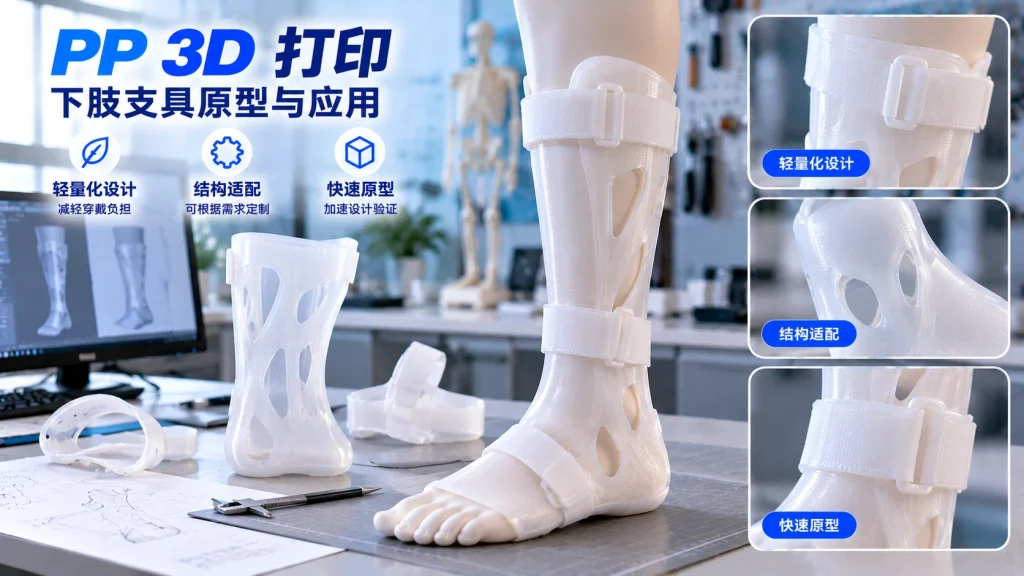
Can 3D Printing Make Medical and Rehabilitation Aid Prototypes? Exploring PP Applications
3D printing provides a flexible prototyping method for the design and development of medical and rehabilitation aids. For orthosis shape verification, prosthetic socket trial fitting, and auxiliary tooling for rehabilitation training equipment, designers can use digital modeling plus rapid printing to repeatedly adjust dimensions, shape and structure.
Polypropylene (PP) has low density, fairly good toughness and low water absorption, making it worth trying for some lightweight rehabilitation-aid prototypes and functional structural parts. Its actual performance is also affected by material formulation, print orientation, structural design and service conditions. A prototype used for design verification differs markedly from a final product that can be applied directly to the human body in terms of performance requirements and applicable conditions.
1. The Role of 3D Printing in the Rehabilitation-Aid Development Process
Rehabilitation-aid development typically includes steps such as shape taking or scanning, 3D design, trial fitting, adaptation adjustment and final production. 3D printing is especially suited to the prototype-verification stage that requires repeated modification.
Designers can adjust the orthosis contour, hole positions, strap routing and local structure according to the digital model, then quickly produce a new version for comparison. In the past, every change required rebuilding a traditional mold or machining a whole part; now some prototype-iteration cycles can be shortened, and different design schemes are easy to save and compare.
In rehabilitation-aid development, 3D printing can be used in these directions:
- Orthosis prototypes: verify shape, hole layout and strap structure.
- Prosthetic socket trial-fitting parts: try different shape and size schemes.
- Rehabilitation training auxiliary tooling: make positioning parts, holding fixtures and equipment auxiliary components.
- Structural verification parts: compare different wall thicknesses, snap structures and local flexible designs.
These applications mainly leverage the advantages of rapid fabrication and structural iteration. A prototype whose shape or dimensions meet expectations does not mean it already has the strength, comfort or long-term service performance that the final product requires.
2. PP’s Material Properties and Rehabilitation-Aid Requirements
1. Low Density, Favorable for Lightweight Design
PP’s typical density is about 0.90 g/cm³, placing it among the lower-density common plastics. For parts that must be carried or worn, weight is a factor worth considering in design.
For orthosis shells, auxiliary fixators and other non-critical structural parts, lightweighting can be one of the design goals. How heavy the final product is also depends on geometry, wall thickness, infill ratio and printing method, so it cannot be judged by material density alone.
2. Toughness and Repeated-Bending Potential
PP has a degree of toughness; combined with appropriate structural design, it can be used to try parts that require elastic deformation.
For example, strap buckles, elastic clamps and thin-wall connection structures can all change their bending mode and deformation extent by adjusting geometry. Designers can compare the structural differences brought by different wall thicknesses, snap lengths, fillets and slot positions.
Whether a snap is durable depends on material, structure and actual load. Print orientation, interlayer bonding and local stress concentration also affect cyclic-bending performance, so long-term reliability cannot be judged merely from the material name or a few bending tests.
3. Low Water Absorption, Suitable for Parts Exposed to Humid Environments
PP’s low water absorption is a reference worth considering for aid components that may contact sweat or require periodic cleaning.
A material’s own low water absorption does not mean the printed part has antibacterial properties, nor does it guarantee the surface is easy to clean thoroughly. Actual use experience also depends on surface layer lines, structural gaps, cleaning method and maintenance frequency.
4. Design Potential of Thin-Wall and Local Flexible Structures
Through thin walls, slots and local structural changes, PP can achieve different degrees of bending and deformation, making it suitable for trying elastic strap parts, clamps and some flexible orthosis prototypes.
The performance of such structures depends not only on the material but also closely on geometry and print orientation. Printing the same design in a different orientation may change the bending feel and load performance. Design must simultaneously consider flexibility, structural strength and expected service life.
3. Application Directions of PP 3D Printing in Rehabilitation Aids
1. Orthosis Shape and Fit-Structure Prototypes
Orthosis design must balance shape, local fit, fixation method and usage space. With 3D printing, different-version prototypes can be made relatively quickly to compare hole positions, edge contours, strap layouts and local structures.
For customized products, the digital model also makes it easy to save different versions and record dimensional changes and design adjustments.
2. Prosthetic Socket Shape Verification
A prosthetic socket involves complex shape-fitting requirements; both the external contour and the internal contact surface affect the final design. 3D printing can quickly produce different-version shape models and dimensional verification parts, helping developers compare different geometric schemes.
These prototypes are mainly for design study and shape verification; they cannot replace fit assessment, load analysis and professional fitting in actual use. Designs involving load-bearing and human-body adaptation must be evaluated against specific product requirements.
3. Elastic Snaps and Strap Connectors
Snaps and strap connectors must balance installation convenience, deformation capacity and repeated-use performance. PP has a degree of toughness; with reasonable structural design, different types of elastic connectors can be tried.
Designers can adjust wall thickness, snap length, fillet and slot position to compare the deformation behavior of different structures. Whether a snap is durable depends on material, structure and actual load. For parts used to support or fix the human body, actual force and reliability requirements must be fully considered.
4. Auxiliary Tooling for Rehabilitation Training Equipment
Beyond wearable parts, 3D printing can also be used for auxiliary tooling around rehabilitation equipment, such as positioning parts, mounting brackets, non-critical holding fixtures and equipment accessories.
Such parts usually must fit the dimensions and installation space of specific equipment. By modifying the digital model, designers can quickly adjust hole positions, connection structures and shape, reducing the development time for custom auxiliary parts.
PP’s low density helps with trying lightweight structures, but actual material selection must also combine the load the part bears, the required stiffness and the service environment.
4. How to Design More Reasonable PP Rehabilitation-Aid Prototypes?
1. Pay Attention to Contact Surfaces and Edge Structures
For prototypes that must fit the human contour, edge shape, contact area and local protrusions all affect the contact experience.
During design, appropriate fillets and smooth transitions can be used to reduce sharp edges and obvious protrusions. For strap-fixed structures, strap channels, installation space and adjustment margins must also be considered.
2. Incorporate Print Orientation into Structural Design
FDM prints are directional; interlayer bonding and load performance may differ in different orientations.
For parts that bend repeatedly, the bending direction, layer-line direction and local stress-concentration locations must be considered together. The print orientation of snaps, thin-wall parts and connection structures may significantly affect deformation behavior and durability.
3. Adjust Flexibility Through Structural Variation
Thin walls, slots, local thickening and fillet design can all change a part’s flexibility behavior.
Thinner structures are usually easier to bend but may also reduce load capacity and durability; local sharp corners may increase stress concentration. A reasonable design must find a balance among deformation capacity, structural strength and expected life.
4. Keep Prototype Version Records
During design iteration, recording each version’s dimensions, structural changes and print orientation helps compare the performance of different schemes.
For example, after adjusting the strap-channel position or changing the local wall thickness or snap length, the deformation and fit of the old and new versions can be compared. Clear version records also make it easy for the design team to review structural changes and provide reference for subsequent product development.
5. Usage Requirements for Medical and Rehabilitation Aids
The requirements for medical and rehabilitation aids depend on the intended use, contact mode, service duration and functions undertaken by the specific product. 3D-printed prototypes for design verification can help developers try shapes and structures, but they cannot directly replace the performance evaluation required for the final product.
Human-Body Contact and Biocompatibility: biocompatibility requirements applicable must be evaluated based on the contact site, contact duration and material composition.
Mechanical Performance and Structural Reliability: parts undertaking support, fixation or other mechanical functions need evaluation against actual load, fatigue behavior and fixation method.
Cleaning and Maintenance: sweat, cleaning agents, usage frequency and surface structure may all affect the product’s maintenance requirements.
Regulations and Product Positioning: depending on the product’s intended use and sales market, medical-device or other related regulatory requirements may apply; specific requirements are subject to the applicable regulations.
Material properties, appearance adaptation and prototype testing alone cannot prove a product is suitable for direct human use. Actual medical or rehabilitation aids must undergo corresponding professional evaluation according to their function and risk.
Summary
3D printing provides a flexible prototyping method for medical and rehabilitation-aid development, especially suited to shape verification, structural adjustment, dimensional-fit studies and auxiliary-tooling development.
PP’s low density, fairly low water absorption and certain toughness make it worth trying for some lightweight prototypes, elastic snaps and non-critical functional structural parts. Its actual performance is affected by factors such as material formulation, structural design, print orientation and service conditions.
In rehabilitation-aid development, the value of 3D printing lies not only in rapid manufacturing but also in helping design teams compare different structural schemes, iterate product design, and provide a physical basis for subsequent evaluation.
Related Reading
- Does PP Printing Smell? Odor and Ventilation Recommendations During Printing
- Can PP Make Living Hinges? Printing One-Piece Living Hinges with POLIVE PPpro™
- Are PP 3D-printed parts drop-resistant? A comparison of impact resistance: PP vs. PETG and ABS
- Why is the PP density only about 0.90 g/cm³? A 3D printing material that is lighter than water!
- How to Design PP Parts for 3D Printing? Wall Thickness, Fillets, Snap Fits and Warp Prevention
3D 打印能做医疗和康复辅具原型吗?
能做设计与开发阶段的快速原型,比如矫形器外形验证、装配与佩戴手感确认、个性化尺寸迭代,这是 3D 打印最合适的环节。
PP 的哪些性能对得上辅具需求?
轻、韧性好、抗疲劳、耐化学易清洁、低吸水,佩戴负担小,也便于反复试戴和调整。
设计辅具原型时要注意什么?
贴合面圆角过渡、避免局部压点、壁厚均匀、受力方向避开层间结合面;打印不加热床、不封箱,开放散热配合裙边和 PPLOCK26811。
可以直接当正式辅具使用吗?
不能只凭原型判断。正式使用涉及载荷、长期接触、清洁消毒和相应的合规要求,需要按实际用途单独验证和确认。