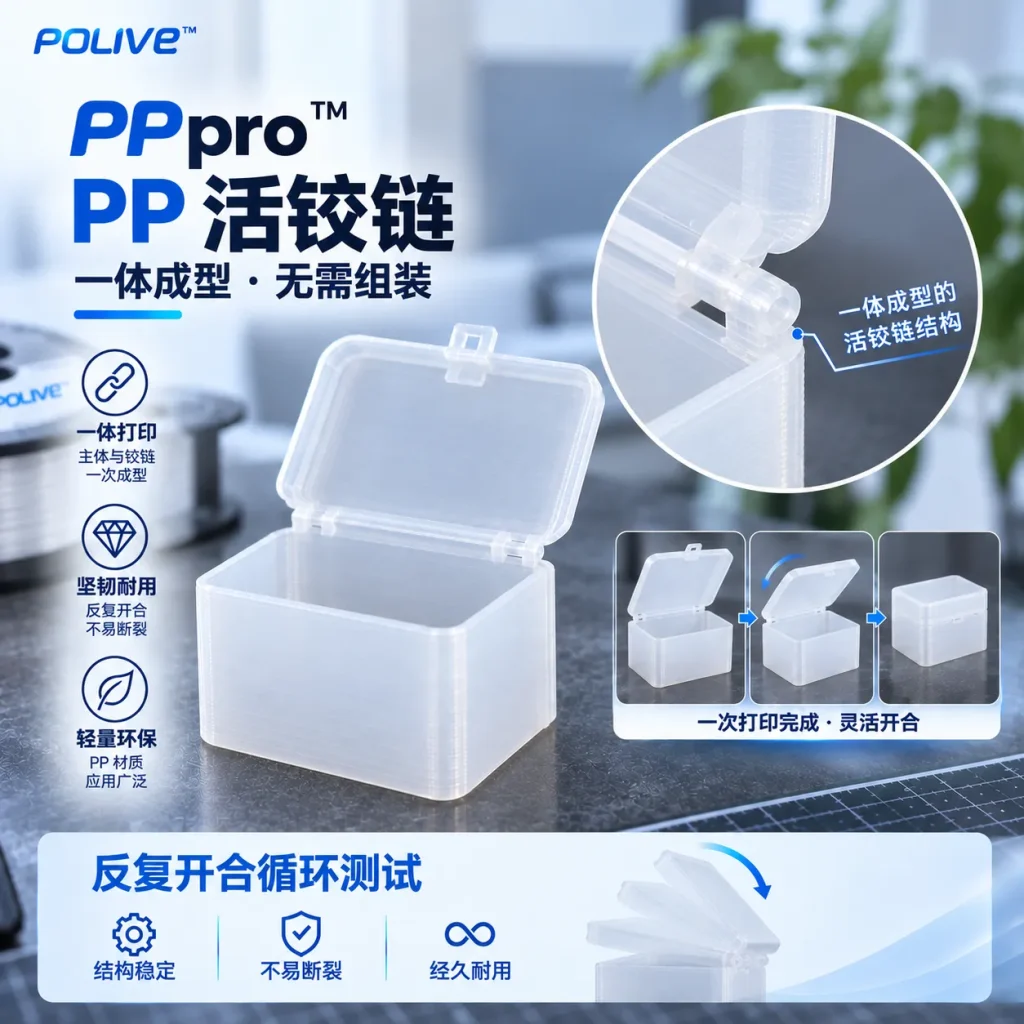
Can PP Make Living Hinges?
Yes. PPpro prints one-piece living hinges that survive repeated bending, because PP resists fatigue and thin flex zones print cleanly.
Yes.
If you have opened a shampoo bottle, cosmetic packaging, or some plastic storage boxes, you may have noticed a very thin plastic connecting region between the lid and the body.
It can bend back and forth repeatedly, rather than being connected by a traditional metal hinge.
This structure is called:
a living hinge
PP is a very common material in living-hinge design.
The reason is that PP has goodfatigue resistance and repeated-bending capability. Through suitable materials, structure, and processing, the thin-wall region can withstand a large number of bending cycles.
And this also makes PP a very interesting FDM 3D printing material.
What is a living hinge?
A living hinge is not a mechanical hinge in the traditional sense.
It has no separate metal pin, nor does it require an additionally installed hinge.
Instead, the designer places between two rigid structures athinner flexible region.
When the lid opens or closes, it is mainly this thin-wall region that bends.
Simply put:
rigid structure → flexible connection zone → rigid structure
The entire structure can be formed in a single 3D print.
This means:
No extra hinge part is needed, nor any post-assembly.
Why is PP suitable for living hinges?
One of the most important properties of a living hinge is:
the fatigue life after repeated bending.
If the material is relatively brittle, cracks may appear after the first few bends.
PP, on the other hand, has good fatigue resistance and repeated-bending performance, so it is widely used in living-hinge structures in traditional plastic products.
Common products include:
- bottle caps
- flip-top containers
- Storage boxes
- packaging boxes
- small snap-fit structures
- reusable open-close plastic components
However, a living hinge’s life is not determined by the material name alone.
It also depends on:
- Material formulation
- hinge thickness
- hinge width
- bend radius
- Print orientation
- Interlayer bonding
- Printing temperature
- bend angle
- bend speed
- actual load
Therefore,“PP can make living hinges” is a conclusion at the material-property level, while “how many open-close cycles it can achieve” must be determined through specific testing.
What are the challenges of FDM-printed living hinges?
Traditional injection-molded PP is very suitable for making living hinges.
But FDM 3D printing introduces an extra problem:
the printed part is formed layer by layer.
Therefore, the material’s molecular orientation, interlayer bonding, and print direction all affect the bending behavior of the hinge region.
If the print direction or structural design is unsuitable, the following may appear:
- cracking in the hinge region
- interlayer separation
- noticeable whitening after bending
- reduced fatigue life
Therefore, 3D-printed living hinges cannot simply replicate injection-molded designs.
material + print direction + hinge structure + print parametersmust be considered together.
POLIVE PPppro™ can be used for living hinges?
One application direction for PPpro™ is to use PP’s flexibility and fatigue resistance to make functional structures.
For example:
- One-piece flip box
- foldable containers
- snap-fit structures
- reusable protective covers
- flexible connection structures
One of the biggest advantages is:
the living hinge and the main body can be printed directly as a single integrated piece.
After printing, no separate hinge needs to be installed.
How should a living hinge be designed?
If you plan to use PPpro™ to print living hinges, several design factors are worth focusing on.
1. The hinge region needs to be sufficiently thin
A living hinge usually bends through a thinner flexible region.
But thinner is not always better.
Too thin may cause:
- printing difficulty
- insufficient local strength
- the hinge region is prone to damage
Too thick may cause:
- increased bending resistance
- stress concentration
- reduced open-close life
Therefore, it is recommended to start testing from a suitable thickness range and then adjust based on actual print results.
For example, you can use 0.4–0.8 mm as a testing starting point, rather than a fixed design standard.
2. Print layer height also affects hinge performance
For thin-wall structures, a smaller layer height usually provides finer geometric control.
For example:
0.16 mm
can serve as a test parameter for the living-hinge structure.
But the final optimal layer height still needs to be combined with:
- nozzle diameter
- Print speed
- hinge thickness
- Print orientation
- material temperature
for adjustment.
3. Print direction is very important
FDM printed parts are clearly anisotropic.
Therefore, how the hinge region is arranged relative to the print layers is an important factor to consider in design.
If the direction of repeated hinge bending coincides with the weaker interlayer-bonding direction, the risk of cracking may increase.
So when designing a living hinge, do not just look at the model’s appearance.
First determine the hinge’s bending direction, then determine the print direction.
Does a living hinge need to be “activated” after printing?
For some PP living-hinge structures, the first bend may change the local material’s molecular orientation and stress state.
Therefore, before formal use, a small amount of controlled pre-bending can be performed.
This process is sometimes called:
hinge activation
But it should be noted that:
Pre-bending does not necessarily extend the service life of all living hinges.
The specific effect depends on the material, structure, and printing conditions.
Therefore, if your application has life requirements, the most reliable method is still to perform actual cycle testing.
How many open-close cycles can a PP living hinge actually achieve?
This is a question very worth testing.
But it is not recommended to simply assign a fixed life to all PP-printed living hinges.
Because:
“10,000 open-close cycles” is not a fixed parameter of the material itself.
It should correspond to specific:
- Material
- print parameters
- hinge dimensions
- bend angle
- test speed
- Test environment
- failure criteria
If POLIVE PPpro™’s actual testing can reach 10,000 cycles or more, then the best way to express it is not: 10,000 cycles or more, then the best way to express it is not:
“PPpro™ living hinges can open and close tens of thousands of times.”
Instead, it is:
Under our test conditions,PPpro™ completed 10,000 open-close cycle tests.
This is more professional and more technically credible than an absolute product claim.
Why is the living hinge an interesting application for PP 3D printing?
Because it vividly demonstrates the differences between PP and other common FDM materials.
PLA’s advantage is:
rigidity, ease of printing, and good surface effect.
While one of PP’s advantages is:
flexibility and repeated-bending performance.
Therefore, some products that traditionally required extra mechanical structures can now be attempted via PP 3D printing:
one print → no assembly → direct open-close
This is also a very worthwhile application direction for PP in functional 3D printing.
Start testing PP with a living hinge
If you are just starting to use PP for FDM printing, you might as well begin with a simple living-hinge model.
Test:
hinge thickness
↓
Print orientation
↓
Floor height
↓
Printing temperature
↓
first bend
↓
cyclic open-close
Through actual testing, you can find the print parameters and structural design that best suit you.
PPppro™: explore more of PP’s possibilities in functional 3D printing
PP’s value lies not just in whether it “can be printed.”
What is truly interesting is that it can be used for some applications that need:
- Lightweighting
- flexibility
- fatigue resistance
- moisture resistance
- chemical resistance
functional parts.
The living hinge is a very typical example of this.
POLIVE PPpro™, through material modification, makes PP more suitable for FDM 3D printing and offers more possibilities for one-piece, flexible, and repeat-motion structures.
Summary
PP is a very common material in living-hinge design because it has good fatigue resistance and repeated-bending performance.
For FDM 3D printing, the real challenge is:
how to make the material properties, print direction, and hinge structure match each other.
If properly designed, PP 3D printing can achieve:
one-piece molding + no assembly + repeatable open-close
while the specific number of cycles achievable should be determined through actual testing.
If your test data can show that a PPpro™ living hinge has completed tens of thousands of cycles, that is real-world data well worth featuring on a product page and in application case studies.
PP 能做一体成型的活铰链吗?
能,而且这是 PP 最擅长的方向之一。PP 耐疲劳、反复弯折不易断,适合把盖子和盒体一次打印出来,省掉装配和金属铰链。
活铰链在设计和打印上要注意什么?
铰链区要足够薄才弯得动,层高会影响弯折寿命,打印方向更关键——让弯折受力尽量沿着连续的挤出路径,而不是去撕层间结合面。
打活铰链需要加热床或封箱吗?
不需要。PPpro™ 按开放式打印设计:不加热床、不封箱,空调房里开门开盖散热更快。首层用裙边加 PPLOCK26811,等干透直接打;圆角和均匀壁厚也能减少铰链根部的应力集中。
Related Reading
- Can PP 3D printed parts withstand boiling water? POLIVE PPPro™ 100°C boiling water test
- Why was PP so difficult to handle in the past? The three main problems are shrinking, curling edges, and not sticking.
- Are PP Prints Dimensionally Accurate? Shrinkage Compensation and Tolerance Control
- PP or PLA: Which Should You Choose? A Guide to Selecting 3D Printing Materials