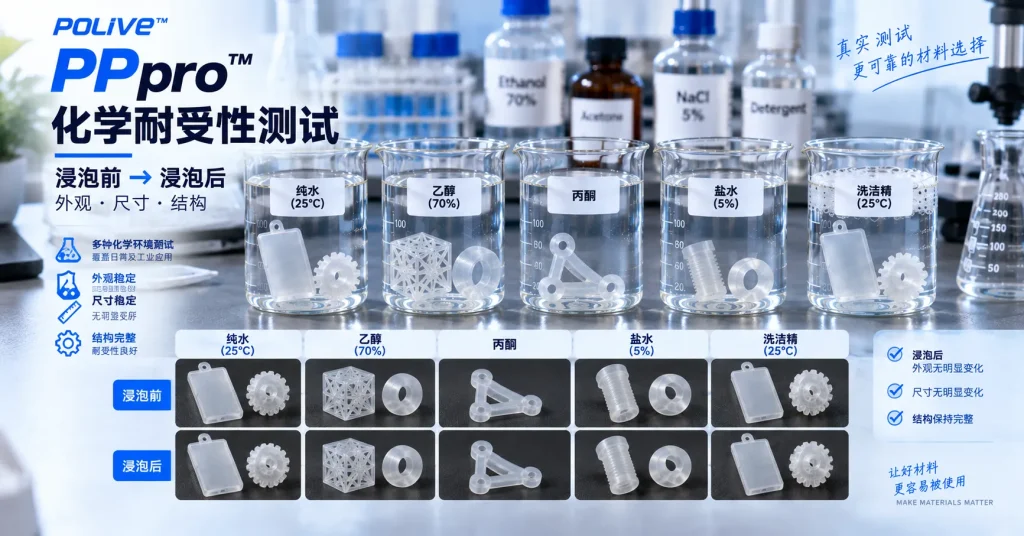
How chemical-resistant is PP?
If a 3D printed part needs to contact cleaning agents, acid/alkali solutions, or other chemical media, the material’s chemical resistance becomes a very important consideration.
PP (polypropylene) has a clear advantage in this regard.
It has good resistance to many common acids, alkalis, and chemical media, and has therefore long been widely used in:
- chemical containers
- pipes and fittings
- laboratory supplies
- industrial equipment
- packaging materials
This is also one of the important reasons why PP has become a functional 3D printing material.
But it should be noted that:
“PP has good chemical resistance” does not mean PP is completely unaffected by all chemicals.
Actual performance depends on the type of chemical, concentration, temperature, contact time, and the specific material formulation.
Which Chemicals Can PP Withstand?
PP usually has good resistance to many common acids and alkalis.
For example, under suitable concentrations and usage conditions, you may consider testing:
- hydrochloric acid
- sulfuric acid
- sodium hydroxide
- hydrogen peroxide
- alcohol
- cleaning agents
- some aqueous chemical solutions
But here is a very important distinction:
“Being able to resist” is not a fixed conclusion.
For example, the same chemical under low vs. high concentration, room vs. high temperature, and short-term vs. long-term immersion may have completely different effects on the material.
Therefore, if a part needs long-term contact with a certain chemical, the most reliable method is:
to test it under the actual usage conditions.
Why Does PP Have Good Chemical Resistance?
PP’s chemical structure and molecular properties give it good stability in many common chemical environments.
Its non-polar nature also gives it good tolerance to many aqueous chemical media.
This is also why PP is often used in traditional industrial products for:
liquid storage containers → pipes → chemical packaging → laboratory equipment
For 3D printing, these traditional applications also mean PP has the opportunity to be used for making corresponding functional prototypes and parts.
Different 3D Printing Materials Have Different Chemical Resistance
Different materials show very different performance when exposed to chemicals.
PLA
PLA is very common in ordinary model and prototype printing, but for certain chemical environments and long-term exposure conditions, its suitability may be inferior to PP.
ABS
ABS can be surface-treated with acetone, because acetone can affect the surface of ABS.
Therefore, ABS’s resistance to certain organic solvents needs to be judged on a case-by-case basis.
PETG
PETG has some resistance to many common chemicals, but it also cannot be assumed to be stable against all solvents and chemical environments.
PA / Nylon
Nylon has good mechanical properties, but its moisture-absorption characteristic is noticeable. After absorbing water, the material’s dimensions and mechanical properties may change.
PP
PP has good resistance to many common acids, alkalis, and aqueous chemical media, so it has advantages in some chemical environments.
Chemical Resistance Cannot Be Judged by “Material Name” Alone
This is a point very easily overlooked when choosing 3D printing materials.
For example:
PP + dilute acid + room temperature + 24 hours
and:
PP + high-concentration acid + high temperature + long-term immersion
are not the same test.
Factors affecting material performance include:
- chemical type
- chemical concentration
- Temperature
- Contact time
- Material formulation
- Part structure
- internal stress
- printing process
So, if your application involves chemicals, it is recommended to establish a test plan close to the actual usage conditions.
PPPro™’s Chemical Resistance
An important goal of modified PP is to preserve PP’s own valuable material characteristics as much as possible while improving FDM print performance.
For PPpro™, the focus of material modification is:
to make PP more suitable for FDM printing, rather than simply sacrificing PP’s core material performance.
Therefore, in applications involving chemical resistance, PPpro™ printed parts can be tested according to actual needs.
For example:
- Functional containers in chemical environments
- Pipe and fitting prototypes
- Laboratory fixtures
- Cleaning equipment components
- Auxiliary parts in acid/alkali environments
- Industrial functional prototypes
But specific applications should still be verified through actual testing.
A Simple PP Chemical Resistance Test
If you want to preliminarily understand how PPpro™ performs against a certain chemical medium, you can design a simple immersion test.
For example:
Test steps
1. Print test specimens
Make multiple specimens of consistent size using the same printing parameters.
2. Record the initial state
Record:
- Appearance
- Dimensions
- Weight
- specimen status
3. Place in the test liquid
Select the target chemical and concentration based on the actual application.
4. Set the test time
For example:
24 hours / 72 hours / 7 days
5. Compare after testing
Observe:
- appearance changes
- Size changes
- mass changes
- whether cracking appears
- whether softening appears
- whether obvious discoloration appears
- test mechanical properties if necessary
This kind of test is more meaningful than simply saying:
“PP is afraid of no chemical.”
.
Why Are Actual Tests More Important Than Material Lists?
Chemical resistance data usually comes from specific materials and specific test conditions.
And 3D printed parts add new variables.
For example:
Print orientation
Interlayer bonding
Wall thickness
Fill rate
internal residual stress
can all affect the final part’s performance.
Therefore, if your product needs long-term contact with a specific chemical, it is recommended to test againstfinal material + final printing process + final part structurefor testing.
Which Chemical-Environment 3D Printing Applications Is PP Suitable For?
PP can be considered for:
chemical experiment auxiliary parts
For example, fixtures, supports, and auxiliary structures in laboratories.
Pipe and fitting prototypes
Suitable for prototype development that needs to test fluid connection structures.
Cleaning equipment components
For parts that need to contact some cleaning agents, PP can be considered and tested against the actual cleaning agent.
Industrial functional prototypes
If a part needs to consider lightweighting, moisture resistance, and chemical resistance simultaneously, PP is a material worth testing.
PP’s Advantage Is Not “Afraid of Nothing”
PP’s true advantage lies in:
It has good resistance to many common chemical media.
But professional material selection should not be built on absolute statements like “afraid of nothing.”
What truly needs to be answered is:
Under what chemical, what concentration, what temperature, and what duration can this specific printed part maintain what performance?
This is where chemical resistance testing truly adds value.
PPpro™: Bringing PP’s Material Advantages into FDM 3D Printing
Traditional PP faces challenges such as warping, first-layer adhesion, and print stability in FDM printing.
The goal of modified PP is to improve these printing-process problems while preserving PP’s original material advantages as much as possible.
POLIVE PPpro™ focuses on modified PP 3D printing materials, providing a material option worth testing for functional applications requiring lightweighting, flexibility, moisture resistance, and chemical resistance.
Summary
PP has good resistance to many common acids, alkalis, and aqueous chemical media, which is also one of the important reasons it has long been used in chemical containers, pipes, and industrial products.
For 3D printing, this means PP can be used for some functional parts with chemical-environment requirements.
But it must be remembered:
Chemical resistance is not a simple “yes or no.”
The final performance depends on:
chemical + concentration + temperature + time + material formulation + print structure
If your part needs to contact a specific chemical, the most reliable method remains testing under the actual usage conditions.
PP 的耐化学性到底怎么样?
PP 分子链只含碳氢、化学惰性强,对多数酸碱、清洁剂和常见化学介质都有很好的耐受性,这也是它被大量用在化工容器、实验室器具上的原因。
PP 打印件能长期装化学液体吗?
材料耐受不等于容器可靠。FDM 件有层间缝隙,长期盛装要先做实液试漏;壁厚均匀、避免尖角、圆角过渡能减少应力开裂风险。强氧化剂和特定溶剂仍需单独确认。
耐化学性好,是不是也意味着难粘、难涂装?
是同一件事的两面。PP 表面能低,胶水和涂料都不容易附着,后处理要用针对 PP 的方式;反过来看,这也让它在化学环境里不容易被侵蚀。
Related Reading
- PP 能做活铰链吗?PP 3D 打印活铰链设计指南
- 为什么 PP 以前这么难打?PP 三大打印难题
- PP or PLA: Which Should You Actually Choose?
- PP 3D 打印参数怎么设置?