PP vs PLA vs PETG for Floating Parts: Why PP Comes First
PP vs PLA vs PETG, 3D printed floating parts, lightweight materials, density comparison, PPpro
Still the same 3D printing, so why is PP the first choice for floating parts? This article compares PP, PLA and PETG on buoyancy across density, water absorption and water resistance, and tells you which material can truly go in the water.
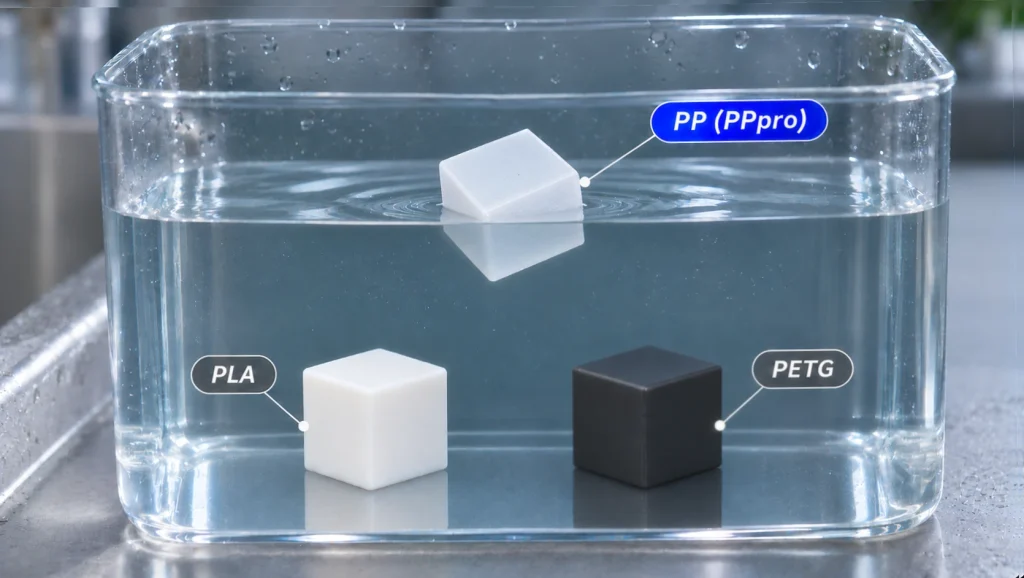
Making water gear, buoys or lightweight drone parts, many people’s first move is to print with the PLA or PETG they already have. Then the part hits the water and sinks straight to the bottom.
The problem is material density. Here is a quick table comparing how these three common materials behave in water.
| Material | Density (g/cm³) | Water absorption | Behavior in water | Hydrolysis resistance |
|---|---|---|---|---|
| PLA | About 1.24 | Medium | Sinks | Poor; degrades and turns brittle after long soaking |
| PETG | About 1.27 | Low | Sinks | Excellent, but the material itself is too heavy |
| PP (PPpro) | About 0.90 | Extremely low | Floats naturally | Excellent; resists acids, alkalis and water |
1. Why PLA and PETG Cannot Float
Water’s density is 1.0 g/cm³. PLA is about 1.24 and PETG about 1.27, both heavier than water, so a solid print sinks naturally.
Even if you print an internal cavity at a very low infill (say 10%) to make it barely float, the moment water enters through a tiny gap in the wall, the buoyancy is gone. And PLA hydrolyzes and turns brittle after long soaking.
2. Where PPpro’s Buoyancy Confidence Comes From
PP’s density is only about 0.90 g/cm³, 10% lighter than water and about 27% lighter than PLA. That means even a 100% solid print still floats steadily on the surface.
Combined with PPpro’s own extremely low water absorption, it can soak for a long time without degrading or gaining weight. That is the core material confidence for floating parts.
For a desk ornament or an indoor storage box, PLA is cheap and good enough; if you need a bit of transparency and toughness, PETG is a mature choice. But in water-contact, floating and extreme weight-saving scenarios, density and water absorption are hard specs, and PLA and PETG cannot get around physics.
Many developers making water drone parts, fishing buoys or lightweight enclosures end up moving to PP precisely because of its material foundation: lighter than water by nature, with extremely low water absorption. If you happen to have PP on hand (modified filaments like PPpro, for example), just slice a solid cube and drop it in water for a test — no waterproof glue, no special post-processing, and its natural floating state tells you whether it suits your water project.
No material is absolutely good or bad, only suitable or not. Before designing a part that goes in the water, check the material density table first and save yourself plenty of trial-and-error time.
Related Reading
- Why PP Is One of the Lowest-Density Commodity Plastics
- Can 3D Printing Handle Parts That Touch Water? Tanks, Floats and Bathroom Fittings
- How to Design PP Parts for 3D Printing? Wall Thickness, Fillets, Snap Fits and Warp Prevention
- What Is PPpro? A Modified PP 3D Printing Filament That Needs No Heated Bed and Makes Living Hinges