Can 3D Printing Handle Parts That Touch Water? Tanks, Floats and Bathroom Fittings
Yes. Small water tanks, floats, flow guides and bathroom fittings are all water-related 3D printing applications worth trying first.
PP (polypropylene) has low water absorption, low density and resistance to many common chemical media. Using it to evaluate functional parts that touch water or stay in damp environments for long periods is reasonable.
But water-related parts are not only about the material. Print structure, seams, wall thickness and overall sealing design all have to be managed too. A material that does not readily absorb water does not mean the printed part will not leak.
With the right structural design, 3D printing’s advantages in custom dimensions, complex shapes and functional integration come into play, and PP has plenty to offer across different water-related scenarios.
1. Which Water-Related Parts Are Worth 3D Printing?
Small Water Tanks and Liquid Storage Boxes
Small water tanks and liquid storage boxes can be used in hydroponic equipment, experimental setups, pet products or other scenarios requiring custom containers.
3D printing allows the container shape, opening size, internal dividers and connection structures to be adapted to the equipment space, making it suitable for custom-sized containers and functional prototypes.
When designing, consider rounded inner walls, openings that are easy to clean, and structures that are easy to assemble and disassemble, which makes daily use and maintenance simpler.
For containers that hold water long-term, wall thickness, base structure and interface design all need close attention.
Floats and Buoys
PP has a typical density of about 0.90 g/cm³, lower than water, so solid PP material itself offers a buoyancy advantage.
How much weight an actual printed float can support also depends on overall volume, structure, wall thickness, and whether water gets inside.
With 3D printing, the buoy’s shape, internal cavities, mounting holes and ballast structures can be customised, making it suitable for some water level indicators, buoyancy experiments and light floating devices.
Float design is not just about material density; displacement volume, centre of gravity and floating stability also matter. To keep a float oriented in a specific direction, internal structure and ballast position can be adjusted to improve its floating attitude.
Bathroom Fittings
Bathroom accessories such as hooks, shelves, shower head brackets and some auxiliary fittings may sit in damp environments for long periods.
PP has low water absorption and resists many common cleaning agents, so it is worth including in the evaluation scope for this kind of material.
For load-bearing brackets, focus on the mounting method, screw boss structure and the stress from repeated assembly and disassembly. For parts that must fit walls, piping or other bathroom components, dimensional accuracy and connection method also matter.
Water Treatment Auxiliary Parts
Filter positioning parts, flow nozzles, sampling cups and some internal auxiliary structures in equipment can also be customised with 3D printing.
These parts usually have to be designed around the equipment interface, flow channel shape and installation space.
If a component will be in long-term contact with specific water treatment chemicals, its chemical compatibility with the actual medium must be checked — do not judge suitability from the material’s general properties alone.
2. What Advantages Does PP Offer in Water Applications?
Low Water Absorption
PP has relatively low water absorption, giving it a material advantage in many water-related applications.
However, a material’s water absorption and a printed part’s leak resistance are two different things. FDM prints may have interlayer gaps, internal porosity or local defects, and liquid can still seep through these channels.
So when designing a water container, material properties and print structure must be considered together.
Good Resistance to Many Common Cleaning Agents
PP resists many common chemical media, so it can be considered for some bathroom fittings and water treatment auxiliary parts.
Actual compatibility depends on the type, concentration and temperature of the cleaning agent or chemical, the contact time, and the material formulation. Parts in long-term contact with a specific medium must be selected according to the actual conditions of use.
Low Density and Float Design
PP has a typical density of about 0.90 g/cm³, making it suitable for lightweight water-related parts and float structures.
For a float, external volume and displacement volume are the key factors determining buoyancy. By adjusting external dimensions and internal cavities, parts with different buoyancy requirements can be designed.
At the same time, the influence of centre of gravity, ballast and internal water ingress on the float’s attitude must be considered.
Hot Water Applications Depend on Actual Conditions
PP’s thermal performance cannot be judged from melting point alone. For holding hot water or use in scenarios with large temperature swings, the actual temperature, duration, part wall thickness and load conditions must all be considered.
For parts that will contact hot water, dimensional stability and structural behaviour can be assessed against the specific application.
3. How Can Leak Resistance of Water-Related Prints Be Improved?
For printed parts that hold or convey liquids, both structural design and print quality affect overall performance.
Design Wall Thickness Reasonably
Container wall thickness must be determined by size, shape and actual use requirements. Appropriately increasing continuous wall layers helps form a more complete container wall structure, but simply making walls thicker does not guarantee a leak-free part.
For large or complex-shaped containers, also pay attention to wall thickness uniformity and local structural changes, so that poor design does not affect print quality.
Focus on Layer Bonding and Print Consistency
FDM printing builds parts by stacking material layer by layer. Interrupted extrusion, insufficient layer bonding or local defects can all create paths for liquid leakage.
So during printing, watch extrusion stability, layer bonding and overall wall continuity, then adjust parameters according to the container structure.
Optimise Corners and Openings
Sharp internal corners and complex transitions are difficult to print and hard to clean.
For water storage boxes and bathroom fittings, appropriate fillets make inner walls easier to clean, while the geometry of openings, interfaces and connection points can be optimised at the same time.
Design Interfaces and Sealing Locations Well
Threaded interfaces, pipe connections and removable covers are usually the critical locations in water-related part design.
Choose suitable O-rings, gaskets or connection methods for the actual application, and leave reasonable installation space for the sealing elements.
For containers that need to be disassembled for cleaning, the structural design must also balance sealing, ease of assembly and cleaning requirements.
4. How Should Different Types of Water-Related Parts Be Tested?
Different water-related parts serve different functions, so testing priorities should differ too.
Water Containers
Small water tanks and liquid storage boxes can be tested by filling them with water to see whether the walls, base and interfaces leak.
During testing, record the water volume, duration and environmental conditions, and check the base, seams and connection points.
For containers that hold water long-term, dimensional changes and structural condition after a period of use can also be observed.
Floats and Buoys
Floats should be assessed for floating attitude, load capacity and stability.
The float’s attitude changes in water can be observed for the actual application, checking whether ballast position, internal cavities and connection points match the design.
For floats that carry equipment, the effect of load changes on draft depth and stability must also be considered.
Bathroom Fittings
Bathroom hooks and brackets not only get wet, but may also be repeatedly assembled and disassembled, subjected to external forces and exposed to cleaning agents.
So the assessment should look at how securely they are mounted, the condition of connection points, and how easy they are to clean and maintain.
Drinking Water and Food Contact Scenarios
If a part will be used in drinking water systems or in direct contact with food, it must be assessed against the specific application, material information and applicable regulations. Ordinary PP material or 3D printed parts do not automatically qualify for drinking water or food contact use.
For components such as pressurised pipes and pump bodies, the actual pressure, connection structure and working conditions must also be considered, with appropriate engineering verification for the application.
5. POLIVE PPpro™ in Water-Related Parts
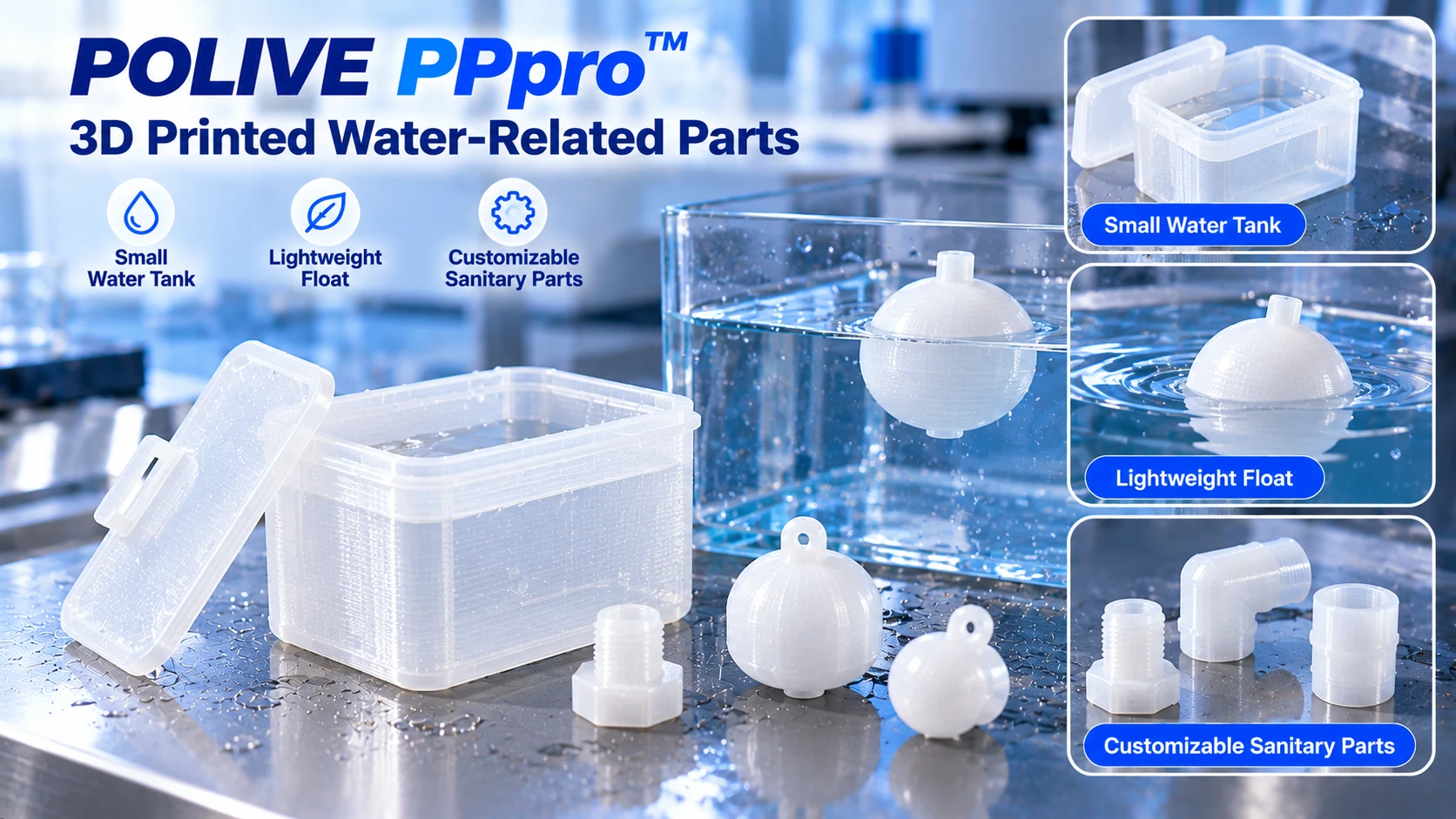
POLIVE PPpro™ can be used to trial small water storage boxes, floats, bathroom fittings and other custom water-related structures.
For water-related part design, container shape, wall thickness, internal cavities and connection points can be adapted to the specific application.
For example:
- Small water storage boxes: customised dimensions, openings and internal structures to fit the equipment space.
- Floats and Buoys: shapes designed around the required volume, buoyancy and mounting method.
- Bathroom Fittings: customised hooks, brackets and storage structures.
- Water Treatment Auxiliary Parts: flow guides, positioning parts and sampling auxiliary structures designed around the equipment interface.
By combining material characteristics with actual structural requirements, more water-related applications suitable for PP printing can be trialled, and 3D printing’s advantages in customised design can be put to use.
6. Summary
PP 3D printing is suitable for trialling many kinds of water-related parts, especially small water containers, floats, bathroom fittings and water treatment auxiliary structures.
- Typical Applications: small water tanks, buoys, bathroom hooks, flow guides and equipment auxiliary parts.
- Material Properties: low water absorption, low density, good resistance to many common cleaning agents.
- Structural Priorities: wall thickness, layer bonding, interfaces, sealing and internal cavity design.
- Float Design: combine volume, displacement, centre of gravity and ballast to account for actual buoyancy.
- Conditions of Use: select suitable structural and material solutions based on temperature, medium and load requirements.
To make customised water-related parts, POLIVE PPpro™ can be used to trial different container, float and functional fitting designs. With sound structural design, the customisation advantages of 3D printing can be fully realised.
Related Reading
- Are PP Prints Waterproof? How PP Performs in Wet and Water Environments
- Can 3D Printed Parts Touch Food? Key Considerations for PP in Food Contact Applications
- Can PP 3D Printed Parts Hold Boiling Water? POLIVE PPpro™ 100°C Boiling Water Test
- Can PP Prints Be Used Outdoors? Weather and UV Resistance of PP
- Why Is PP Density Only About 0.90 g/cm³? A 3D Printing Material Lighter Than Water
Can 3D Printing Produce Water-Contact Parts?
Yes — small tanks, floats, flow guides and bathroom fittings are all good candidates to try first. PP absorbs almost no water and stays dimensionally stable in humid and wet environments, making it a suitable material for these parts.
What Is PP's Biggest Advantage in Water Applications?
Low water absorption, water and chemical resistance, and a density below water (so solid parts can float), plus toughness that resists brittle cracking. That covers both floats and container prototypes.
How Do You Improve Leak Resistance in Water-Contact Parts?
Increase wall thickness, improve perimeter sealing, avoid sharp corners and abrupt wall-thickness changes, and keep loads away from interlayer bonding planes. After printing, run a water leak test at the actual fill level and duration.
How Do You Test Different Water-Contact Parts?
Test floats for buoyancy and dimensions after prolonged immersion, tanks for leakage and hydrostatic pressure, and bathroom fittings for repeated hot/cold cycles and cleaning-agent contact. Splash resistance and long-term watertightness are two different criteria — do not judge them as one.