Is PP 3D Printing Filament Expensive? How to Calculate Material Cost
Whether PP filament is expensive should not be judged only by the price per spool. What really matters is how much it costs to produce one qualified part, including actual material used, failed reprints, consumables, machine occupancy time and labor cost.
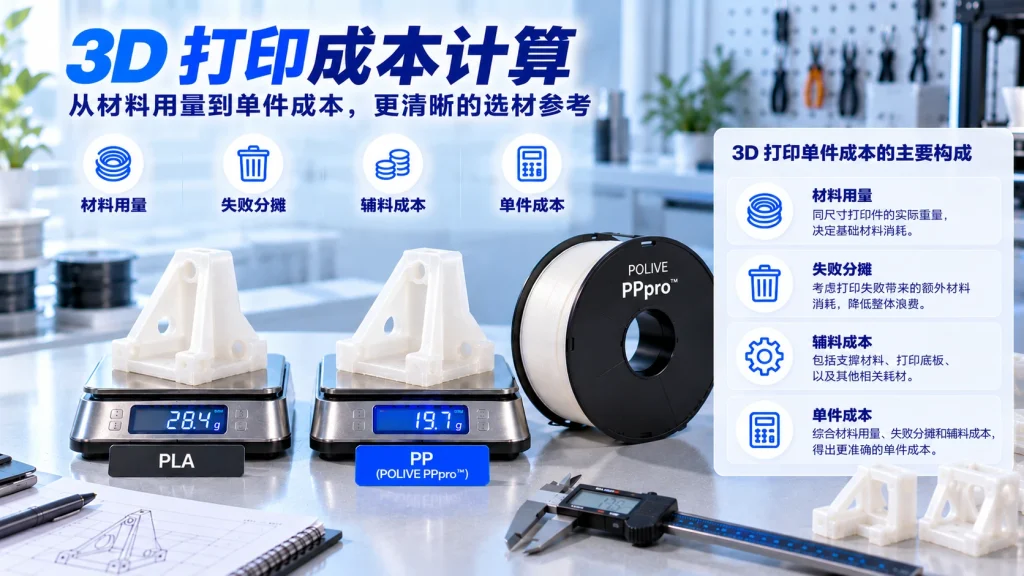
PP’s typical density is about 0.90 g/cm³. For parts of the same volume, PP usually requires less material mass, so when comparing different materials, besides the price per kilogram you must also look at the actual material usage and the final part weight.
Below, from the perspective of actual procurement and print costing, we present a method that can be entered directly into a cost spreadsheet.
Beyond the Unit Price, Three Easily Overlooked Cost Items
1. Actual Material Usage
The price per spool does not directly reflect the material cost of a single part. More useful is the consumable weight or length reported by the slicer software.
In costing, supports, skirts, brims and other printed material that does not remain in the finished part must all be counted. The same model with different slicing settings can yield different actual material usage, so when comparing materials use the same STL model and comparable print settings where possible.
2. Failures and Rework
Warping, part detachment, damage during removal, and scrap parts generated during parameter tuning all increase material consumption and machine occupancy time.
The failure rate can differ greatly between the new-material development stage and the mature production stage. A filament with a low unit price but frequent reprints can end up with a higher cost per qualified part.
It is recommended to calculate prototyping cost and stable production cost separately. The former should include investment in parameter adjustment and process validation, while the latter is calculated from the success rate in actual production.
3. Auxiliary Materials and Post-Processing
Build-platform consumables, adhesives, sanding materials, coatings and other post-processing supplies can also be costs that cannot be ignored.
These expenses can be tallied by batch and then allocated to qualified parts. If a material requires more surface treatment or extra assembly steps, the corresponding cost should also be included in the comparison, rather than looking only at the filament price itself.
Comparing by Volume Reveals the Effect of Material Density
Different materials have different densities; comparing the price per kilogram directly easily overlooks the actual material-usage difference for parts of the same volume.
PP’s typical density is about 0.90 g/cm³, with the exact value varying by grade and formulation. For parts of the same volume, lower-density materials usually have a weight advantage.
Material cost can be calculated with this formula:
Per-part material cost = actual material mass à filament unit-mass price
If the slicer software reports material volume, first convert to mass:
Material mass = material volume à material density
Units must be consistent in the calculation. Use g/cm³ for density and cm³ for material volume, and the resulting mass unit will be g.
Filament is bought by the spool; first derive the price per gram or per kilogram from the filament net weight, and do not count the spool’s own weight into the consumable net weight.
For lightweight structural parts, you can further evaluate the assembly, handling and shipping benefits brought by part weight reduction. These benefits must be calculated separately per project and should not be equated directly with material-cost savings.
A Reusable Cost Formula
It is recommended to break the per-part cost into four parts:
Total per-part cost = material cost + failure allocation + auxiliary-material allocation + machine-time and labor cost
Material cost
The actual material mass consumed in a single print, multiplied by the filament unit-mass price. The data tallied by the slicer software already includes supports and other additional structures, so do not count them again.
Failure allocation
First tally a certain number of print jobs to work out the actual success rate, then estimate the failure cost borne by each qualified part.
Assuming each print has roughly the same average cost and the success rate is relatively stable, you can use:
Expected per-part cost = single-print cost ÷ success rate
At a 90% success rate, on average about 1.11 print attempts are needed to obtain one qualified part. This method is more accurate than directly treating the scrap rate as a cost-increase ratio.
Auxiliary-material allocation
Tally the total auxiliary-material cost consumed by a batch of prints, then divide by the number of qualified parts. Cleaning, sanding or other processing steps shared by multiple parts can be allocated by actual usage or labor hours.
Machine-Time and Labor Cost
Machine-time cost can be estimated from equipment occupancy time and the hourly equipment operating cost. The equipment operating cost, per the enterprise’s accounting method, includes items such as electricity, maintenance and depreciation.
Labor cost is calculated from the time required for print preparation, part removal, inspection, post-processing and rework.
The prototyping stage must count the time for testing and parameter adjustment; the stable production stage uses actual data under normal process conditions. Keeping the two separate makes it clear where cost changes come from.
When Inquiring with Suppliers, What Else to Ask Beyond Price?
The specifications and quality-control information provided by the supplier affect the material’s actual in-use performance and also bear on whether the cost estimate is reliable.
When inquiring, focus on confirming these items:
- What is the filament diameter tolerance?
- How is diameter consistency checked, and is there batch inspection documentation?
- What are the net weight and nominal length per spool?
- Does the packaging have appropriate protective measures?
- Is a material specification sheet and Safety Data Sheet (SDS) provided?
- Are samples and volume-supply products held to the same specification standard?
- Can stable batch quality be supplied consistently?
This information helps judge whether the material can be used stably and whether the failure allocation in the cost spreadsheet is reasonable.
Actual prices depend on the supplier, purchase volume, product specifications and transaction terms. Procurement should be based on a formal quotation; do not decide on general price comparison alone.
Summary: Compare Per-Part Cost, Not Just Per-Spool Price
Whether PP 3D printing filament is cost-effective must be judged comprehensively against actual material usage, print success rate, auxiliary materials, machine time and labor.
- Unit price is not the same as cost; you must account for the actual material expense of each qualified part.
- Supports, skirts and other additional structures also consume material.
- Prototyping and stable production should separately account for failure rate and equipment-occupancy cost.
- When comparing different materials, consider the effect of density on the weight of equal-volume parts.
- Auxiliary materials, post-processing, equipment operation and labor costs likewise affect the final result.
If you are evaluating modified PP filament, you can start with a sample print of POLIVE PPproâ¢, using your own part model and actual slicing data to record material consumption, print success rate and per-part cost. Once the costing method is unified, judging whether the material suits your application becomes more objective.
Related Reading
- PP or PLA: Which Should You Choose? A Guide to Selecting 3D Printing Materials
- What is Modified PP? What Exactly Does POLIVE PPpro™ Change?
- How to Configure PP 3D Printing Settings? PPpro™ Parameter Guide
- How to Choose 3D Printing Materials? Understanding Key Indicators on the Spec Sheet
Is PP Filament Expensive?
Do not look only at the price per spool — what matters is the cost per good part: scrap rate, setup time, rework and wasted material all cost money. PP used to be hard to print, and that is where the hidden costs were buried.
Why Is Calculating by Volume More Accurate Than by Weight?
PP has a density of about 0.90 g/cm³, lighter than many common FDM materials, so one spool produces more parts of the same volume. Comparing price per kilogram alone underestimates PP's real output.
What Formula Should You Use for Cost per Part?
Material used × unit price + machine time + failed retries and post-processing + labour, divided by the number of good parts. Putting good-part count in the denominator reflects the real gap better than fixating on material price.
What Else Should You Ask a Supplier Besides Price?
Ask about the printing conditions (whether a heated bed or enclosure is needed), batch consistency, and whether there are real test parts and failure cases. PPpro™ needs neither a heated bed nor an enclosure, and one coat of plate adhesive lasts through multiple prints — all of which cut hidden costs.