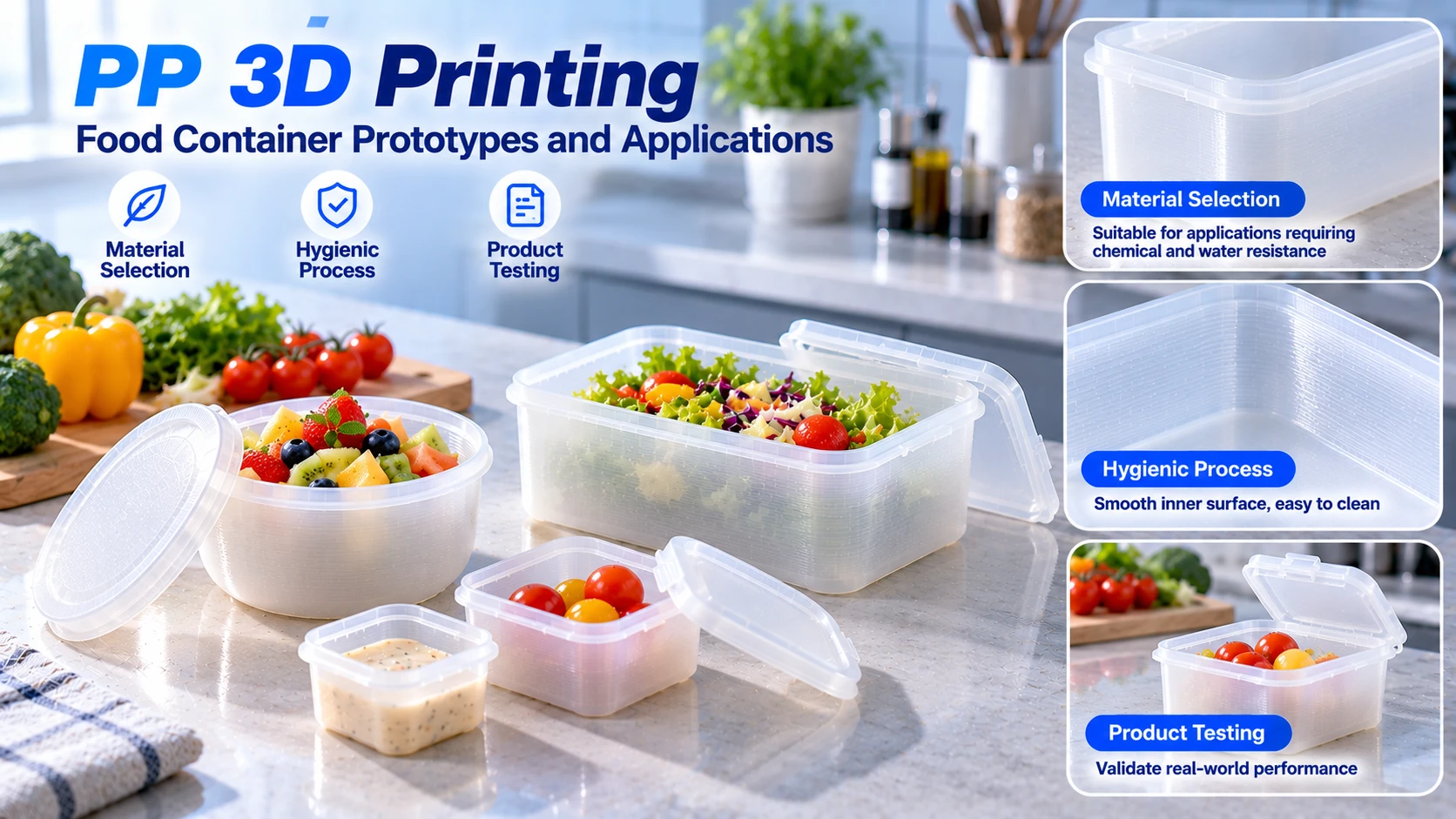
Can 3D Printed Parts Touch Food? Key Considerations for PP in Food Contact Applications
3D printing can produce custom containers, portioning boxes and food-related auxiliary tools. But whether a printed part can directly contact food cannot be judged from the material name or its appearance alone.
Polypropylene (PP) is a common base plastic for food contact use, with low density, low water absorption and good chemical resistance, and many developers working on functional 3D printing are paying attention to it. However, a base material being suitable for food contact does not mean a finished part printed from it automatically meets food contact requirements.
Material formulation, the printing process, part structure and applicable regulations all affect the final judgment. For FDM 3D printed parts in particular, layer lines, micro-porosity and cleaning difficulty are the issues to watch in food contact applications.
1. First, Separate Three Concepts
1. The material itself meets food contact requirements
Food contact materials must meet the requirements of the relevant regulations for raw materials, additives and other constituents.
Even if the base resin is a common food contact material, the additives, masterbatch or other components used during modification can affect the compliance of the final material. So you cannot judge whether a filament is suitable for food contact from the name "PP" alone.
2. The printing process does not introduce unacceptable risks
In FDM 3D printing, nozzle material, equipment condition, lubricants, printing environment and processing conditions can all affect how clean the finished part is.
Printing temperature and the processing route can also affect the material’s migration behaviour. So raw material compliance does not guarantee that a printed part will meet all applicable requirements.
3. The final part meets applicable requirements
Food contact compliance must be assessed against the intended use of the final product, including what food it contacts, for how long, at what temperature, and whether it is single-use or reusable.
Depending on the applicable regulations and the specific product, overall migration, specific migration or other relevant testing may be required.
Material compliance, process control and final part assessment must be considered together — that is the basis for judging whether a 3D printed part can contact food.
2. Why Is PP Worth Attention?
PP is widely used in food containers, lunch boxes and other everyday plastic products. Its low density, low water absorption and resistance to many common chemicals make it a functional 3D printing material worth watching.
However, several concepts need to be kept clearly apart.
Heat resistance does not mean suitability for every high-temperature scenario. A material’s heat performance depends on its specific formulation, the part structure and the conditions of use.
Grease resistance does not mean suitability for every food. Fats, acidic components and other substances in different foods can affect the material’s migration behaviour.
Modification does not mean automatic compliance with food contact requirements. The additive system and the final formulation both affect a material’s suitability.
Compliant raw material does not mean a compliant printed part. Printing equipment, the processing route and part structure must also be included in the assessment.
To judge the food contact suitability of a modified PP filament, you need the specific formulation and the relevant material documentation — you cannot draw conclusions from base resin properties alone.
3. What Extra Risks Come with FDM 3D Printing?
1. Layer lines and micro-porosity make cleaning harder
FDM parts are built up layer by layer, so the surface usually shows visible layer lines, and some structures may contain micro-porosity.
These structural features make food residue and soil harder to remove completely, especially in deep grooves, narrow gaps, internal cavities and hard-to-reach areas.
For reusable food contact parts, cleanability is an important design factor. Even if the material itself is compliant, the part structure may not suit the intended washing and use.
2. Printing equipment can introduce contamination
Nozzles, equipment maintenance materials, lubricants and the printing environment can all affect the cleanliness of the finished part.
Some brass nozzles, for example, may contain elements such as lead, so the parts of the printing equipment that touch the material can also become part of the assessment. Equipment condition, maintenance practice and the processing environment likewise affect final product quality.
For food contact use, do not look only at the filament — consider the contamination sources that the whole printing process may introduce.
3. Additives and masterbatch also matter
A filament’s final performance depends not only on the base resin but also on additives, masterbatch and other formulation components.
Colour alone cannot determine whether a material is safe. Both natural and coloured filaments must be assessed against their actual formulation and documentation. Materials with clear, traceable composition information are generally easier to review for compliance, but this cannot replace the necessary testing.
4. Part design affects cleaning and maintenance
In reusable food contact parts, complex internal structures, narrow gaps and hard-to-reach areas increase cleaning difficulty.
Simpler structures with accessible cleaning areas are usually easier to maintain. Detachable designs can help clean certain joints, but you still need to check whether the removed parts can be cleaned effectively and whether soil tends to remain at the joints.
So when designing 3D printed parts for food contact, you must consider not only functional requirements but also cleaning method, frequency of use and maintenance conditions.
4. Which Food-Related Applications Deserve More Attention?
3D printing can be used for many food-related products, but applications that directly contact food and those that do not are subject to different assessment requirements.
Parts that are food-related but do not directly contact food
For example:
Locating parts on food packaging equipment
Equipment mounting brackets
Label holders and display stands
Auxiliary fixtures that do not directly contact food
Non-contact functional parts in a packaging line
These applications avoid some of the extra requirements that come with direct food contact, but the operating environment, cleaning method and potential contamination risks still need to be considered.
Parts that directly contact food
For example:
Food containers and portioning boxes
Tableware and food-handling tools
Custom parts that directly contact food
Specific auxiliary parts used in food processing or handling
These applications require the material, the process and the final product to be assessed for the specific use. For parts that are reused, heated or contact particular foods, the relevant use conditions and applicable requirements must be taken into account.
For 3D printed parts that directly contact food, compliance cannot be judged from material name, appearance, smell or a single simple use test.
5. Which Regulatory Requirements Apply to Food Contact Applications?
Different markets have different regulatory systems for food contact materials and articles. The specific requirements depend on product type, material composition, intended use and the region of sale.
Common regulatory references include:
China: the GB 4806 series of standards for food contact materials and articles.
European Union: food contact material regulations, including Regulation (EU) No 10/2011 where applicable.
United States: relevant U.S. Food and Drug Administration (FDA) regulations and food contact substance requirements.
These regulations do not have identical scopes or compliance pathways. A material meeting the requirements of one market does not automatically satisfy all requirements in another.
For 3D printed food contact products, you also need to consider the actual processing method and the use conditions of the final part when deciding whether migration testing and other relevant assessments are needed.
Summary
PP is a common food contact base plastic, but a part printed with PP filament does not thereby automatically become food contact compliant.
When assessing PP 3D printed parts, pay attention to these points:
Whether the material formulation and additives meet the applicable requirements.
Whether printing equipment, processing environment and process conditions introduce contamination.
Whether layer lines, porosity and complex structures affect cleaning and maintenance.
Whether the final part meets the regulatory and testing requirements of the target market for its specific use.
Food contact applications depend not only on the material itself but also on the process and the final product. Only by combining material properties, printing process, part structure and applicable regulations can the suitability of a 3D printed part in food-related scenarios be properly assessed.
Related Reading
Can 3D Printed Parts Touch Food? Cleaning and Structural Design for Food Scenarios
Can PP 3D Printed Parts Hold Boiling Water? POLIVE PPpro™ 100°C Boiling Water Test
How Chemical-Resistant Is PP? Understanding the Chemical Resistance of PP 3D Printed Parts
PP 3D Printed Part Design Guide: Wall Thickness, Fillets, Snap Fits and Warp Prevention
Can 3D Printing Make Packaging Prototypes? Clamshell Boxes, Snap Fits and One-Piece Molding
Can an FDM-Printed Container Hold Food Directly?
First separate three concepts: the material itself being compliant, the filament being compliant, and the finished part being compliant. They are not the same thing — being able to print a container does not make it suitable for food contact.
What Material Advantages Does PP Have for Food Contact?
PP has a simple chemical composition, chemical resistance, low moisture absorption and good heat performance. It is already a standard material for food containers, widely used in everyday lunch boxes and microwaveable containers.
What Extra Risks Does FDM Printing Add?
Interlayer gaps that trap dirt, difficulty cleaning, residue from the nozzle and build plate, contamination during post-processing, and the variables introduced by the printing process itself. Material compliance does not cover any of these.
Which Food-Related Uses Need Special Care?
Long-term contact, high temperatures, oils and fats, and repeated-use containers carry higher risk; short-term auxiliary tools and prototypes are relatively manageable. For anything that goes in the mouth, validate separately against the regulations and testing requirements of the relevant market.