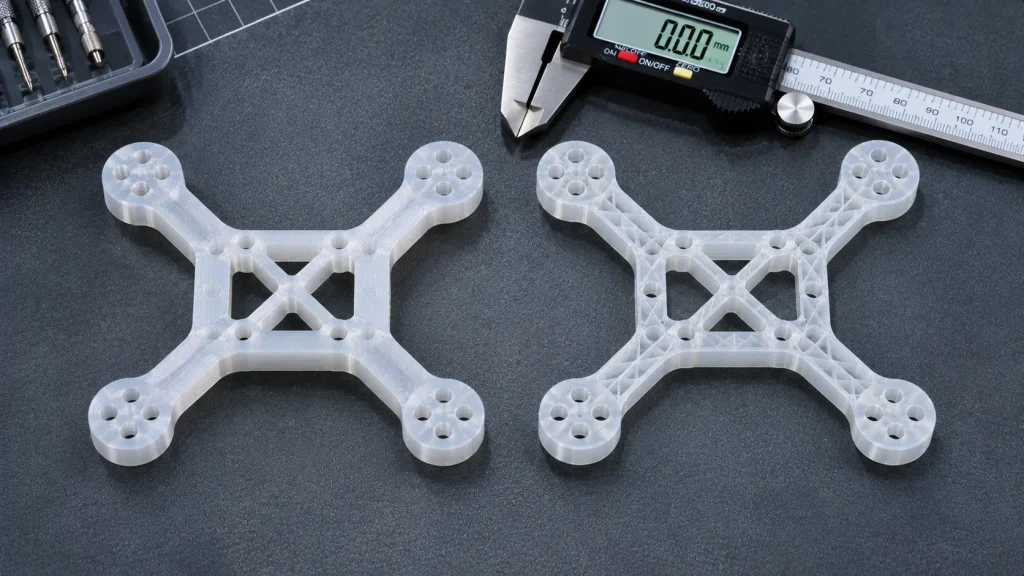
PP vs PLA vs PETG: Which Material Is More Crash-Resistant and Lighter for RC and Drone Parts?
If you want to 3D print drone parts, the first step is choosing the material. Many beginners just use whatever is on hand, and the resulting parts either shatter at the first crash or weigh like a brick.
Today we put the three most common RC materials — PLA, PETG and PP — side by side to see how they really perform in drone applications.
| Material | Density (g/cm³) | Toughness / crash resistance | fatigure durability | Best suited for |
| PLA | About 1.24 | Very poor; brittle | Poor | Static display models, ground test stands |
| PETG | About 1.27 | Moderate; somewhat brittle | Moderate | Structural parts, protective covers (but heavy) |
| PP (PPpro) | About 0.90 | Excellent; strong and tough | Excellent | Propellers, frames, crash-proof guards |
1. An Overwhelming Advantage in Weight
PLA has a density of 1.24 and PETG 1.27, while PP is only 0.90.
What does that mean on a drone? A PETG bracket that weighs 10 g drops to about 7 g when printed in PP. Those 3 saved grams may be exactly the two extra minutes of flight time you gain.
2. The Lifesaver When You Crash
“Crashing” on landing is part of drone life. PLA parts crack at the first knock; PETG has some toughness but still brittle-fractures under high-speed impact. PP is different — its molecular chain structure gives it extremely high impact strength and flexural fatigue resistance. Plenty of times a PP part lands bent out of shape; bend it back by hand and it flies again.
3. High-Frequency Motor Vibration
Drone motors vibrate at high frequency when spinning fast. PETG and PLA gradually develop micro-cracks under that vibration, while PP absorbs shock and energy extremely well — perfect for motor damping mounts.
Summary:
No material is absolutely perfect in the RC and drone world. For static display, PLA is enough; for a transparent look, PETG does the job. But as soon as your parts have to fly, survive takeoffs and landings, and shave every gram, PPpro — combining low density with high toughness — is the best choice in FDM printing today.
Related Reading
- The Core Differences Between PP and PC
- PP vs PET: Why Drink Bottles and Food Containers Use Different Plastics
- Are PP 3D-printed parts drop-resistant? A comparison of impact resistance: PP vs. PETG and ABS
- What Is PPpro? A Modified PP 3D Printing Filament That Needs No Heated Bed and Makes Living Hinges