PP vs PET: Why Drink Bottles and Food Containers Use Different Plastics
Both are plastics, yet drink bottles are mostly PET (recycling code 1) and microwave containers mostly PP (recycling code 5).
The reason is not complicated: each excels at different things in transparency and heat resistance, serving its own scenarios.
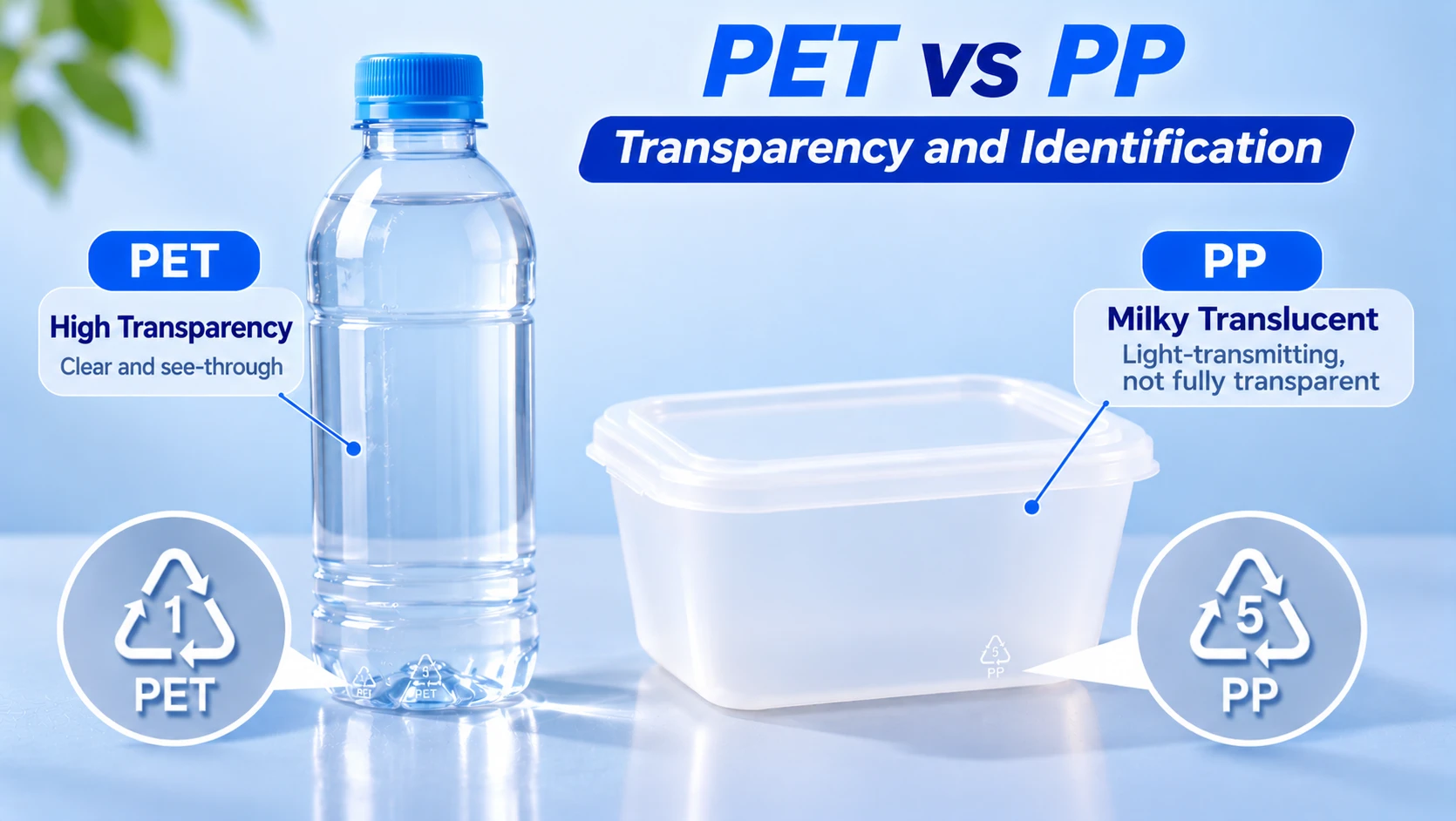
Transparency: PET is clear, PP is milky white
PET’s strengths are transparency, good gas barrier, and sturdiness. That is why it holds carbonated drinks and mineral water—clear bottles let you see the contents.
Carbonated drinks demand a high gas barrier so CO2 does not escape, and PET performs well here. Mineral water benefits from transparency so the quality is visible.
PP’s molecular arrangement is less regular, so it cannot achieve PET’s crystal-clear bottle body; it is usually milky white or translucent. This is not a process issue but a material property. PP’s methyl side branches prevent the molecules from packing neatly, increasing light scattering and reducing clarity.
Heat resistance: PP above 100°C, PET only about 65–70°C
PP’s advantage is precisely heat resistance; it withstands above 100°C, making it suitable for microwave containers and cups that hold hot water.
PET’s heat resistance is only about 65–70°C; it deforms with boiling water and must not be microwaved.
This temperature gap defines their usage boundaries. PET bottles are fine for cold and room-temperature drinks, but soften and deform with boiling water and may lose stability. Heating PP containers in the microwave is routine because they stay structurally stable at that temperature.
So hot-food packaging and microwave containers are essentially always PP, not PET. This is not preference but the temperature ceiling.
Reuse: PET bottles are not recommended for repeated hot-water use; PP containers can be reheated per label
PET bottles should not be reused repeatedly for hot water, nor used long-term repeatedly. As the bottle ages it may leach more substances.
PP containers can be reheated repeatedly under the labeled conditions.
This point is often overlooked. Many people keep PET mineral-water bottles to refill repeatedly; short-term room-temperature water is fine, but hot water or long-term use goes beyond the design purpose. PP containers are designed for repeated heating, so use them per the label.
Recycling codes: PET is number 1, PP is number 5
In the triangular recycling symbol at the bottom of plastic products, PET corresponds to number 1 and PP to number 5.
The number is the fastest way to tell them apart. For hot food or microwave use, look for number 5; number 1 PET suits cold drinks and room-temperature storage—keep it away from high temperatures.
How to choose: by temperature, not price
For transparent cold-drink bottles, look at PET; for hot-food containers, look at PP.
If you need transparency, gas barrier, and carbonated drinks, choose PET.
If you need heat resistance, microwave use, and hot water, choose PP.
If you need light weight, chemical resistance, and repeated flexing, choose PP.
Their maximum temperature limits are completely different—this is the first watershed in material selection.
What these differences mean for 3D printing
Both PP and PET can be made into 3D printing filaments, but in FDM the more common form of PET is PETG, not pure PET.
Pure PET crystallizes fast and shrinks a lot, so it warps easily and bonds poorly between layers when printed, making it hard to form. PETG is the glycol-modified version that lowers crystallinity and greatly improves print stability, which is why most FDM transparent filaments on the market are PETG, not PET.
PP has traditionally also been hard to print, with poor adhesion and severe warping. POLIVE PPpro™, a modified PP 3D printing filament, solves exactly this problem: it keeps PP’s heat resistance, chemical resistance, and lightness, while optimizing print adhesion and interlayer bonding, following a no-heated-bed, no-enclosure, open-cover printing approach.
If your part relies on PP’s strengths—heat resistance, hot-food contact, and chemical resistance—then PPpro™ is the right direction. If you want a highly transparent bottle effect, PETG or another transparent material is more suitable; PP cannot achieve that clarity.
Conclusion
The core differences between PP and PET lie in transparency and heat resistance: PET is transparent with good gas barrier and heat resistance of about 65–70°C, suiting cold-drink bottles and room-temperature storage; PP is milky/translucent, heat-resistant above 100°C, and suits microwave containers and hot-water holding.
Simple rule: transparent cold-drink bottles look to PET, hot-food containers look to PP; their temperature ceilings are completely different. PET bottles are not recommended for repeated hot-water use, while PP containers can be reheated per label.
Common Questions
Which is more heat-resistant, PP or PET?
PP is clearly more heat-resistant. PP withstands above 100°C while PET resists only about 65–70°C. So microwave containers use PP and mineral-water bottles use PET; a PET bottle deforms with boiling water and must not be microwaved.
Can PET bottles be reused?
Long-term repeated use is not recommended, especially not for repeated hot water. As the PET bottle ages it may leach more substances. Short-term room-temperature water is fine, but hot water or prolonged use goes beyond its design purpose.
For 3D printing, PP or PETG?
It depends on the part’s needs. For heat resistance, hot-food contact, and chemical resistance, choose PPpro™. For high transparency and a near-glass feel, choose PETG or another transparent material. Pure PET is difficult to print in FDM, so most transparent filaments on the market are PETG, not PET.
饮料瓶和餐盒为什么用不同塑料?
因为工况不同:饮料瓶要透明、阻隔、成本低,PET 合适;餐盒要耐热、能重复加热、化学惰性,PP 合适。不是谁更好,是分工。
透明度和耐热的差别从哪来?
PET 容易做成高透明,但耐热上限较低;PP 偏乳白半透明,耐热表现明显更好。所以选容器先看温度,再看外观。
回收标志怎么记?
PET 是 1 号,PP 是 5 号。饮料瓶和餐盒分属两条回收流,投放时分开更利于再生料质量。
3D 打印里怎么对应?
桌面 FDM 常见的是 PETG 而非 PET;PP 这边有改性线材可用,不加热床、不封箱,适合做容器原型和耐化学功能件。
Related Reading
·PP vs PVC: What’s the Difference
·The Core Differences Between PP and PC
·What Is PPpro? A Modified PP 3D Printing Filament That Needs No Heated Bed and Makes Living Hinges