What Print Bed Should Be Used for PP 3D Printing? A Comparison of Common Bed Materials
PP bonds poorly to most surfaces, so plate prep matters more than heat. A brim and PPLOCK26811 hold parts; alcohol cleans the plate.
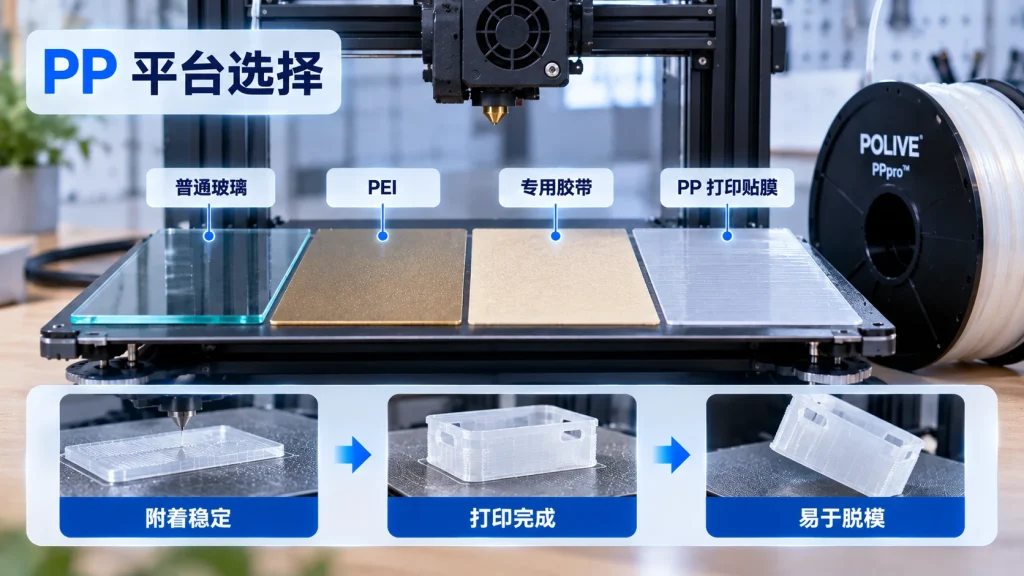
What print bed should be used for PP 3D printing?
When choosing a bed for PP 3D printing, the core is not simply pursuing “the stickier the better,” but satisfying two conditions at the same time:
It must adhere during printing and be removable after printing.
PP is a low-surface-energy material and shrinks during cooling. Therefore, bed selection needs to consider both adhesion and demolding.
Common beds such as ordinary glass and PEI may not directly achieve ideal PP adhesion. In practice, options such as PP sheet, PP printing sticker film, or PP-specific specialized tape can be considered.
For a specific bed, it is best to first verify with small test prints before moving to larger prints.
Why is PP picky about the print bed?
PP is a polyolefin material with relatively low surface energy.
This leads to a direct problem:
Molten PP does not easily wet certain bed surfaces well.
At the same time, PP is a semi-crystalline material that shrinks during cooling.
Therefore, PP printing actually needs to solve two problems at the same time.
First: allow the first layer to adhere fully
If the wetting and interfacial bonding between the molten material and the bed are insufficient, the first layer may easily detach.
Second: control warping caused by cooling shrinkage
Even if the first layer has adhered, the shrinkage stress generated during subsequent cooling may lift the edges upward.
Therefore:
PP bed selection = adhesion + warping resistance + demolding
You cannot just look at whether the bed “sticks.”
Comparison of Common PP Print Bed Materials
The performance of different beds is affected by factors such as PP formulation, bed surface condition, printing parameters, and first-layer conditions. The following can serve as a basic reference when choosing.
1. Glass
The biggest advantage of glass is:
- Flat surface
- Easy to clean
- The bottom surface is usually relatively flat
- Relatively easy part removal
But for PP, direct adhesion on bare glass is usually insufficient.
Therefore, if you use a glass bed to print PP, it usually needs to be combined with:
- Glue
- Tape
- Specialized film
- Other surface treatments suitable for PP
Glass is more suitable as a base bed, rather than assuming bare glass alone can stably print PP by default.
2. PEI (Polyetherimide) Sheet
PEI is currently one of the most common general-purpose 3D printing bed materials, and usually provides good adhesion for materials such as PLA and PETG.
But PP behaves differently on PEI.
Since PP itself is a low-surface-energy material, PP’s direct adhesion on PEI is affected by the specific material formulation and bed surface condition.
Therefore, it is not recommended to simply assume:
“PEI is a general-purpose bed, so it must be suitable for PP.”
A more reasonable approach is to first verify with small test prints:
- Whether the first layer is stable
- Whether the edges lift
- Whether detachment occurs during printing
- Whether the part is easy to remove after printing
3. Masking Tape / Specialized Tape
The main advantages of the tape solution are:
- Low cost
- Easy to replace
- Can quickly adjust the bed surface
- Helps with edge adhesion for some PP prints
But it also has some disadvantages:
- Limited service life
- Tape seams may leave marks on the bottom surface
- For large prints over long durations, edges may still be lifted by shrinkage stress
- After each replacement, the bed condition may change
Therefore, tape is suitable for low-cost testing and some printing scenarios, but for long-term stable production, a more durable bed solution needs to be considered.
4. PP Sheet / PP Printing Sticker Film
This is an approach considered from the perspective of material compatibility.
Simply put, it tries to use a surface similar to the printing material as the print bed.
PP sheet or PP printing sticker film can serve as a testing solution for PP printing. However, the specific adhesion performance still needs to be verified based on the actual material, bed surface, and printing conditions.
Under our test conditions, this type of bed solution is a direction worth prioritizing for testing.
PPpro⢠adhesion comparison tests across beds: data to be added.
At the same time, it should also be noted that:
Stronger adhesion is not always better.
If the bed and the print are bonded too strongly, the following may instead occur after printing:
- Difficulty removing the part
- Damage to the bottom surface of the print
- Wear on the bed surface
Therefore, an ideal PP bed should maintain stable adhesion during printing and allow relatively easy demolding after printing.
5. Glue-Based Auxiliary Solutions
If your existing printer uses a glass or PEI bed, you can also consider using a PP-compatible bed glue or other auxiliary bonding solutions.
They can serve as a supplement to bed adhesion.
But you need to pay attention to the amount used.
A glue layer that is too thick may:
- Affect the first-layer surface
- Change the first-layer height
- Affect bottom-surface flatness
- Increase cleaning difficulty
Therefore, glue is more suitable as an auxiliary solution, rather than simply solving all adhesion problems by continuously increasing the amount of glue.
How should you choose a PP print bed?
If you are just starting to try PP 3D printing, you can choose according to the following approach.
| Bed option | PP adhesion approach | Key features |
|---|---|---|
| Bare glass | Usually requires auxiliary treatment | Flat, easy to clean |
| PEI | Requires actual verification | Strong versatility, but PP performance depends on material and surface |
| Masking tape / specialized tape | Can serve as a low-cost solution | Low cost, easy to replace, but limited lifespan |
| PP sheet / PP film | Material compatibility approach | Worth prioritizing for testing, suitable for PP scenarios |
| Glue assistance | Improves adhesion on existing beds | Flexible to use, but requires controlling the amount |
If it is your first time printing PP, it is not recommended to test directly with a large part.
A more reasonable approach is:
Small test prints â confirm bed adhesion â adjust first layer â check environment and cooling â then print large parts
This can reduce waste of material and time.
How should the bed surface be prepared?
Regardless of which bed is used, pre-print preparation directly affects first-layer performance.
1. Keep the bed clean
Before printing, try to remove:
- Fingerprints
- Oil stains
- Dust
- Glue residue
- Other contaminants
You can choose an appropriate cleaning method based on the bed material.
After cleaning, also try to avoid touching the printing area directly with your hands.
2. Adjust the first-layer height
The first layer of PP needs to form sufficient actual contact with the bed.
If the first-layer gap is too large, it may lead to:
- Insufficient melt spreading
- Insufficient contact area
- Reduced first-layer adhesion
Therefore, even if the bed itself is suitable for PP, improper first-layer height settings may cause the print to detach from the bed.
3. Pay attention to environment and cooling
Bed material is only one factor affecting print results. Printing environment and cooling conditions also affect first-layer stability, print shrinkage, and warping.
It is recommended to focus on:
- Whether there is airflow blowing directly onto the print
- Whether the printing environment has obvious temperature fluctuations
- Whether the cooling of different regions of the print is uniform
- Whether large parts or sharp-corner regions are more prone to warping
For POLIVE PPproâ¢, its product positioning is room-temperature printing, no heat bed required, and open-frame printing. In actual use, you should focus on environmental stability and cooling uniformity, rather than defaulting to solving all adhesion or warping issues by raising the heat-bed temperature.
4. Check bed wear
Tape and printing sticker film are themselves consumables.
If you notice:
- Edge lifting
- Scratches
- Obvious indentations
- Surface wear
- Localized abnormal adhesion
you should consider replacing it.
Do not wait until the bed suddenly releases the print during a large job to discover that the bed surface can no longer provide stable adhesion.
Why is “stickier” sometimes worse?
This is a point easily overlooked when choosing a PP bed.
An ideal bed does not glue the print down firmly, but keeps the print stable during printing and allows controllable demolding after printing.
If adhesion is too weak:
Insufficient adhesion â edge lifting â print failure
If adhesion is too strong:
Difficulty removing â bottom-surface damage â bed wear
Therefore, when evaluating a PP print bed, you should observe both the adhesion during printing and the demolding performance after printing, rather than only testing whether it “sticks” during printing.
What bed should PPpro⢠be paired with?
For POLIVE PPproâ¢, bed selection should still be tested in combination with the actual printer and printing conditions.
Since PPpro⢠is a modified PP filament formulated for FDM 3D printing, its material design focuses on:
- Platform attachment
- Shrinkage behavior
- Melt flow
- Interlayer bonding
- Printing stability
In actual use, you can prioritize testing bed solutions suitable for PP, then adjust based on first-layer performance.
Ultimately, the actual test results of the following combination should be the standard:
PPpro⢠+ current printer + bed + printing parameters + environment and cooling conditions
Summary
- The core of a PP print bed is not simply pursuing the strongest adhesion, but achieving stable adhesion and easy demolding.
- PP’s low surface energy makes its direct adhesion on some general-purpose beds relatively difficult.
- PP shrinks during cooling, so bed adhesion and warping resistance need to be considered together.
- Bare glass usually needs to be combined with glue, tape, or other surface treatments.
- PEI is a common general-purpose bed, but PP’s performance on PEI should be confirmed through actual testing.
- Masking tape or specialized tape is low cost, but its lifespan and stability for large prints are limited.
- PP sheet or PP printing sticker film is a PP bed solution worth testing.
- Bed cleanliness, first-layer height, environmental stability, and cooling uniformity also affect the final result.
- When testing a new bed for the first time, it is recommended to first print small test pieces, then proceed to larger prints.
- For POLIVE PPproâ¢, you should verify the optimal printing conditions based on the specific printer and bed combination, and follow the product’s corresponding printing guide.
PP 打印该用什么平台?
核心不是越粘越好,而是同时满足首层贴得住和能控制冷却收缩。玻璃、PEI、美纹纸、专用胶带、PP 板各有取舍,选择要看你配的粘附方案。
PPpro™ 的平台怎么配?
不用反复贴 PP 胶带。平台薄涂 PPLOCK26811 专用胶水,等几分钟干透后直接打印,加裙边即可;一次涂抹可以多次打印,需要清洁用酒精擦掉重涂。
为什么有时候太粘反而不好?
粘得过死会让脱模时伤到平台涂层或零件,尤其 PP 韧性好、硬撬容易把底层撕坏。更稳的是让涂层提供均匀适中的附着,等平台自然冷却后再取件。
不加热床,平台还要做什么准备?
把表面油污用酒精擦净、确认胶水干透、检查首层高度;环境上放在空调房、避开穿堂风,让 PP 开放散热均匀定型。
Related Reading
- How to Prevent PP Warping? How to Choose Between Brim, Raft, and Skirt
- 为什么 PP 以前这么难打?收缩、翘边、粘不住的三大难题
- How to Configure PP 3D Printing Settings? PPpro™ Parameter Guide
- What Is PP’s Melting Point? How Should PP Printing Temperature Be Understood