PP vs PE: How to Tell Them Apart at a Glance
PP and PE are close relatives: both are made only of carbon and hydrogen and both belong to the polyolefin family, so neither contains chlorine nor a bisphenol A (BPA) structure.
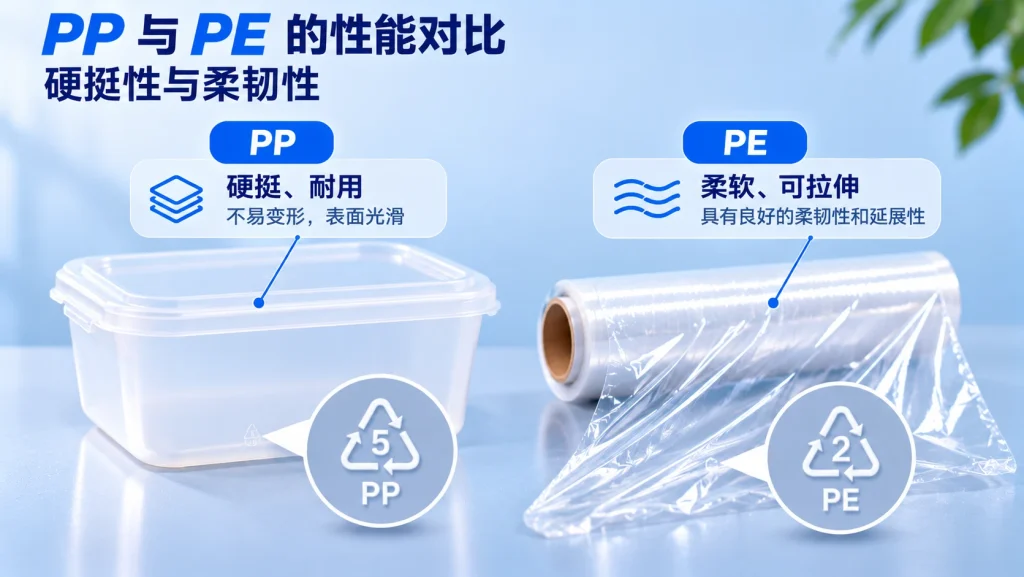
In the recycling symbol, PP is number 5, while the common PE grades are number 2 (high-density) and number 4 (low-density).
区别主要在”硬”和”软”。
Composition: Sibling Materials, Differing Only in Side Chains
Both PP and PE have a backbone of long carbon-hydrogen chains; the difference is in their side chains.
PE’s backbone carries essentially no side chains, so its molecular chains pack more neatlyâmaking it softer and more flexible. PP’s backbone attaches a methyl side chain to every other carbon; these branches keep the molecules from packing too neatly, so PP is harder and stiffer.
This single side chain is what determines the two materials’ softness, heat resistance and feel. It is their most fundamental difference.
Stiffness and Heat Resistance: PP Is Stiff and Heat-Resistant, PE Is Soft and Cold-Resistant
PP is harder, stiffer and more heat-resistantâit stays rigid above 100°C. That is why microwave lunch boxes, cups and storage bins use PP. Its surface is fairly smooth and it gives a crisp sound when tapped.
PE is softer, more flexible and more cold-resistant. It feels a little waxy and is less transparent. Cling film, plastic bags and shampoo bottles are mostly PE. PE’s heat resistance is typically around 70â90°C, so cling film should not be used to cover food going into the microwave.
This difference is very practical: whether it can go in the microwave is the most direct dividing line between PP and PE. PP can; PE cannot.
Feel and Appearance: Smooth and Crisp vs. Waxy and Flexible
PP products have a fairly smooth surface and give a crisp sound when tapped; they feel stiff in the hand and do not deform easily.
PE products feel a little waxy, soft and stretchableâthey extend when torn. They are also less transparent; between the two semi-transparent materials, PE looks hazier while PP looks brighter.
With these two traits, you can tell them apart roughly even without looking at the markings.
Recycling Marks: PP Is Number 5, PE Is Number 2 or 4
In the triangular recycling symbol at the bottom of plastic products, PP corresponds to the number 5.
PE comes in two types: high-density polyethylene (HDPE) is number 2, and low-density polyethylene (LDPE) is number 4. Number 2 is commonly found in shampoo and milk bottles, while number 4 is common in cling film and plastic bags.
Reading the number is the most accurate way to tell them apartâmore reliable than feel.
How to Tell Them Apart at a Glance
If it is stiff and can go in the microwave, it is most likely PP.
If it is soft, stretchable and extends when torn, it is most likely PE.
If the surface is smooth and it sounds crisp when tapped, it is most likely PP.
If it feels waxy and looks hazy, it is most likely PE.
The most reliable check is still the recycling number at the bottom: number 5 is PP, number 2 or 4 is PE.
Neither is suited to long-term outdoor sun exposure; both become brittle after aging. On this point they are in the same boatâneither is clearly stronger.
What these differences mean for 3D printing
Both PP and PE can be made into 3D printing filaments, but PE is rarely seen in FDM.
The main reason is that PE has high shrinkage and severe warping, poor adhesion during printing, and noticeable dimensional change after coolingâmaking it even harder to form than PP. Mainstream FDM filaments are PLA, PETG, ABS, TPU and PP; PE is not among the common choices.
PP has traditionally also been hard to printâpoor adhesion and severe warping. POLIVE PPpro modified PP 3D printing filament solves exactly this problem: it keeps PP’s stiff, heat-resistant and chemical-resistant nature while optimizing print adhesion and interlayer bonding, and is designed for printing without a heated bed, enclosure or cover.
If your part relies on PP’s strengthsâstiffness, heat resistance, food-contact safety when hot and chemical resistanceâthen PPpro is the right direction. If you need an extremely soft, highly flexible film-like effect, PP is not suitable; but PE is not a practical FDM option either, so you would need another solution.
Conclusion
PP and PE are polyolefin siblingsâboth contain only carbon and hydrogen and neither contains chlorine nor BPA. The main difference is rigid versus soft: PP is harder and more heat-resistant, staying rigid above 100°C, and suits microwave lunch boxes, cups and storage bins; PE is softer and more cold-resistant, with heat resistance of 70â90°C, and suits cling film, plastic bags and shampoo bottles.
Tell them apart at a glance: the stiff, crisp, microwave-safe one is PP; the soft, waxy, stretchable one is PE. The most accurate check is the recycling numberânumber 5 is PP, number 2 or 4 is PE.
Common Questions
Which Is More Heat-Resistant, PP or PE?
PP is more heat-resistant. PP stays rigid above 100°C, while PE’s heat resistance is typically around 70â90°C. That is why microwave lunch boxes use PP and cling film uses PE, and why cling film should not cover food in the microwave.
Which Is Safer, PP or PE?
Neither contains chlorine nor a BPA structure, so their baseline safety is similar. Which to use depends on the scenario: choose PP for hot-food contact and PE for when you need softness and extensibility. Compliance depends on the product’s certification and applicable regulations.
Can You Use PE Filament for 3D Printing?
It is rarely seen in FDM printing. PE has high shrinkage, severe warping and poor adhesion, making it even harder to form than PP. Mainstream FDM filaments are PLA, PETG, ABS, TPU and PP; PE is not a practical option.
PP 和 PE 怎么一眼分辨?
看手感和外观:PP 偏挺、表面爽脆、半透明乳白;PE 偏软、有蜡感、更容易弯。回收标志也直接:PP 是 5 号,PE 常见 2 号或 4 号。
两者是亲戚,差别到底在哪?
同属聚烯烃、都只含碳氢,差在侧链结构:PP 每个重复单元带一个甲基侧基,PE 没有。正是这个侧基让 PP 更刚、更耐热。
刚性和耐热怎么影响选料?
需要挺括、耐热、能做活铰链的结构选 PP;需要柔软、耐低温冲击的缓冲或薄膜类选 PE。
打印时这个差别体现出来吗?
两者都低表面能、都收缩明显,平台粘附是共同难题;PE 在 FDM 上可参考的工艺经验更少,PPpro™ 已把方案固化成不加热床、不封箱加 PPLOCK26811。
Related Reading
·What Is PPpro? A Modified PP 3D Printing Filament That Needs No Heated Bed and Makes Living Hinges