What Is PP? Understanding Polypropylene at a Glance
Polypropylene is a low-density, chemical-resistant, fatigue-tolerant thermoplastic used in food containers, living hinges and functional prints.
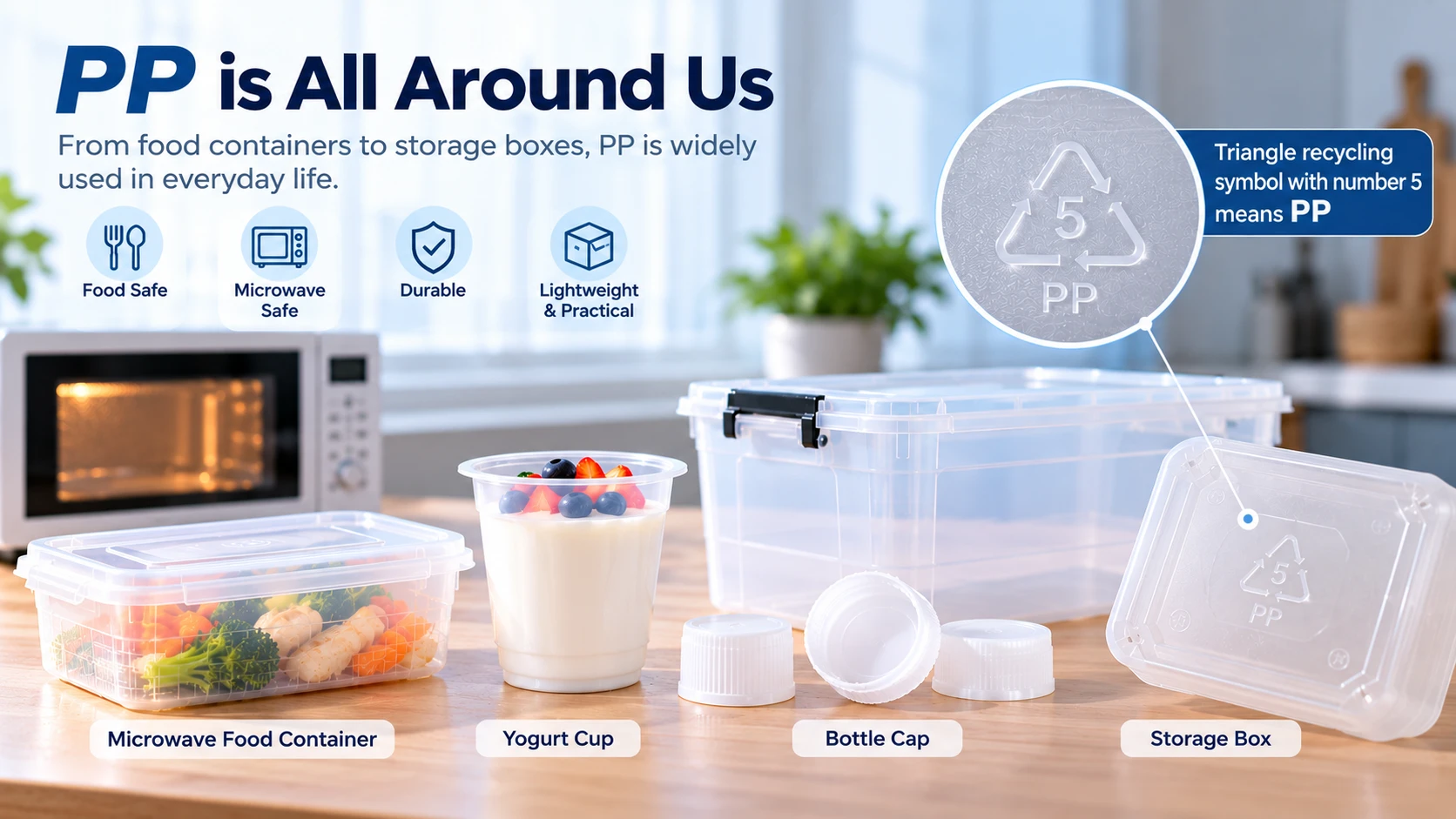
PP stands for polypropylene. Many everyday items around youâmicrowave containers, yogurt cups, bottle caps, storage boxesâare made from it. This article explains what PP is, where it comes from, and what it can do.
What PP Is: From Propylene to Polypropylene
PP is a large molecule made by linking propylene monomers one after another. Propylene has the formula CHâ=CHâCHâ; stringing it together repeatedly yields polypropylene with the formula (CâHâ)â.
Propylene mainly comes from by-products of petroleum refining; with a catalyst it polymerizes into PP pellets, which are then formed into various products through injection molding, blow molding, extrusion, and similar processes.
In short: PP is a hydrocarbon polymer made from propyleneâlight, heat-resistant, and chemically stableâand is one of the most common plastics in consumer goods and medical consumables.
What PP Can Do: Light, Heat-Resistant, Chemical-Resistant, and Bendable
PP is one of the five major commodity plastics. Its advantages are low cost, heat resistance, chemical corrosion resistance, and the ability to withstand repeated bending.
Lightweight: with a density of about 0.90 g/cm³, lighter than water, it is one of the lightest commodity plastics in common use.
Heat-resistant: its heat-deflection temperature can exceed 100°C, so it handles boiling water without issue.
Chemical resistance: its saturated hydrocarbon backbone resists most acids, alkalis, and common solvents.
Bendable: it has good toughness and can be bent repeatedly without easily breakingâthis is the basis for its use in living hinges.
These very properties are exactly what functional 3D-printed parts most lack.
Where PP Is Found: Common Everyday Products
PP products are all around you: microwave containers, yogurt cups, bottle caps, masks, storage boxes, and even automotive bumpers contain it.
How to recognize it? Plastic products usually have a triangular recycling symbol on the bottom with a number inside. PP corresponds to number 5.
What These Properties Mean for 3D Printing
PP’s strengths are lightness, chemical resistance, and repeated bendability; its weaknesses are warping, poor adhesion, and unstable interlayer bonding during printing. So whether a part should use PP does not come down to memorizing material facts, but to whether your part relies on its strengths or weaknesses.
For those relying on its strengthsâliving hinges, buoyant parts, acid/alkali-resistant parts, and weight-saving structuresâPP is a great fit. For those relying on its weaknessesâparts requiring extremely high dimensional accuracy or long-term heavy loadsâmore validation is needed.
Conclusion
PP is a hydrocarbon polymer made from propyleneâlight, heat-resistant, and chemically stableâand one of the most common plastics in consumer goods and medical consumables. Its lightness, chemical resistance, and bendability are exactly the properties that functional 3D-printed parts lack.
POLIVE PPpro⢠modified PP 3D printing filament brings these inherent properties into FDM printing: it keeps PP’s foundation of lightness, chemical resistance, and repeated bendability, while optimizing print adhesion and interlayer bonding, following a path of heater-bed-free, enclosure-free, open-lid printing.
Common Questions
How is PPpro modified PP 3D printing filament related to general-purpose PP?
PPpro is a PP filament modified for FDM 3D printing. It retains PP’s light weight, chemical resistance, and repeated-flexibility nature, and optimizes print adhesion and interlayer bonding.
Is PPpro modified PP 3D printing filament difficult to print?
PP’s difficulty lies in adhesion and warping, not temperature. PPpro follows a no-heated-bed, no-enclosure, open-cover routeâeven faster in an air-conditioned roomâand prints stably with proper bed preparation.
PP 到底是什么?
聚丙烯,由丙烯聚合而成的热塑性塑料。微波炉餐盒、酸奶杯、瓶盖、收纳盒,身边很多日用品都是它。
PP 有哪些拿得出手的特性?
轻、耐热、耐化学、能反复弯折,而且吸水率低、化学惰性强,日常使用很稳。
这些特性对 3D 打印意味着什么?
意味着它适合做功能件而不是摆件;但也因为半结晶收缩和低表面能,过去在 FDM 上难打。PPpro™ 用不加热床、不封箱的开放方案把门槛降下来了。
Related Reading
·PPpro 是什么?一款不用热床、能做活铰链的改性 PP 3D 打印线材
·PP 能做活铰链吗?用 POLIVE PPpro™ 打印一体式活铰链
·PP 密度为什么只有约 0.90 g/cm³?比水还轻的 3D 打印材料
·PP 3D 打印参数怎么设置?PPpro™ 参数指