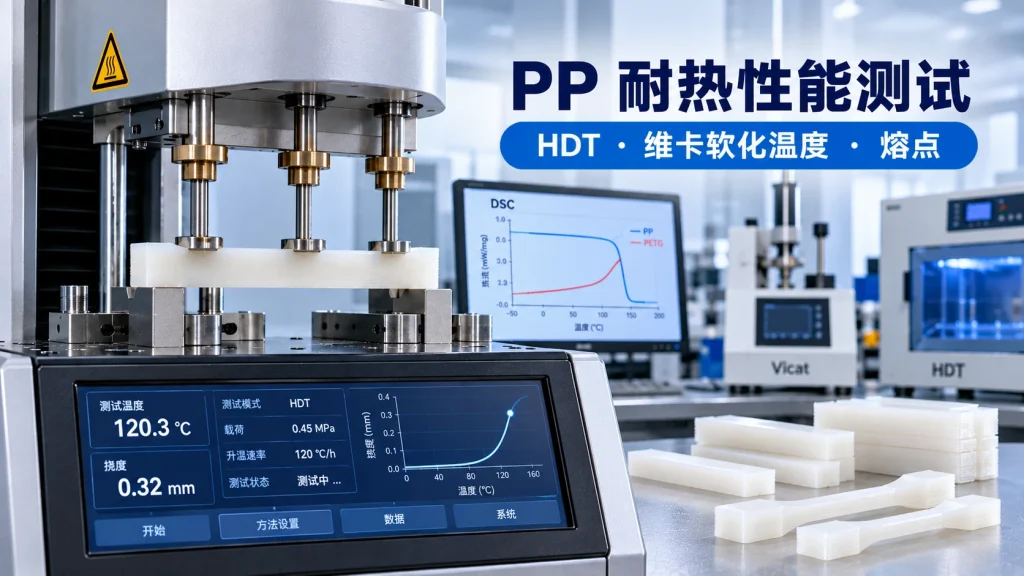
How Much Temperature Can PP Prints Withstand? PP’s Heat-Resistance Performance
The heat resistance of PP prints cannot be summed up by a single temperature.
Melting point, heat deflection temperature (HDT), Vicat softening point, and long-term service temperaturedescribe different temperature characteristics, and the actual performance is also affected by load, heating time, and environmental conditions.
Therefore, to judge whether a PP print can be used in high-temperature scenarios, you shouldn’t look only at the material’s melting point, but should combine three core conditions:
How high is the temperature? How much load does it bear? For how long?
For an actual part, these three conditions are usually more meaningful than a single ‘maximum temperature’ number.
Don’t Confuse the Three Temperature Concepts
1. Melting point
The melting point is the temperature range at which a material undergoes a melting transition.
PP is a semi-crystalline thermoplastic, and the melting temperature varies among different PP formulations.
Note:
The melting point is not the part’s long-term service temperature.
A material’s mechanical properties may already change significantly as temperature rises before it reaches the melting point, so you cannot simply assume ‘as long as the melting point isn’t reached, it can be used long-term’.
2. Heat deflection temperature (HDT)
HDT is the temperature at which a standard specimen reaches a specified amount of deflection under specified test conditions and a specified load.
Therefore, HDT is not a fixed temperature entirely detached from test conditions.
In the test:
- Load
- Specimen dimensions
- Test method
- Deflection criteria
all affect the final result.
This is also why the same material may yield different HDT values under different test conditions.
3. Vicat softening point
The Vicat softening point evaluates a material’s softening behavior during heating through a specified penetration test.
Both it and HDT can describe a material’s performance change during heating, but their test principles and criteria differ.
Therefore,HDT and Vicat also cannot simply be substituted for each other.
Why Can’t the Melting Point Be Used Directly as the Service Temperature?
This is one of the most important points when understanding PP’s heat resistance.
Assuming a material has a high melting point does not mean it can still maintain its original mechanical properties when approaching that temperature.
For a load-bearing part, as temperature rises, the material’s stiffness and load-carrying capacity may gradually decline.
Therefore:
The melting point answers ‘when melting transition occurs,’ not ‘how much temperature the part can endure long-term.’
If you need to judge whether a PP print can be used in a real high-temperature environment, you should further consider HDT, deformation under long-term load, and actual service conditions.
Heat Resistance Without Load Differs Greatly from Heat Resistance Under Load
This is a problem especially easy to overlook in 3D-printed functional parts.
Some parts bear almost no mechanical load in high-temperature environments, such as:
- Decorative covers
- Some enclosures
- Storage boxes
- Non-load-bearing structures
While other parts still need to bear sustained loads in high-temperature environments, such as:
- Hooks
- Snaps
- Brackets
- Connectors
- Fixtures
These two types of parts have completely different heat-resistance requirements.
Why Can a Part ‘Not Melt’ Yet Still Deform at High Temperatures?
One of the reasons iscreep..
Polymers under sustained load may develop slow, continuous deformation over time even if the temperature hasn’t reached the melting point.
The higher the temperature, the more this time-dependent deformation usually needs attention.
For example, a PP hook that can bear a certain weight at first does not mean it will keep the same shape after carrying load continuously for days or months at higher temperatures.
Therefore, for load-bearing parts, don’t just ask:
‘Has this temperature exceeded PP’s melting point?’
You should ask instead:
‘Will this part, under this load at this temperature for this long, develop unacceptable deformation?’
How to Compare the Heat Resistance of PP with PLA, PETG, and ABS?
Different materials’ heat resistance needs to be compared using specific metrics, not ranked simply by a single melting or softening temperature.
PP
PP is a semi-crystalline polymer that usually has good heat-resistance potential while retaining some toughness.
For parts that need to balance:
- Heat-resistant
- toughness
- chemical stability
- low density
, PP is a material worth considering.
PLA
PLA has a lower printing temperature and good rigidity, but its heat resistance is relatively limited. At higher ambient temperatures, PLA prints may soften and deform earlier.
Therefore, PLA is better suited for applications with relatively limited temperature requirements.
PETG
PETG offers a certain balance among heat resistance, toughness, and printability, suiting many general functional parts.
But its specific heat-resistance capability still needs to be judged from the material grade and test data.
ABS
ABS is commonly used for functional and engineering prints, with certain advantages in heat resistance and mechanical performance.
But ABS’s shrinkage and warping during printing can also affect the final part’s dimensional stability and real-world performance.
Therefore, rather than simply asking ‘is PP more heat-resistant than PETG or ABS,’ it’s better to target the specific:
temperature + load + time
for testing and comparison.
How to Verify High-Temperature Scenarios?
If a PP print needs to be used in a real high-temperature environment, it’s recommended to test it as closely as possible to actual service conditions.
1. Constant-temperature test
Place the print in an environment at the set temperature and observe after a specified time:
- Size changes
- Warping
- Softening
- Permanent deformation
- Surface changes
This helps judge the part’s stability in high-temperature environments.
2. High-temperature test with load
If the actual part needs to bear load during use, it’s best to add the corresponding mechanical load during testing.
For example:
Hook → high-temperature environment + actual weight
Bracket → high-temperature environment + actual load
Snap → high-temperature environment + assembly stress
This kind of test is closer to real usage than simply putting the part in an oven.
3. Thermal cycling test
If the product needs to undergo repeated temperature changes, thermal cycling can also be performed.
For example:
Room temperature → high temperature → cooling → room temperature
After repeated cycling, observe:
- Cracks
- Deformation
- Size changes
- Interlayer failure
- Joint failure
Thermal cycling helps reveal problems that a single constant-temperature test may miss.
What Does a 100°C Boiling-Water Test Show?
For PP 3D prints, a 100°C boiling-water test can serve as an intuitive short-term high-temperature verification.
For example, observe whether the print shows the following after boiling-water immersion:
- Obvious softening
- Severe deformation
- Cracking
- Size changes
But it should be noted that:
A 100°C boiling-water test is not the same as a 100°C long-term service test.
Conditions such as water-bath temperature, heating method, duration, and whether the part is loaded differ from the actual service environment.
Therefore, such tests are better suited asapplication verification under short-term high-temperature conditions, rather than directly defining the material’s long-term service temperature.
For POLIVE PPpro™, if it needs to be used in specific high-temperature applications, we still recommend verification with the actual part, actual load, and actual service time.
Clarify Three Conditions First When Selecting Materials for High Temperatures
Facing a high-temperature application, you can first answer three questions:
Temperature
How much temperature does the part actually need to withstand?
Is it:
- 60°C
- 80°C
- 100°C
- or even higher?
Load
Does the part bear mechanical load at this temperature?
Is it static, dynamic, or repeated load?
Time
How long does the high-temperature state last?
Is it:
- A few minutes
- A few hours
- A few days
- or long-term continuous use?
Only by pinning down these three conditions can you more easily judge whether the material and structure are suitable.
PP Prints’ Heat Resistance Depends on More Than the Material Alone
For FDM prints, the final high-temperature performance is actually the result of multiple factors acting together:
material formulation + print parameters + print orientation + part structure + temperature + load + time
Different parts printed from the same PP filament may also perform completely differently at high temperatures.
A thin-walled, load-bearing snap and a load-free thick-walled enclosure, even with identical PP material, cannot be judged by the same ‘heat-resistance temperature’.
Therefore, material selection for high-temperature applications should start fromactual service conditions, rather than searching for a single maximum temperature detached from test conditions.
Summary
- Melting point, HDT, Vicat softening point, and long-term service temperature are not the same concept.
- The melting point cannot be used directly as the long-term service temperature of a PP print.
- Load-bearing PP parts need special attention to creep and long-term deformation at high temperatures.
- The heat resistance of PP, PLA, PETG, and ABS should be compared in the context of specific test conditions and application scenarios.
- High-temperature verification should ideally considertemperature, load, and time.
- Constant-temperature, high-temperature-with-load, and thermal-cycling tests can help determine whether a print is suitable for real high-temperature applications.
- A 100°C boiling-water test can serve as short-term high-temperature application verification, but it does not directly equal long-term 100°C service capability.
- For a specific PP material, selection should be based on its corresponding actual test data, not just general PP parameters.
PP 打印件能承受多少温度?
一个温度说不清,要分熔点、热变形温度、维卡软化点三个概念,而且无负载耐热和带负载耐热差别很大。熔点不能直接当成使用温度。
为什么没熔化也会高温变形?
半结晶材料在远低于熔点时就可能软化,尤其零件持续受力的时候。所以判断能不能用在热环境,要看实际载荷和实测结果,不是看材料化不化。
100°C 沸水测试说明什么?
说明 PPpro™ 在这个条件下不会立刻软化变形,但不能外推成所有高温工况都可用;壁厚、层间结合和是否承重都会改变结果。
怎么验证自己的高温场景?
用真实零件、真实温度、真实负载和真实时长去测,冷却后复测尺寸与装配;和 PLA、PETG、ABS 在同一条件下对比,比查参数表可靠。
Related Reading
- Can PP 3D Printed Parts Hold Boiling Water? POLIVE PPpro™ 100°C Boiling Water Test
- How Long Do PP Prints Last? Ageing and Service Life of PP
- Are PP Prints Strong? How to Assess PP’s Mechanical Properties
- Can 3D printing be used to produce automotive parts? Applications of PP (polypropylene) in the automotive sector