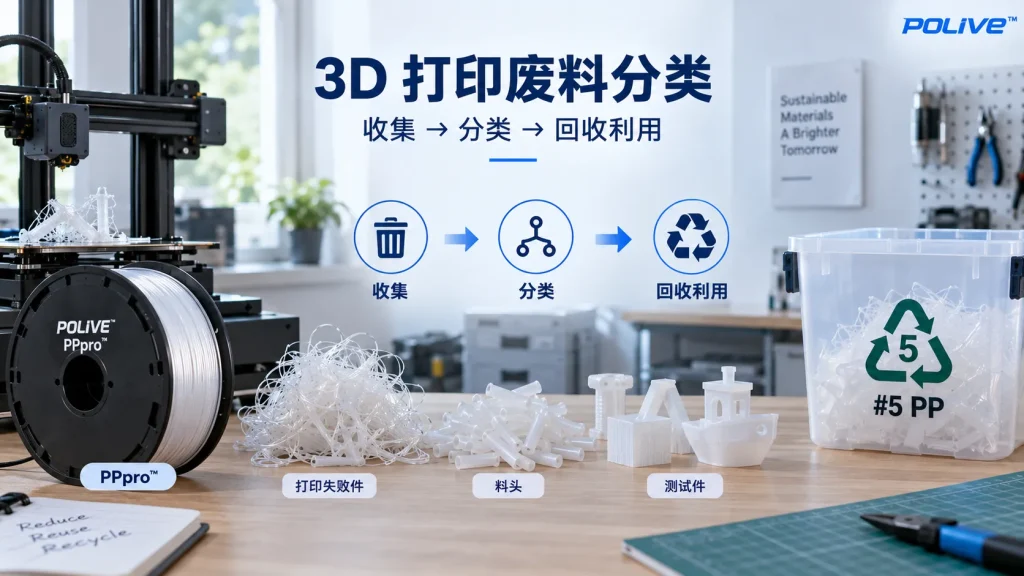
Can PP Be Recycled?
Yes.
PP (polypropylene) is a very common plastic in daily life, and it also falls under #5 plastic (#5 PP).
If you see, on the bottom of some plastic containers, packaging, and household items, a recycling-triangle symbol marked with 5, it usually means the product is mainly made of PP.
PP has a mature industrial recycling and reprocessing pathway; it can be reclaimed through processes such as sorting, washing, crushing, and melting.
However, it is important to note:
“PP can be recycled” does not mean “every PP product can be directly recycled in any region’s household recycling system.”
Whether a product can actually enter the local recycling stream depends on local recycling facilities, collection rules, product form, and contamination level.
Can PP 3D printing waste be recycled?
PP 3D printing usually generates some waste, such as:
- failed prints
- support material
- first-layer waste
- filament ends and offcuts
- parameter test parts
- discarded models from slicer tests
These materials are, in essence, still PP or modified PP.
Therefore, from the perspective ofMaterial typematerial type, they have the potential to be reclaimed.
For a modified PP 3D printing material like PPpro™, the actual recycling method must be judged according to the specific material formulation and the local recycling system.
If you want to recycle the material, we recommend collecting the same type of material separately and avoiding mixing it with different plastics such as PLA, ABS, and PETG.
What does PP being “#5 plastic” mean?
In the Resin Identification Code (RIC):
#5 = PP(Polypropylene)
this number is mainly used to identify the type of plastic resin, facilitating sorting and recycling.
Note:
A plastic number does not equal “the local system definitely accepts it for recycling.”
For example, a product marked #5 PP may be accepted into the local recycling system in one region but not in another.
Therefore, when handling 3D printing waste, you should still follow the rules of the local recycling authority.
What is the difference between PP recycling and PLA “biodegradability”?
PLA is often called a “biodegradable plastic,” but this easily leads to a misunderstanding:
biodegradable ≠ can be tossed directly into the natural environment and rapidly decompose.
PLA can biodegrade under specific industrial composting conditions, but this usually requires appropriate temperature, humidity, a microbial environment, and processing time.
If PLA enters the ordinary municipal waste stream, its actual fate depends on local waste-handling methods; it will not automatically enter an industrial composting system just because it is PLA.
PP, on the other hand, follows a different logic:
PP itself is not a biodegradable plastic, but it has a mature material-recycling and reprocessing pathway.
Therefore, when discussing the environmental friendliness of 3D printing materials, you cannot simply compare “biodegradable” versus “non-biodegradable.”
You should also consider:
material source → product service life → waste collection → recycling system → reprocessing
Why does recycling matter for 3D printing?
3D printing has a characteristic:
material can go directly from filament to final part.
When developing new products, adjusting print parameters, or testing different designs, a certain number of test parts and failed parts are often produced.
If these materials can be sorted, collected, and routed into appropriate recycling or reprocessing flows, some plastic waste can be reduced.
This is especially true for users who frequently do:
- parameter testing
- prototype development
- structural validation
- printing experiments
establishing a simple waste-sorting habit becomes more practical.
How should PP 3D printing waste be handled?
If you use PPpro™ for 3D printing, you can first sort the waste.
Step 1: Collect PP material separately
Do not mix different materials such as PP, PLA, ABS, and PETG together.
Step 2: Keep the material as clean as possible
Waste contaminated by oil, dust, or other materials is harder to recycle afterward.
Step 3: Confirm local recycling rules
Recycling systems differ by region.
Even if the local system accepts #5 PP, it does not necessarily accept 3D printed parts, support material, or other specially shaped PP waste.
Therefore, before discarding, it is best to check with the local recycling authority about #5 PP the specific requirements.
PPpro™ and sustainable 3D printing
PPpro™ uses PP as its base material and cares about more than just printing performance; it also considers the material’s value across its actual service life.
PP itself offers:
- low density
- low water absorption
- good chemical resistance
- good fatigue resistance
- recyclable material properties
For 3D printing users, a material’s environmental friendliness is not just about “whether it degrades after printing.”
Longer part service life, reducing unnecessary waste, and reasonable material recycling are equally worth attention.
PP vs. PLA: which is more environmentally friendly?
There is no simple answer.
One of PLA’s advantages is its biodegradability under specific industrial composting conditions.
PP’s characteristic is:
rather than relying on biodegradation, it achieves resource circulation through material recycling and reprocessing.
The final environmental impact also depends on raw material source, manufacturing process, transportation, product service life, and waste-handling methods.
Therefore, rather than simply saying:
“PP is more environmentally friendly than PLA.”
or:
“PLA is more environmentally friendly than PP.”
it is better to judge based on the specific product life cycle and local waste-handling conditions.
Summary
PP is the #5 PP#5 plastic, with a mature industrial recycling and reprocessing pathway.
For 3D printing users, failed PP prints, test parts, and some print waste have the potential to be reclaimed by material type, butwhether they can actually enter the local recycling system must be judged by local recycling facilities and regulations.
PP and PLA also differ in their environmental paths:
PLA: biodegradation / industrial composting under specific conditions
PP: material recycling / reprocessing
For PP 3D printing, using materials reasonably, extending part life, reducing unnecessary print waste, and correctly sorting and handling scrap material are all more practical sustainability practices.
打印剩下的 PP 边角料能回收再利用吗?
能。PP 就是塑料回收标志里的 5 号,是回收体系里最成熟的品类之一;和热固性材料不同,它可以重新熔融加工。
PP 的回收和 PLA 的可降解是一回事吗?
不是。PLA 讲的是工业堆肥条件下降解,PP 讲的是进入回收流被重新利用,这是两套不同的环保逻辑,不能混着算。
打印失败的 PP 件和边角料怎么处理?
单独收集 PP 材质、尽量保持干净不混其它料、按本地回收规则投放。混料会直接影响回收料质量,所以分类比扔进可回收桶更关键。