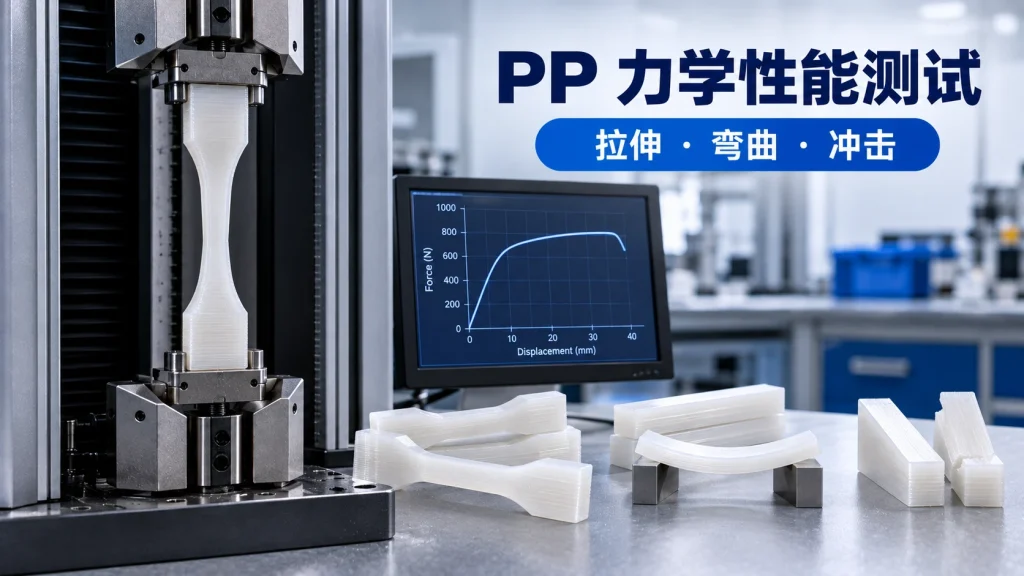
Are PP Prints Strong? How to Assess PP’s Mechanical Properties
Are PP printed parts strong?
Whether PP printed parts are “strong” cannot be answered with a single number.
If what you care about isrigidity, PP is usually not a particularly outstanding material; but if what you care about istoughness, impact resistance and repeated bending ability, PP often has the advantage.
Therefore, when judging the mechanical properties of PP printed parts, you need to consider the specific loading mode:
- tension
- bending
- impact
and you also need to consider print orientation, wall thickness, infill density, print temperature and material formulation.
Strength is not a single number: tension, bending, impact
The “strength” in a material datasheet actually contains several different indicators.
Tensile performance
Tensile testing mainly observes how a material behaves when subjected to a pulling force, for example:
- tensile strength
- Elongation at break
- elastic modulus
Tensile strength reflects the stress level a material can withstand during tension; elongation at break reflects how much deformation it can undergo before fracture.
For PP, high ductility and toughness are among its important characteristics.
Bending performance
Bending testing helps understand how a material behaves under bending loads.
In addition to bending strength, you can also look atbending modulus, which is the material’s ability to resist bending deformation.
For actual printed parts, bending performance is related to the part’s:
- Wall thickness
- geometry
- Fill rate
- Print orientation
are all related.
impact performance
Impact testing focuses on the material’s ability to resist failure under instantaneous loads.
For example:
- drops
- collision
- instantaneous impact
- rapid bending
A typical characteristic of PP is its good toughness, so in some impact and repeated-deformation scenarios it is less prone to sudden fracture than some more brittle materials.
Simply put, PP printed parts under load tend todeform to some extent before failing, rather than fracturing suddenly with no obvious deformation.
For POLIVE PPpro™, and the material formulation has been modified for PP 3D-printing applications, so its specific tensile, bending and other properties should be based on data under the corresponding test conditions.
Several key factors affecting the strength of PP printed parts
Even using the same PP filament, two printed parts can show significantly different mechanical behavior.
1. Print orientation
FDM printed parts are clearly anisotropic.
Because parts are formed layer by layer, there is a difference between material continuity in the XY plane and interlayer bonding in the Z direction.
Therefore, for the same test specimen, changing the print orientation can noticeably change the final tensile, bending and fracture behavior.
For load-bearing parts, the print orientation should be designed according to the actual load direction, rather than focusing only on the material’s own parameters.
2. Wall thickness and infill density
A part’s load-bearing capacity depends not only on the material but also on its structure.
For example:
- Wall thickness
- Number of wall lines
- Fill rate
- infill pattern
- top and bottom layer thickness
all affect the final mechanical behavior of the part.
Therefore, you cannot simply assume that “because the material has high tensile strength, any part printed from it will be very strong.”
A thin-wall, high-infill part and a thick-wall, low-infill part may perform completely differently under actual load.
3. Print temperature and interlayer bonding
Print temperature affects the bonding between molten materials.
If the temperature or heat input is insufficient, the previous layer and the next layer may fail to fuse sufficiently, leading to poor interlayer bonding.
In this case, even if PP itself has good material toughness, the actual strength of the printed part may still be significantly affected.
Therefore, print temperature affects not only surface quality but also actual structural performance.
4. Material formulation
The properties of different PP formulations are not exactly the same.
Material modification can target:
- rigidity
- toughness
- flowability
- Interlayer bonding
- Shrinkage behavior
and other aspects for adjustment.
For POLIVE PPpro™, and the specific mechanical properties should be based on actual test data and test conditions.
If engineering material selection is needed, it is recommended to also check:
- tensile strength
- Elongation at break
- bending modulus
- impact performance
- Testing Standards
- test direction
- Testing Conditions
rather than looking only at a single “strength” number.
How does PP compare with PLA, PETG and ABS?
Different materials have different advantages, so it is more appropriate to compare them from specific applications.
PP vs PLA
PLA usually has higher rigidity and is more suitable for parts that need a harder surface.
PP’s advantages are more reflected in:
- toughness
- flexibility
- Repeated bending
- low density
- chemical resistance
Therefore, if a part needs some flexibility or repeated motion, PP may be more suitable.
PP vs PETG
PETG usually achieves a relatively balanced trade-off among rigidity, toughness and printing convenience.
PP stands out more in:
- low density
- flexibility
- Chemical resistance
- repeated bending ability
The final choice depends on the part’s actual use environment and mechanical requirements.
PP vs ABS
ABS usually has good rigidity and a solid engineering foundation, while PP leans more toward lightweight, flexible and chemically resistant applications.
Therefore, PP is more suitable for some:
- Snaps
- Living hinge
- containers
- lightweight structural parts
- parts that need repeated bending
while for structures requiring high rigidity such as load-bearing beams and supports, you need to judge based on specific design and test results.
How to verify the PP printed part in your hands?
If you need to know how much force a particular PP printed part can actually withstand, the most reliable method is not to simply refer to the material’s advertised parameters, but to performtests related to the actual part and printing process.
tensile testing
You can use standard or self-made dumbbell-shaped test specimens.
When testing, record:
- Material grade
- Print orientation
- Nozzle temperature
- Floor height
- Fill rate
- Number of wall lines
- specimen dimensions
This makes test results easier to compare across different batches.
three-point bending
Three-point bending testing helps judge the ability of the material and printed part to resist bending deformation.
If your actual product mainly bears bending loads, this type of test is usually more meaningful than simply looking at tensile data.
impact testing
If the product may experience drops, collisions or instantaneous impacts, you can further perform impact testing.
For example, choose the appropriate pendulum impact, drop-weight or other verification method based on the actual application.
Why must print parameters be recorded during testing?
Test results for 3D-printing materials are closely related to printing conditions.
Even with the same filament, if you change:
- Print orientation
- Temperature
- Floor height
- Print speed
- Fill rate
- Wall thickness
- Cooling conditions
the final test results may all change.
In addition, whether the specimen has been dried, annealed or otherwise post-processed may also affect the test results.
Therefore, a complete test report should not just write “tensile strength XX MPa”, but should also statethe test standard and sample preparation conditions.
For POLIVE PPpro™, if it is to be used for specific engineering selection, the actual data under the corresponding batch, test standard and test conditions should be used as the basis.
What loading scenarios are PP printed parts actually suitable for?
The key to understanding the mechanical properties of PP is not simply judging “whether PP is strong”, but judging:
whether it suits your loading mode.
If the part needs:
- Repeated bending
- some flexibility
- Impact resistance
- low weight
- tolerance of chemical environments
PP may have a clear advantage.
If the part mainly requires:
- high rigidity
- very small deformation
- high dimensional stability
then other materials need to be compared further, combined with specific structure testing.
The final mechanical performance comes from:
material + print parameters + print orientation + part structure
rather than the material name itself.
Summary
- PP’s rigidity is usually not outstanding, but its toughness and impact resistance are its important characteristics.
- Judging PP’s strength cannot rely on a single number; tensile, bending and impact performance should be considered separately.
- Print orientation will significantly affect the actual mechanical properties of FDM parts.
- Wall thickness, number of wall lines, infill density and structural design all affect the final load-bearing capacity.
- Print temperature and interlayer bonding quality also affect the actual strength.
- The mechanical properties of different PP formulations differ, and modified materials should be based on specific test data.
- For actual load-bearing parts, it is recommended to first make test specimens, then verify according to the real working conditions.
- When material selection is needed, you should check the test standard, sample preparation conditions and specific test data together, rather than comparing only a single strength number.
PP 件的强度算不算高?
强度不是一个数字,要分拉伸、弯曲、冲击来看。PP 的特点偏韧性和抗冲击,刚度不是强项,所以结不结实要先说清楚是哪种受力。
影响 PP 件强度最大的因素是什么?
打印方向、壁厚与填充、喷嘴温度带来的层间结合,常常比材料牌号影响更大。测试时务必把参数记录下来,否则结果没法复现。
怎么验证手上的 PP 件够不够用?
按真实工况做装配件测试:实际载荷、实际方向、反复加载和跌落,而不是只拉一根标准试条。圆角过渡和均匀壁厚往往比换材料更快提升表现。
哪些受力场景适合 PP?
反复弯折、卡扣、跌落冲击、需要变形卸能的功能件。长期恒定高载荷、要求高刚性和尺寸极稳的结构件,应该另选材料。
Related Reading
- What is Modified PP? What Exactly Does POLIVE PPpro™ Change?
- How Strong Are the Interlayer Bonds of PP Prints? How to Improve Z-Direction Strength
- Are PP 3D-printed parts drop-resistant? A comparison of impact resistance: PP vs. PETG and ABS
- Can PP Make Living Hinges? Printing One-Piece Living Hinges with POLIVE PPpro™