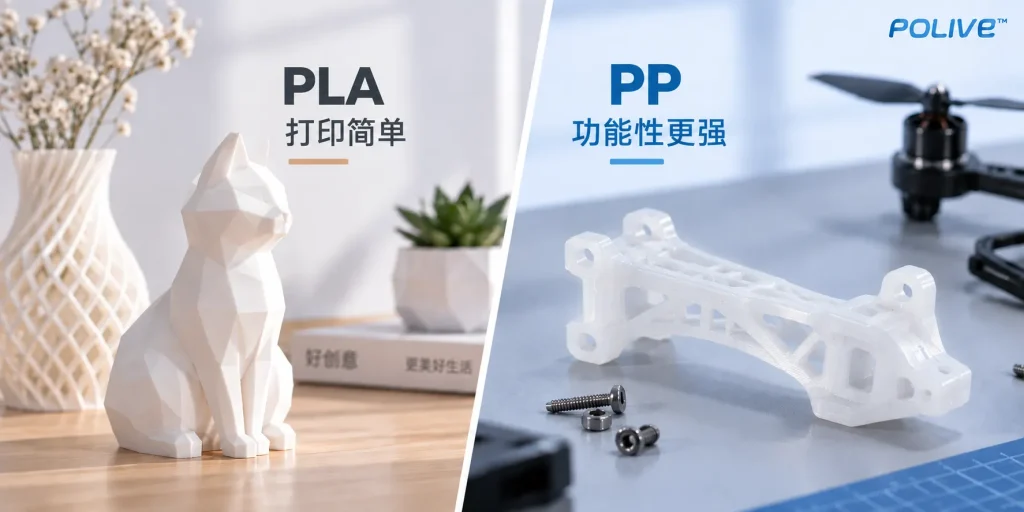
PP or PLA: Which Should You Actually Choose?
PP suits tough, chemical-resistant, flexible parts; PLA suits easy display prints. PPpro prints open-frame with no heated bed.
When choosing a 3D printing filament, many people ask:
PP or PLA — which is better?
In fact, no single material suits every application.
The real question to ask is:
What properties do your printed parts need to have?
If you mainly print models, decorative parts, or need to get good print results quickly, PLA is usually the easier choice to start with.
But if your parts needlower weight, chemical resistance, a certain flexibility, moisture resistance or a higher service temperature, then PP may be worth considering.
Simply put:
PLA is easier to print, while PP is better suited to applications with functional performance requirements.
1. What Are the Differences Between PLA and PP?
PLA (polylactic acid) is a very common material in FDM 3D printing.
It offers good printability, surface finish and dimensional stability, along with a wide range of colors, making it very suitable for beginners as well as for models, display pieces and general prototyping.
PP (polypropylene), by contrast, is a very widely used engineering plastic.
It has the following characteristics:
- Low density, light weight
- Water and moisture resistance
- Good resistance to many acids, alkalis and chemicals
- A certain degree of flexibility
- Good fatigue resistance
- Better temperature resistance than ordinary PLA in many applications
Therefore, the strengths of the two are not exactly the same.
PLA emphasizes printing convenience, while PP emphasizes the functional performance of the material itself.
2. Heat Resistance: PP Is Usually Better for High-Temperature Environments
This is one of the most important differences when choosing between PP and PLA.
PLA’s glass transition temperature is usually around 55–60°C. When the temperature approaches this range, the material’s stiffness can drop noticeably, making it more prone to deformation under sustained load.
This is why some PLA printed parts can deform in high-temperature environments, such as inside a car in direct sunlight.
PP’s temperature performance is generally better than that of ordinary PLA.
However, it is important to note that:
HDT (heat deflection temperature), glass transition temperature, melting temperature and actual service temperature are not the same concept.
A material’s actual heat resistance is also affected by the following factors:
- Material grade
- Part structure
- Wall thickness
- Fill rate
- Load conditions
- Heating duration
- Actual ambient temperature
Therefore, rather than simply saying “PP can withstand 100°C,” it is better to judge based on the specific material and test conditions.
If your printed part needs to stay in a relatively high-temperature environment for a long time,PP is usually worth prioritizing, but the final decision should still be based on test data for the specific material.
3. Chemical Resistance: PP Is Better for Many Functional Applications
Another important advantage of PP is chemical resistance.
PP generally resists many common acids, alkalis and other chemical media well, so it is widely used in containers, pipes, laboratory supplies and industrial components.
But this does not mean PP is completely unaffected by all chemicals.
Actual performance depends on:
- Type of chemical
- Concentration
- Temperature
- Contact time
- Material formulation
- Part structure
By comparison, PLA is better suited to general models, display pieces and conventional prototypes, rather than functional parts that require long-term contact with aggressive chemical media.
If your printed part needs to operate inhumid conditions, cleaning agents or specific chemical environments, PP can be a material choice worth testing.
4. Food Contact: You Cannot Go by the Material Name Alone
PP is often used in food packaging and food containers, so many people assume:
“PP is a food-grade material, so PP printed parts are food-safe.”
This is not accurate.
Whether a 3D printed part is suitable for food contact depends not only on PP itself, but also on the following factors:
- The specific formulation of the resin and filament
- Color masterbatch and other additives
- Whether the material has the relevant compliance documentation
- Printer and nozzle materials
- contamination during printing
- Surface structure of the printed part
- Post-processing methods
- actual food-contact conditions
The same applies to PLA.
Therefore, if a product is intended for food contact, you should checkthe specific material, the specific application and the applicable regulationsto confirm whether requirements are met, rather than judging solely from the material name “PP.”
5. Print Difficulty: PLA Is Still Easier to Start With
If we compare print difficulty alone, PLA is usually noticeably more forgiving.
PLA generally offers:
- Lower risk of warping
- Good first-layer adhesion
- A relatively easy-to-control printing process
- A higher print success rate
- Broad printer compatibility
This is an important reason PLA has become an entry-level FDM filament.
PP is different.
Conventional PP can encounter the following during FDM printing:
- Warping
- shrinkage
- difficulty with first-layer adhesion
- interlayer bonding issues
- Demanding temperature control
- Print parameters need adjustment
Therefore, PP itself has decent material properties, buthow to reliably translate these properties into FDM printed parts is another question.
6. What Problem Is POLIVE PPPro™ Trying to Solve?
This is exactly the reason modified PP 3D printing filaments exist.
POLIVE PPPro™ is a modified PP filament developed for FDM 3D printing.
Our goal is not simply to turn ordinary PP into filament, but to adjust material properties around the common problems in FDM printing so that PP is better suited to real 3D printing applications.
Key areas of focus include:
- Warping control
- First-layer adhesion
- Interlayer bonding
- Printing stability
- Shrinkage control
- Real-world performance of functional parts
The ultimate goal is simple:
To let more ordinary FDM users use PP more conveniently.
If you are printing with PP, it is recommended to adjust print temperature, speed, cooling and first-layer parameters based on your specific printer and material test results.
[View the PP Printing Parameter Guide →]
7. When Should You Choose PLA?
If your main needs are:
- Model printing
- Figurines
- Decorative parts
- Display models
- General visual prototypes
- Rapid appearance validation
- Wanting the printing process to be as simple as possible
Then PLA is usually a very suitable choice.
Its greatest advantage is not any single material metric, but rather:
being easy to print and easy to get stable results.
For many ordinary 3D printing tasks, this is very important.
8. When Should You Choose PP?
If your printed parts focus more on functional performance, consider PP.
For example:
- Lightweight parts
- Functional prototypes
- Parts requiring a certain flexibility
- Applications requiring moisture resistance
- Parts with chemical resistance requirements
- Certain higher-temperature environments
- Buoyancy-related parts
- Lightweight structural parts in drones and model equipment
- Parts requiring good fatigue resistance
PP’s low density is also an important advantage.
The typical density of PP is about 0.90 g/cm³, lower than water’s approximately 1.0 g/cm³, so PP can be used in designs where lightweighting or buoyancy matters.
Of course, whether the final printed part can float also depends on factors such as the part’s actual structure, infill rate, wall thickness and whether water gets inside.
[Learn Why PP Density Is Lower Than Water →]
9. PP or PLA: Which Is Right for You?
You can judge it simply like this:
Choose PLA if you care more about:
Easy printing + appearance + cost + rapid prototyping
Suitable for:
- Decorative models
- Figurines
- Display pieces
- General prototypes
- Everyday printing
Consider PP if you care more about:
Lightweighting + flexibility + chemical resistance + moisture resistance + functional performance
Suitable for:
- functional parts
- Lightweight structures
- Chemical environment applications
- Certain high-temperature environments
- Buoyancy-related parts
- Functional prototypes
PLA handles “getting it printed,” while PP handles “holding up in use”
This sentence sums up the difference between the two materials well.
Of course, this does not mean PLA can only print models, nor that PP is necessarily suitable for every functional part.
A real choice should be based onactual application needs and material test data.
If you only need to print a model quickly and reliably, PLA is often the simpler choice.
If your printed parts need to take on more functional demands in terms of weight, flexibility, chemical resistance, moisture resistance or temperature, then PP is worth testing further.
POLIVE PPPro™: Making PP More Suitable for FDM 3D Printing
PP itself is not a new material.
What is truly difficult is:
how to bring it more effectively into FDM 3D printing workflows.
POLIVE PPPro™ focuses on modified PP 3D printing materials, aiming to improve its processability and stability during FDM printing while retaining PP’s important material properties.
If you are looking for a PP filament suited to functional 3D printing, POLIVE PPPro™ can be an option worth testing.
[Learn About POLIVE PPPro™ →]
Finally: There Is No “Best” Filament, Only a More Suitable One
PLA and PP are not simply in competition with each other.
PLA’s advantage is ease of printing.
PP’s advantage lies in its unique material properties.
If your goal is to quickly get a good-looking model, PLA is often enough.
If your goal is to make a functional part that will actually be put into use, PP may offer more performance worth exploring.
Before choosing a material, first ask yourself one question:
What does this 3D printed part ultimately need to do?
The answer is usually the most important basis for choosing a filament.
选 PP 还是选 PLA,判断依据是什么?
没有绝对更好的耗材,看零件用途。外观件、展示模型、追求容易打和表面细节,选 PLA;要耐温、耐化学、反复弯折或抗跌落的功能件,选 PP。
新手第一次打 PP 会不会很难?
用改性 PP 线材门槛已经明显降低:不用加热床、不用封箱,开放式机器在空调房里就能打。首层靠裙边加 PPLOCK26811 专用胶水解决,剩下主要是把模型底部做圆角、加大接触面积。
PLA 能做的事,PP 是不是都能替代?
不是替代关系。PLA 刚性好、尺寸稳定、打起来省心;PP 韧性优先、带一点弹性,刚性要求高的结构件不该硬换。更合理的是按零件分工,两种材料都留在料架上。