How to Judge the Quality of Modified PP Filament? Which Tests to Check When Buying
Judge modified PP by repeatable print tests: open-frame adhesion, warping on large flat parts, hinge fatigue and batch consistency.
To judge whether a modified PP filament suits your application, the key is to look at actual test results rather than marketing claims. Shrinkage and warpage, interlayer strength, chemical resistance, repeated bending performance, and batch-to-batch consistency are the five categories of indicators worth checking when buying.
Each test needs to be interpreted together with its method and specific conditions. Material data helps you screen candidate products, but whether one is truly suitable still depends on prototyping with real parts.
First question: what exactly has been improved in the material?
"Modified PP" is a broad label; different products may target completely different improvements. Some focus on reducing crystallization shrinkage and warpage, some on interlayer bonding, and others on toughness, surface adhesion, or other properties.
When buying, start by asking the supplier two questions:
- Which properties has the material been improved for?
- Is the product specifically designed for FDM 3D printing, and what print conditions are recommended?
Then check whether the test items match these improvement goals. If the main selling point is dimensional stability, warpage and dimensional-change tests are critical; if the target application is snap-fits or living hinges, focus on repeated bending and fatigue performance.
Only when the modification goals are clear can test data provide a sound basis for judgment.
Five test categories to focus on when buying modified PP filament
1. Shrinkage and Warpage Testing
PP is a semi-crystalline material; cooling and crystallization affect dimensional change. In 3D printed parts, warpage may show up as lifted corners, a deformed bottom surface, or overall dimensional deviation.
When evaluating, look at actual prints of large flat areas, long walls, and box-shaped structures, not just a small cube. Different geometries place different demands on dimensional stability, and the size, print orientation, and print conditions of the test piece also affect results.
Check the following items closely:
- Whether the size and structure of the test piece are relevant to the actual use.
- Whether print parameters and test environment were recorded.
- Whether dimensional change after printing was measured.
- Whether the corners of large flat areas and long walls show visible lifting.
For applications requiring precise assembly or large-format printing, this type of testing is especially informative.
2. Interlayer Strength Testing
FDM prints are built from stacked layers, and the bonding between layers affects the part’s real mechanical performance. No matter how good the material’s intrinsic properties are, insufficient interlayer bonding can cause the part to fail along layer lines.
When reviewing tests, look at tensile and bending data and confirm the print orientation of the samples. For interlayer bonding, pay particular attention to performance under Z-direction loading.
When reading the data, confirm whether the test samples were actual 3D printed parts, along with their print orientation, geometry, and test method. Results from injection-molded specimens and FDM printed parts cannot be treated as equivalent.
If the part will bear tension, bending, or repeated loads, it is best to print test pieces close to the actual structure instead of relying on a single data point from standard specimens.
3. Chemical Resistance Testing
PP generally offers good chemical resistance, but actual performance depends on the contact medium, concentration, temperature, exposure time, material formulation, and the stress state of the part.
A chemical resistance report worth referencing should state the test media and conditions and record changes before and after testing — for example, whether samples showed cracking, deformation, surface changes, or weight change.
When buying, distinguish short-term immersion from long-term exposure. Short-term test results cannot directly prove the material suits long-term service in the same environment, nor can tolerance to one chemical be generalized to all media.
For parts used in containers, laboratory accessories, or chemical-contact scenarios, choose test items that match the actual service conditions.
4. Living Hinge and Repeated Bending Testing
PP is often used in structures that require repeated bending, such as living hinges and some snap-fits. For FDM prints, the final performance depends not only on the material but also on hinge thickness, bend radius, print orientation, and interlayer bonding.
When evaluating this type of application, pay attention to:
- The hinge structure and dimensions of the sample.
- The bending angle and operation method for each cycle.
- The number of cycles and test intervals.
- Whether cracks, whitening, permanent deformation, or breakage occurred.
- Whether failure occurred in the hinge body or between print layers.
Cycle counts must be interpreted together with the specific test conditions. Results under different geometries and bending methods are not directly comparable, so validation with the actual product structure is best.
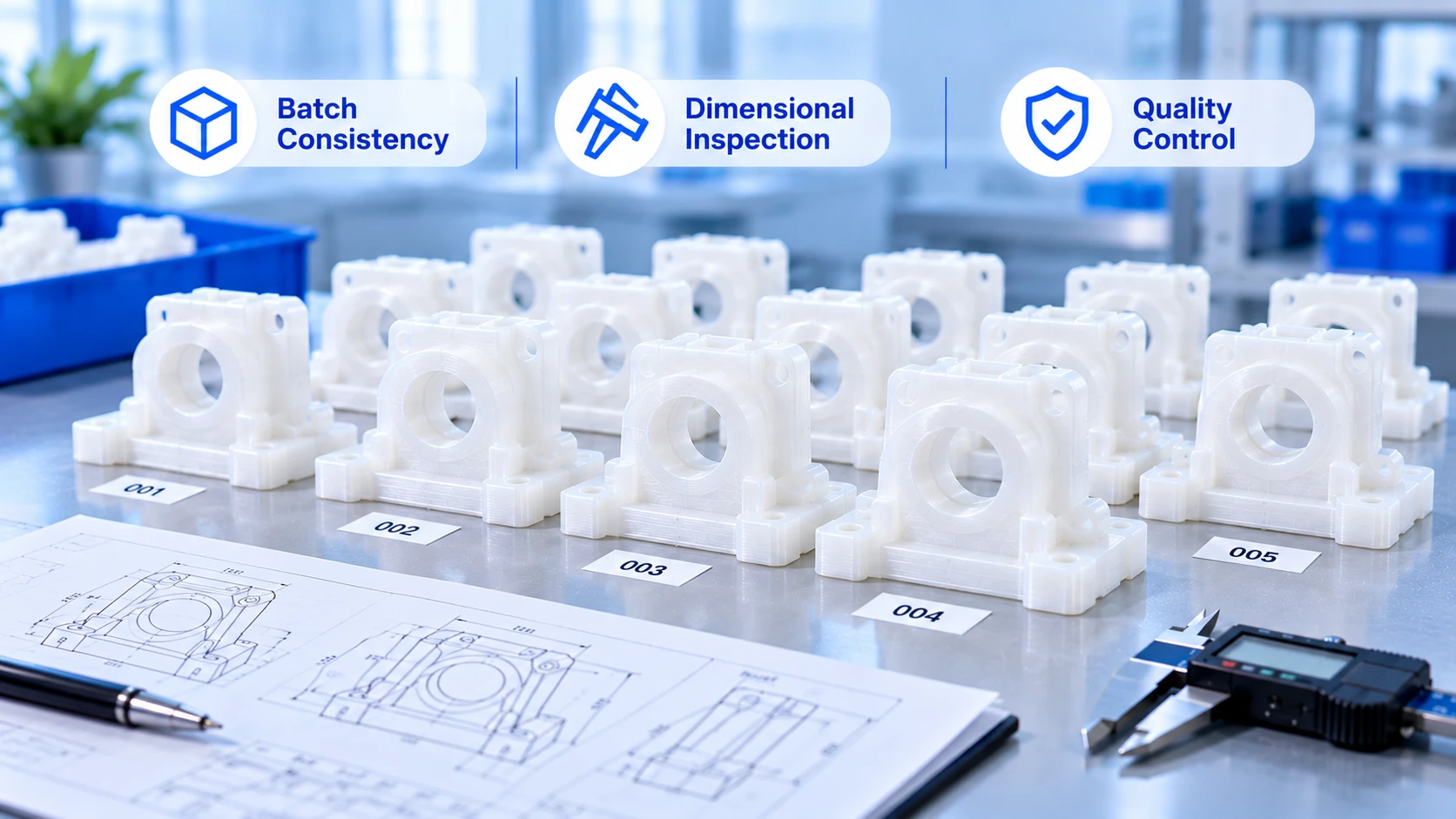
5. Batch Consistency Testing
One spool printing successfully does not guarantee the same performance from later batches. For projects involving continuous purchasing or repeated production, batch consistency directly affects process stability.
Check whether the supplier has per-batch inspection records, and whether they check the following:
- Filament diameter and its tolerance.
- Appearance and filament condition.
- Key performance indicators.
- Test results from different batches.
Since dimensional stability and interlayer bonding strongly affect product quality, these properties should also be included in batch verification rather than only checking filament diameter.
How to read a modified PP filament test report?
When you receive a test report, don’t just look at the final numbers or conclusions. Confirm at least the following four items.
Testing Standards
Check whether the report specifies the test method or reference standard. Different methods may use different sample sizes, loading modes, and calculation approaches, so results are not always directly comparable.
Test Samples
Confirm whether the test object was an injection-molded specimen, a raw-material plaque, or an actual FDM printed part.
For 3D printing filament, data from actual printed samples usually reflects real-world use better, because print orientation, interlayer bonding, and process conditions all affect final performance.
Testing Conditions
Check whether the report states temperature, humidity, print parameters, sample rest time, and other relevant conditions. Without this information, it is hard to judge whether results are reproducible or applicable to your project.
Failure Location and Mode
For mechanical and fatigue tests, beyond the final values, look at where the sample broke.
Cracks propagating between print layers may indicate interlayer bonding issues; breakage through the material body requires further judgment combining material properties and structural design. Failure location helps analysis, but alone it cannot prove whether a given property is good or bad.
A report worth referencing should let readers understand the test object, method, conditions, and results — not just present an isolated number.
Final step: validate with your own printed parts
Test reports are for initial screening; actual suitability still needs to be validated with the target part.
We recommend testing with real product structures whenever possible:
- For assemblies, check dimensions and gaps with mating parts.
- For snap-fits or living hinges, open and close repeatedly as in actual use.
- For parts that will touch water or chemical media, test under the expected exposure conditions.
- For large-format prints, check the bottom surface, corners, and critical dimensions.
- For continuous purchasing, record print parameters and test results across batches.
Keep test conditions consistent across validations, and record print settings, sample dimensions, test procedures, and failures. Accumulated data make it easier to compare materials and suppliers and provide a basis for future purchasing.
Summary
Whether a modified PP filament suits an application depends on the modification goals, test data, and actual print performance combined.
- First understand exactly what the material improves, then choose the corresponding tests.
- Shrinkage and warpage, interlayer strength, chemical resistance, fatigue, and batch consistency are the five core test categories.
- When reading a test report, consider the standard, samples, test conditions, and failure location together.
- Prototype with actual parts to simulate the real use environment; do not rely entirely on generic test specimens.
- Accumulate data with consistent test methods so that batches and suppliers can be compared reliably.
POLIVE PPpro™ is developed for FDM 3D printing applications. When evaluating the material, combine the product datasheet, relevant test conditions, and validation with your actual parts to judge its suitability for the target application.
Related Reading
- What is Modified PP? What Exactly Does POLIVE PPpro™ Change?
- How Chemical-Resistant Is PP? Understanding the Chemical Resistance of PP 3D Printed Parts
- Can PP Make Living Hinges? Printing One-Piece Living Hinges with POLIVE PPpro™
- How to Choose 3D Printing Materials? Understanding Key Indicators on the Spec Sheet
What Should You Ask First When Judging a Modified PP Filament?
First, find out what was actually modified: lower shrinkage, better first-layer adhesion, or stronger interlayer bonding. These are three different problems, and a vague claim of "better performance" says nothing.
Which Types of Tests Should You Look For When Buying?
Focus on shrinkage and warping, first-layer adhesion, interlayer bonding, dimensional stability, and tests on real parts. Look at the test conditions and the printed samples, not just the headline numbers.
How Should You Read a Test Report?
Check whether the machine, environment, model size and parameters are fully documented and whether the test can be reproduced. A report that only shows attractive sample parts without stating the conditions is of limited value.
Why Must You Run Your Own Print as the Final Step?
Every machine, build plate and environment is different, so in the end you need to print a test part with a large flat base and thin walls on your own equipment. PPpro™'s open printing setup states its conditions explicitly: no heated bed, no enclosure, cooling in an air-conditioned room, and PPLOCK26811 with a brim.