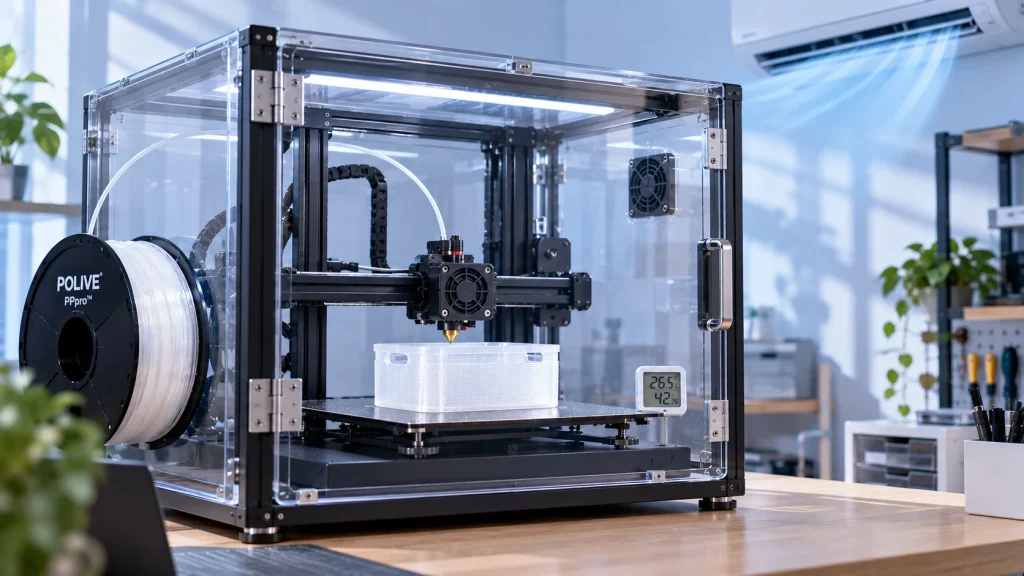
Does PP Printing Require an Enclosure? The Impact of Ambient Temperature on Printing
No. PP releases a lot of heat as it cools, and a sealed chamber traps it; an open machine in an air-conditioned room is more stable.
PP 3D Printingdoes not strictly require an enclosure. However, when the ambient temperature is low, the printer is exposed to direct drafts, or large parts are being printed, an enclosure can help reduce ambient temperature fluctuations, thereby improving warping and uneven cooling during printing.
Whether an enclosure is needed mainly depends on yourprinting environment, part size, and requirements for print stability, rather than any hard rule imposed by the PP material itself.
For POLIVE PPproâ¢, an enclosure is better suited as an auxiliary measure to improve thermal stability in complex printing environments, rather than equipment that must be used for every printing task.
Which Aspects of PP Printing Does Ambient Temperature Affect?
PP is a semi-crystalline material that undergoes some shrinkage during cooling and crystallization, so temperature differences and cooling rates during printing affect the final print performance.
Environmental conditions mainly affect PP printing in the following ways.
First-layer adhesion
If freshly extruded material is directly blown by cold air, it cools and shrinks faster, increasing the risk of first-layer edge lifting.
Therefore, if the printer happens to be near an air-conditioner outlet, even if the overall room temperature is not low, local airflow can still affect first-layer stability.
Interlayer bonding
After each layer of molten material is deposited, it needs to bond with the next layer while still at a certain temperature.
If the ambient temperature is too low, the material cools faster and the time newly deposited material stays at a higher temperature is shortened, which may affect interlayer bondingâespecially on larger parts or parts with structural-strength requirements.
Overall deformation
For large parts, the differences in cooling rates across regions are more pronounced.
When there are large temperature differences between different locations of the part, overall bending or corner lifting may occur.
In actual printing environments, there is another often-overlooked factor:
Draft.
Air-conditioner outlets, open windows, or even equipment fans facing the printing area can all create local airflow.
In some cases, reducing the impact of direct drafts is more effective than simply raising the ambient temperature.
When Is an Enclosure Recommended?
You can consider using an enclosure in the following situations:
- Ambient temperature below about 20°C, or seasonal changes cause large ambient temperature fluctuations;
- Printing large parts with a large base area;
- Continuous or batch printing;
- forinterlayer strength or dimensional stabilityfunctional parts with higher requirements;
- The printer cannot avoid airflow sources such as air-conditioner outlets or vents.
The main role of an enclosure is to reduce the direct impact of external temperature changes and airflow on the printing area, making the environment around the part more stable.
When Can You Skip the Enclosure?
If your printing environment is relatively stable, you can usually try printing without an enclosure first.
For example:
- The room temperature is relatively stable, at about 20â28°C;
- There is no obvious direct draft around the printer;
- The printed item is a small test part;
- After using a suitable PP plate or PP film and combining it with a Brim, warping is already under control.
If you can already print stably under these conditions, adding a dedicated enclosure just for PP printing may not bring obvious additional benefits.
When Only Draft Protection Is Needed, a Full Enclosure Is Not Necessary
If the problem mainly comes fromdirect drafts from air conditioners, windows, or fans, a full enclosure is not necessarily required.
Sometimes, a simple draft shield can reduce the impact of airflow on the printing area.
For example:
- Acrylic protective cover;
- Simple transparent barrier;
- Barrier made of insulation board;
- Other structures that can reduce direct airflow.
This approach is especially suitable when the room temperature itself is normal but the printer happens to be near an air source.
In other words, when facing warping problems, you can first determine:
Is the ambient temperature too low, or is there airflow directly blowing onto the print?
If the main problem is airflow, solving the airflow issue first may be more reasonable than simply raising the temperature.
What Should You Pay Attention to When Building a DIY Enclosure?
Commercial enclosures can be purchased directly, or you can build one yourself based on the printer’s dimensions.
Common DIY solutions include acrylic covers and insulation-board barriers.
However, whichever method you use, you must not only consider “heat retention” but also the printer’s own heat dissipation.
1. Pay attention to electronics cooling
Do not completely enclose heat-dissipating electronics such as the power supply and mainboard in a high-temperature environment.
If the printer structure allows, you can handle this through ventilation, exhaust, or placing some electronic components outside the sealed area.
2. Monitor the temperature inside the enclosure
You can place a thermometer inside the enclosure to observe the actual ambient temperature.
This way you can know what temperature the printing area actually reaches during printing, rather than judging solely based on the indoor temperature.
3. Pay attention to fire safety and ventilation
Do not place flammable items such as paper or alcohol inside the enclosure.
At the same time, you should be able to observe the printer’s operating status during printing, so that any abnormality can be addressed promptly.
4. Be careful of high temperatures when removing prints
If the temperature inside the enclosure is high, be aware of the risk of burns when removing prints.
You can wait for the printer and the print to cool down sufficiently before operating, and especially avoid directly reaching your hand into high-temperature areas just to remove the print quickly.
Is an Enclosure Definitely More Effective Than Raising the Heated-Bed Temperature?
Not necessarily.
The heated bed mainly affects the temperature of the bottom region of the print, while the enclosure mainly improvesthe ambient temperature and airflow stability around the entire printing area.
Therefore, the solutions corresponding to different problems also differ.
For example:
- If the main problem ispoor first-layer adhesion, you should first check the plate material, plate cleanliness, and heated-bed temperature;
- If the main problem isdirect drafts from air conditioners or fans, a draft shield may be more effective than raising the temperature;
- If it isuneven cooling across different regions of large parts, improving the surrounding ambient temperature may be more helpful;
- If the entire room temperature is low, you may need to consider both the heated-bed temperature and the ambient temperature.
So, rather than adding an enclosure directly when warping occurs, it is better to first determine where the problem actually comes from.
How to Determine Whether You Really Need an Enclosure?
You can start by checking the printing environment:
1. Is the room temperature stable?
Observe whether the indoor temperature changes significantly during printing.
2. Is there obvious airflow?
Check whether the air conditioner, windows, fans, and other ventilation equipment are directly facing the printer.
3. How large is the part?
Small test parts are usually easier to control than large parts.
4. Where does warping occur?
If it mainly occurs on the windward side or edges exposed to airflow, you need to focus on checking the airflow impact.
5. Is the interlayer bonding stable?
If the part shows obvious interlayer bonding problems, you can further check the ambient temperature, nozzle temperature, print speed, and cooling strategy.
6. Is the first layer itself stable?
If the first layer does not adhere well to the plate, then simply raising the enclosure temperature cannot solve all problems.
Summary
PP 3D Printingdoes not mandatorily require an enclosure, but in cases of low ambient temperature, obvious airflow, or large-format printing, an enclosure can help improve the thermal stability of the printing area.
A few key points to remember:
- Low ambient temperature may increase cooling and shrinkage problems during PP printing.
- Direct drafts from air conditioners, windows, and fans are sometimes more worthy of attention than the room temperature itself.
- Large parts are usually more susceptible to uneven cooling than small test parts.
- If the main problem is direct drafts, a simple draft shield may already be sufficient.
- An enclosure can improve the environmental stability of the printing area, but not all PP printing requires one.
- When using an enclosure, you need to consider electronics cooling, internal temperature, fire safety, and ventilation at the same time.
- When warping occurs, you should first determine whether it is caused by ambient temperature, airflow, heated bed, plate adhesion, or other print parameters.
For POLIVE PPpro™, with suitable print parameters and a stable room-temperature environment, you can judge based on actual print results whether an enclosure is needed additionally. For poor environmental conditions or large functional parts, an enclosure can serve as an auxiliary solution to improve thermal environmental stability.
打 PP 一定要把机器封起来吗?
不需要。我们实操就是不封箱、也不加热床:PP 冷却要吸收并散掉大量热,密封仓把热量困住,反而不利于定型;空调房里开放机架更快。
环境温度低、有穿堂风怎么办?
优先把机器放到温度稳定的空调房、避开风口和阳光直晒,这属于挡风而不是全封。真要挡风,局部挡板就够,不必做完整密封仓。
为什么开门开盖打印跟 PP 更配?
因为 PP 的冷却需求是散热而不是保温。开放环境让热量及时排走、零件同步降温,配合裙边、PPLOCK26811 和圆角设计,翘边反而比闷在仓里少。
自己搭密封仓要注意什么?
如果因为其它材料确实要用,注意电子件散热、仓内温度监测、消防与通风;但单就 PPpro™ 而言,这一步可以省掉,Bambu A1 这类开放机器直接打就行。
Related Reading
- Does PP printing need an enclosure? Open-frame printing test with POLIVE PPpro™
- Does PP Printing Need a Heat Bed? Room-Temperature Printing and Cooling Setup
- How to Prevent PP Warping? How to Choose Between Brim, Raft, and Skirt
- What Is PPpro? A Modified PP 3D Printing Filament That Needs No Heated Bed and Makes Living Hinges
- Does PP Printing Smell? Odor and Ventilation Recommendations During Printing
- Does PP Printing Need a Heat Bed? Room-Temperature Printing and Cooling Setup