What Is PP Nonwoven Fabric? And Why Masks Use It
无纺布不是”织”出来的。它是把 PP 原料加热熔融后喷成细丝、直接铺成布,纤维之间靠热粘或自身粘连固定。整个过程不用纺纱织布,所以叫非织造布。
The three-layer structure of medical masks
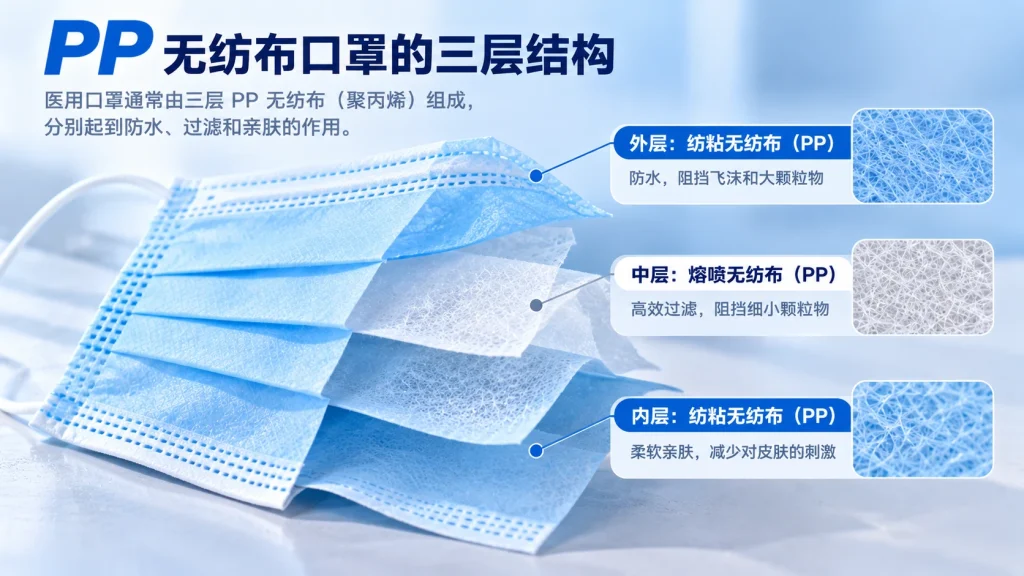
A medical mask generally has three layers: the outer and inner layers are spunbond nonwoven, and the middle is meltblown nonwoven.
Outer spunbond: blocks droplets and large-particle dust, has good strength, and does not tear easily.
Middle meltblown: the core filtration layer. Meltblown fibers are extremely fine, only one or two micrometers in diameter, forming pores that are small and dense, able to block droplets and dust. The fibers themselves are hydrophobic, so moisture does not pass through easily. The meltblown layer also undergoes electret treatment to carry an electric charge, capturing even smaller particles by electrostatic attraction.
Inner spunbond: sits against the face, wicks moisture, is skin-friendly, and channels away exhaled humidity.
Only when the three layers are stacked does the mask truly block while still letting air through.
Why PP, of all materials
PP can be made into nonwoven because of its good melt flow, strong spinnability, and its own lightness, toughness, and water resistance.
Good melt flow means it can be smoothly sprayed into filaments after melting, without breaking or clogging the nozzle. Strong spinnability means the sprayed fibers are uniform in thickness and the laid sheet has consistent pores. Lightness and toughness make the resulting nonwoven light and hard to tear. Being non-absorbent keeps its performance stable in humid environments and prevents it from gaining weight or deforming due to water absorption.
Swap in another material and these conditions are hard to satisfy at once. PET can also make nonwoven, but its melting point and processing conditions differ; some materials have poor spinnability and unstable spraying. PP’s balance across these factors is the direct reason it became the main material for masks.
Where spunbond and meltblown differ
Although both are PP nonwoven, spunbond and meltblown use different processes and serve different purposes.
Spunbond: fibers are relatively coarse, ten to tens of micrometers in diameter, with high strength and good breathability; suitable for the outer and inner layers of masks, and also commonly used in protective clothing, shopping bags, and agricultural fabric.
Meltblown: fibers are extremely fine, one or two micrometers in diameter, with small pores and high filtration efficiency, but low strength, so it breaks easily on its own. That is why it sits in the middle as the filtration layer, protected on both sides by spunbond.
The mask’s three layers are the result of these two processes working together: the outer and inner layers handle structure and comfort, while the middle handles filtration.
Electret treatment: charging the meltblown layer
The meltblown layer filters fine particles not only by small pores but also by static electricity.
Electret treatment gives the meltblown fibers a durable electric charge. Many airborne particles are smaller than the pores and cannot be stopped by physical interception alone, but charged fibers capture them via static electricity. This is why meltblown fabric must go through the electret process.
The charge decays over time, so masks have a shelf life, and storage conditions also affect filtration. This is often overlooked, yet it directly determines whether a mask is still usable.
What this means for 3D printing
PP nonwoven is a processing form of PP, not something 3D printing can directly produce. FDM printing yields solid parts, not fibrous fabric.
But this knowledge is useful for those printing functional parts with PPpro: it shows that PP has a wide processing windowâinjection molding, blow molding, extrusion, and spinning are all possible. A material that covers so many forming methods demonstrates solid melt behavior and stability. PPpro’s stable FDM printing is related to this foundation.
另外,口罩这类应用也提醒一件事:PP 的”轻、韧、不吸水”,在不同形态下都是优势。无纺布靠它做过滤,3D 打印件靠它做轻量结构件,底层逻辑是一样的。
Conclusion
PP nonwoven is not woven; it is a sheet formed by melting PP and spraying it into filaments laid directly. Medical masks use it because PP has good melt flow, strong spinnability, and is light, tough, and non-absorbent, enabling both spunbond and meltblown nonwoven; the three layers work together to achieve blocking and breathability. Core filtration relies on the meltblown layer’s fine pores and electret static electricity.
所以你戴的口罩,核心材料就是经过特殊加工方式的聚丙烯纤维。它不靠一层”膜”隔离,而是靠纤维的细密和带电来过滤。
Common Questions
How is PPpro modified PP 3D printing filament related to general-purpose PP?
PPpro is a PP filament modified for FDM 3D printing. It retains PP’s light weight, chemical resistance, and repeated-flexibility nature, while optimizing print adhesion and interlayer bonding.
Is PPpro modified PP 3D printing filament difficult to print?
PP’s difficulty lies in adhesion and warping, not temperature. PPpro follows a no-heated-bed, no-enclosure, open-cover routeâeven faster in an air-conditioned roomâand prints stably with proper bed preparation.
Are PP nonwoven and 3D-printed PP filament the same material?
Both use PP as the base material, but their forms and processing are completely different. Nonwoven is a sheet of laid fibers, while 3D printing filament is solid wire formed by melt extrusion. Their material nature is connected, but they cannot replace each other.
无纺布到底是不是织出来的?
不是。它把 PP 原料熔融后喷成细丝直接铺成布,纤维靠热粘或自身粘连固定,全程不用纺纱织布,所以叫非织造布。
医用口罩的三层结构各干什么?
外层纺粘层承担机械强度和阻隔,中层熔喷层靠超细纤维与驻极处理承担过滤,内层贴肤层吸湿。三层都是 PP,但工艺完全不同。
为什么口罩偏偏选 PP?
化学惰性、低吸水、易熔融加工成超细纤维、成本低,而且适合做驻极处理保持静电吸附,这几条叠在一起很难替代。
做口罩的 PP 和打印线材差别在哪?
材料同族,但形态和工艺完全不同:无纺布是纤维网,线材是连续挤出的圆丝,对熔体强度和直径稳定性的要求不一样,不能互相替代使用。
Related Reading
·What Is PP? Understanding Polypropylene at a Glance
·Does PP Absorb Water? Moisture Absorption of PP Filament and Prints
·Can 3D Printing Make Medical and Rehabilitation Aid Prototypes? Exploring PP Applications
·What Is PPpro? A Modified PP 3D Printing Filament That Needs No Heated Bed and Makes Living Hinges