The Core Differences Between PP and PC
PP and PC are both plastics, but their origins and properties are completely different. Choose the wrong material and you waste money at best, or end up with parts that fail at worst. Below, we break down the differences across five dimensions.
Raw material: one contains bisphenol A, the other does not
PP is polymerized from propylene; its backbone contains only carbon and hydrogen, with no other elements in the molecular chain.
PC (polycarbonate) is made through a reaction involving bisphenol A, so its structure contains bisphenol A.
This is the most watched difference between the two. Many people choose PP first out of concern about bisphenol Aâespecially in applications that touch food or baby products, where this concern is more common.
需要说明的是,PC 里的双酚 A 是否迁移、迁移多少,跟具体牌号、使用条件和法规要求有关,不能一概而论说”PC 一定不安全”。但对普通消费者来说,PP 不含双酚 A 结构,心理门槛低,这是它的一层优势。
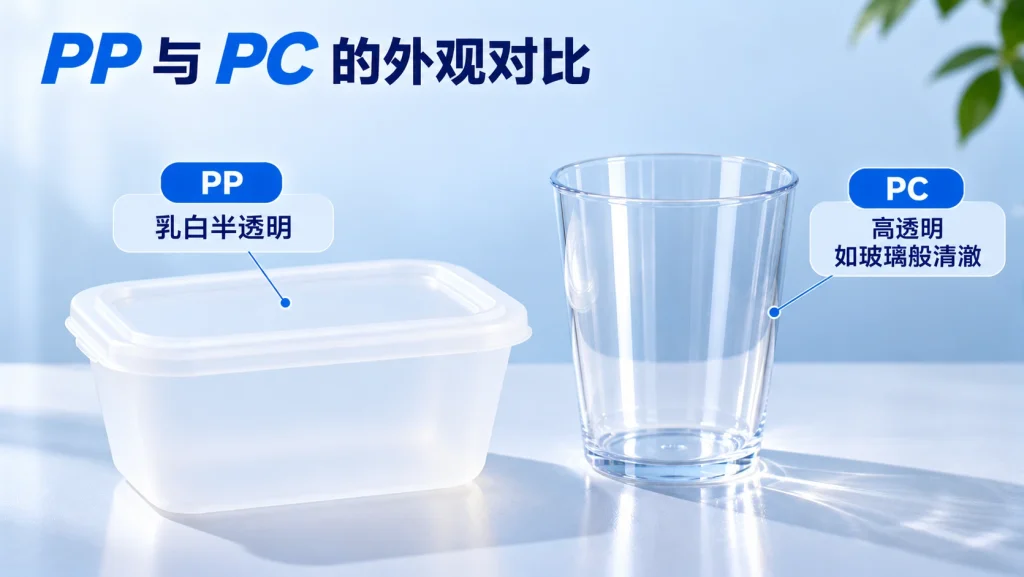
Appearance: PC is glass-like, PP is milky white
PC has high transparency and looks like glass, making it suitable for parts that require clarity, such as lampshades and eyeglass lenses.
PP is usually milky white or semi-transparent, with less clarity than PC. Even as a thin wall, it is hard to achieve the crystal-clear effect of PC.
This is very practical when selecting materials: if your part needs to show its internal structure or require light transmission, PP will likely fall short, and you should consider transparent materials like PC or PETG.
Performance: PC has stronger impact resistance, PP is lighter and more chemical-resistant
Impact resistance: PC far surpasses PP. PC does not shatter when dropped and resists scratches, making it a common material for bulletproof glass and safety helmets. PP is stiffer but more brittle, and tends to become brittle at low temperatures.
Heat-resistant: PC’s long-term service temperature is about 120°C, and PP’s heat resistance is about 100 to 120°C. The two are close in heat resistance; PP used above 100°C long-term needs more validation.
Density: PP is about 0.90 g/cm³ and PC about 1.2 g/cm³. At the same volume, PP is noticeably lighter, which is its foundation for lightweight parts.
Chemical resistance: PP resists most acids, alkalis, and common solvents, while PC has poorer tolerance to strong alkalis and some solvents. This difference is significantâparts that contact chemicals deserve special attention.
Price: PC is noticeably more expensive, while PP is much cheaperâwhich is why PP is widely used for disposable consumables and everyday items.
Applications: each plays to its strengths
PC is commonly found in eyeglass lenses, lampshades, water cups, enclosures, and safety helmets. Its strengths are transparency, impact resistance, and scratch resistance.
PP is commonly found in microwave meal boxes, bottle caps, medical consumables, automotive bumpers, and storage bins. Its strengths are light weight, chemical resistance, flex resistance, and low cost.
Neither is simply âbetterââeach plays to its own strengths. Use PP for a lampshade and it lacks clarity; use PC for a microwave box and both cost and bisphenol-A concerns arise.
How to choose: ask about the application first, then the material
If you care about bisphenol A and need microwave use, choose PP.
If you need transparency, durability, and have the budget, choose PC.
If you need light weight, chemical resistance, and repeated flexing, choose PP.
If you need impact resistance, scratch resistance, and long-term outdoor use, choose PC.
If you are unsure, first clarify three questions: what the part contacts, what it must withstand, and what its appearance requires. Once these three are answered, the material is essentially decided.
What these differences mean for 3D printing
Both PP and PC can be made into 3D printing filament, but the printing difficulty and final results differ considerably.
PC prints at a high temperature, usually above 260°C, warps easily, and demands more from equipment and environment. PP prints at a lower temperature, but traditional PP has poor adhesion and severe warping, and is also notoriously difficult to print.
POLIVE PPpro modified PP 3D printing filament solves exactly PP’s printing problems: it retains PP’s light weight, chemical resistance, and repeated-flexibility nature, optimizes print adhesion and interlayer bonding, and follows a no-heated-bed, no-enclosure, open-cover printing approach.
If your part relies on PP’s strengthsâlight weight, chemical resistance, living hinges, and bisphenol-A-freeâthen PPpro is the right direction. If you need high transparency or extreme impact resistance, PC or another material is more suitable.
Conclusion
The core differences between PP and PC lie in four layersâraw material, appearance, performance, and application: PP contains only carbon and hydrogen, is bisphenol-A-free, tends to be milky-white and semi-transparent, light, chemical-resistant, and cheap; PC contains bisphenol-A structure, is highly transparent, strongly impact-resistant, scratch-resistant, and expensive.
Material selection has no absolute right or wrongâit depends on which strengths the part needs. For 3D printing, PPpro brings PP’s strengths into FDM printing, but be clear that it cannot achieve high transparency, nor is it the strongest impact-resistant option.
Common Questions
Which is safer, PP or PC?
You cannot simply say which is safer. PP has no bisphenol-A structure, lowering the psychological barrier; PC contains bisphenol A, but the migration amount depends on the grade, usage conditions, and regulations. For food contact or baby products, most people prefer PP. Whether it is actually compliant depends on product certification and applicable regulations.
Which is more heat-resistant, PP or PC?
The gap is small. PC’s long-term service temperature is about 120°C, and PP’s is about 100 to 120°C. PP used above 100°C long-term needs more validation. Brief contact with boiling water and long-term exposure to high temperature are two different things.
For 3D printing, PP or PC?
It depends on the part’s needs. For light weight, chemical resistance, living hinges, and bisphenol-A-free, choose PPpro. For high transparency and extreme impact resistance, choose PC or another material. PC prints at high temperatures and is difficult; PPpro follows a room-temperature-bed, enclosure-free route, with a lower barrier to entry.
PP 和 PC 最源头的不同是什么?
原料路线不同:PC 由含双酚 A 的单体制得,PP 由丙烯聚合、只含碳氢。组成差异决定了后续安全性和性能的分叉。
外观上怎么一眼分辨?
PC 像玻璃一样透明、刚性感强;PP 偏乳白半透明、半哑光,弯折时发白但不容易断。
性能上各自强在哪?
PC 抗冲击和透明性突出,PP 更轻、耐化学性更好、抗疲劳、能做活铰链。选料先问用途,再谈材料。
3D 打印里这个差别有什么用?
需要透明或高刚性外观件时 PC 更合适;需要耐化学、反复弯折、轻量化的功能件时 PP 更合适。PPpro™ 还把打印门槛降到不加热床、不封箱。
Related Reading
·What Is PP? Understanding Polypropylene at a Glance
·PP’s Molecular Structure: Why It Consists Only of Carbon and Hydrogen
·Why PP Is One of the Lowest-Density Commodity Plastics
·What Is PPpro? A Modified PP 3D Printing Filament That Needs No Heated Bed and Makes Living Hinges