PP vs PS: What’s the Difference
PS (polystyrene) and PP are often compared because both are heavily used in disposable tableware and outer packaging.
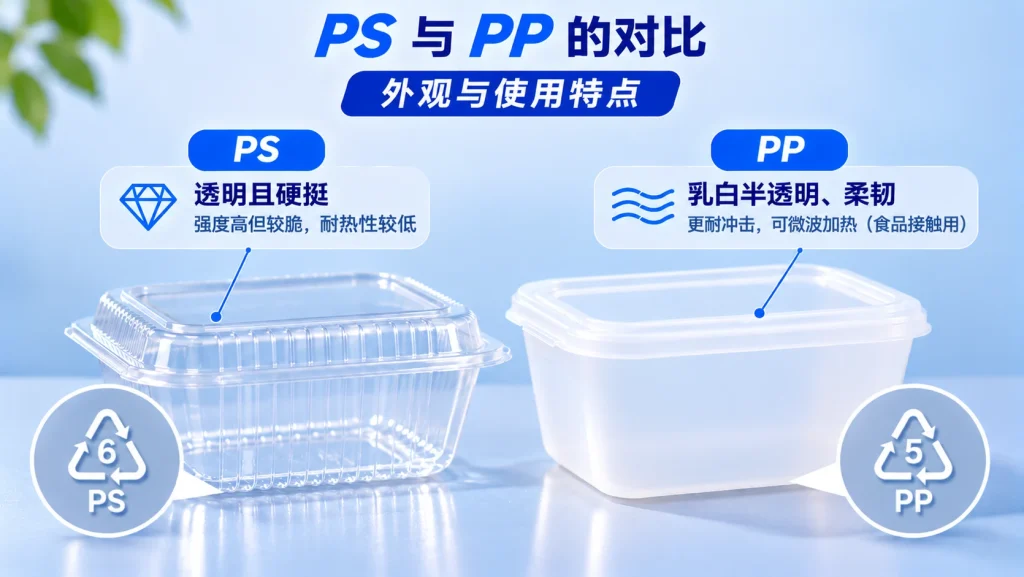
In recycling codes, PS is number 6 and PP is number 5.
The differences mainly show up in four areas: transparency, toughness, heat resistance, and oil/alcohol resistance.
Transparency: PS is clear, PP is translucent
PS has high transparency and good rigidity, so it is commonly used for clear food containers and transparent cup lids.
PP is translucent and less crystal-clear than PS. This relates to molecular structure: PP’s methyl side branches prevent the molecules from packing neatly, causing more light scattering.
For a transparent look, PS has the edge; for overall toughness and heat resistance, PP is the better fit.
Toughness: PS is brittle, PP resists bending
PS 很脆,一掰就裂。透明 PS 餐盒捏一下会”咔”地裂开,这是它最明显的短板。
PP is soft yet tough; a drop usually only deforms it rather than breaking it. It can be bent repeatedly, which is exactly why PP can make living hinges.
This difference matters in real transport and use. PS products fear bumps; PP products survive drops.
Heat resistance: PS about 70–80°C, PP above 100°C
PS has poor heat resistance, with a long-term service temperature of about 70–80°C.
PP withstands heat above 100°C, so microwave containers are essentially always made of PP.
Foamed PS is the common foam plastic used for instant-noodle bowls, cushioning packaging, and disposable coffee cups. Key point: foamed PS deforms easily when heated and is not suitable for microwave heating.
This is a hard boundary in material selection. For microwave use, PS is ruled out outright—only PP qualifies.
Oil & alcohol resistance: PS weaker, PP more stable
PS does not resist oil and alcohol well; be cautious when using it for oily or alcoholic foods.
PP resists most acids, alkalis, and common solvents, and its oil resistance is also better, making it more reliable in food-contact scenarios.
If a part must contact oily foods or alcoholic ingredients, PP is the safer choice.
How to tell them apart by appearance: crack sound vs deformation
PS 做的透明盒又硬又脆,捏一下会”咔”地裂开。
PP products are soft yet tough; a drop usually only deforms them.
Even without checking the label, you can roughly tell by feel: hard, brittle, and transparent means PS; tough, translucent, and drop-proof means PP.
What these differences mean for 3D printing
Both PS and PP can be made into 3D printing filaments, but the situation differs.
In FDM, PS commonly appears as HIPS (high-impact polystyrene), often used as dissolvable support material because it dissolves in limonene. Pure PS is prone to warping and poor interlayer bonding when printed, so it is not a mainstream structural material.
PP has traditionally also been hard to print, with poor adhesion and severe warping. POLIVE PPpro™, a modified PP 3D printing filament, solves exactly this problem: it keeps PP’s heat resistance, chemical resistance, and ability to bend repeatedly, while optimizing print adhesion and interlayer bonding, following a no-heated-bed, no-enclosure, open-cover printing approach.
If your part relies on PP’s strengths—heat resistance, bend resistance, contact with hot food, and oil resistance—then PPpro™ is the right direction. If you need a highly transparent look, PS or PETG is more suitable; PP cannot achieve that crystal clarity.
Conclusion
The core differences between PS and PP lie in transparency, toughness, heat resistance, and oil/alcohol resistance: PS is transparent, rigid but brittle, heat-resistant to about 70–80°C, and weak against oil and alcohol; PP is translucent, flexible and bend-resistant, heat-resistant above 100°C, and oil- and chemical-resistant.
For hot food or microwave use, choose PP; for room-temperature packaging that also needs transparency, PS is cheaper.
Common Questions
Which is more heat-resistant, PP or PS?
PP is clearly more heat-resistant. PP reaches above 100°C, while PS has a long-term use temperature of about 70–80°C. Foamed PS deforms easily when heated and is unsuitable for microwave use, so microwave containers are essentially always made of PP.
Which is safer, PP or PS?
You cannot simply say which is safer; it depends on the use. Both are common food-contact materials, and compliant products are bound by relevant standards. The key is the scenario: for microwaves and hot food, PP is more suitable; PS fits room-temperature packaging, and foamed PS is unsuitable for heating. Whether a product is compliant depends on its certification and applicable regulations.
For 3D printing, PP or PS?
It depends on the part’s needs. For heat resistance, bend resistance, and hot-food contact, choose PPpro™. HIPS is more often used as dissolvable support material, not as a primary structural material. For a highly transparent look that PP cannot achieve, consider PS, PETG, or another transparent material.
PP 和 PS 一次性餐具上怎么分辨?
PS 透明、脆,弯折容易发白开裂甚至有脆响;PP 半透明乳白、韧,弯折会变形但不断。上手掰一下边角最直观。
韧性差别会带来什么使用差别?
PS 怕摔、怕反复弯折,PP 抗冲击和抗疲劳好得多,所以卡扣、翻盖、活铰链这类结构只能用后者这类韧性材料。
耐油和耐酒精表现呢?
PP 化学惰性强,对油脂和酒精更稳定;PS 在这类介质下更容易出现应力开裂或表面失光。装含油食物时这点尤其实际。
打印选料上怎么用这个结论?
需要透明展示件可以找 PS 类材料,功能件、容器、反复受力件更适合 PP;PPpro™ 还能不加热床、不封箱直接打。
Related Reading
·PP vs PET: Why Drink Bottles and Food Containers Use Different Plastics
·PP vs PE: How to Tell Them Apart at a Glance
·PP vs PVC: What’s the Difference
·What Is PPpro? A Modified PP 3D Printing Filament That Needs No Heated Bed and Makes Living Hinges