How Much Force Can PP Printed Parts Withstand?
When discussing the mechanical properties of 3D printing materials, many people first focus on:
“What is the tensile strength? How many kilograms can it withstand?”
But for real parts, strength is not the only metric to consider.
PP is not a material known for high rigidity and high strength. Compared with materials such as PC and PA (nylon), PP usually does not have an advantage in tensile strength and flexural rigidity.
But PP has a very important characteristic:
good toughness, impact resistance, and good fatigue resistance.
Therefore, for parts that require repeated bending, impact, or allow some deformation, PP’s material characteristics may matter more than simply pursuing high rigidity.
PP’s Core Mechanical Characteristics: Toughness and Fatigue Resistance
PP is a plastic with good toughness.
Compared with some more brittle materials, when subjected to impact or large deformation, PP can absorb part of the energy through bending and plastic deformation, rather than immediately undergoing brittle fracture.
Simply put:
Rigid materials emphasize “hardness,” while PP emphasizes “toughness.”
This makes PP suitable for applications that need to withstand:
- Repeated bending
- collisions and impacts
- compression
- cyclic loads
- a certain degree of deformation
functional parts.
Of course, how much force an actual part can withstand also needs to be judged by combining the specific material, print orientation, wall thickness, infill density, structural design, and loading method.
Why Doesn’t PP Suddenly Shatter Like PLA?
PLA usually has high rigidity, but under certain impact or rapid-deformation conditions, it may also exhibit noticeable brittleness.
PP, by contrast, usually has higher ductility.
When subjected to impact, a PP part may first bend or deform, dissipating part of the energy through material deformation.
This is also why, in somedrop-resistant and impact-resistant applications, flexibility and toughness may matter more than simple high hardness.
However, the fracture behavior of 3D printed parts depends not only on the material itself.
Interlayer bonding, print orientation, and structural design are equally important.
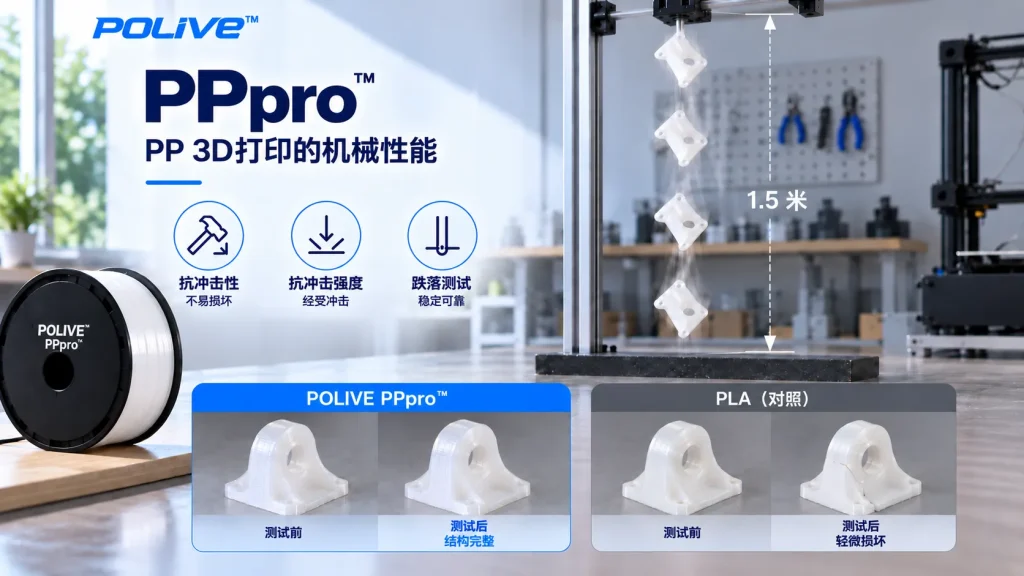
PPpro™ Drop Test
To observe how PPpro™ printed parts perform under real impact conditions, a simple drop test can be conducted.
For example, drop PPpro™ and PLA test specimens of the same size and printing parameters freely from a fixed height, then observe:
- whether cracks appear
- whether fracture occurs
- whether obvious deformation appears
- whether interlayer separation appears
- the structural integrity after the drop
If the test conditions are consistent, a drop test can intuitively show the performance of different materials under impact.
In POLIVE’s actual tests, PPpro™ printed parts maintained their overall structure after dropping from desktop height, with no obvious shattering.
Note that drop results are affected by factors such as part shape, weight, print orientation, infill density, drop height, and the material of the contact surface, so it cannot be simply assumed that all PPpro™ printed parts will never break under any drop condition.
Which Functional Parts Is PP Suitable For?
PP’s mechanical characteristics determine that it is more suitable for certaintoughness-firstapplications.
For example:
Children’s products
Some children’s products need to withstand repeated collisions and drops.
In such applications, the material’s toughness and impact resistance may matter more than simply pursuing high rigidity.
Pet products
Pet products may experience:
- biting
- pulling
- drops
- Repeated bending
PP’s flexibility and fatigue resistance can provide a material option for such parts.
Flexible structural parts
PP is also suitable for:
- flexible connections
- Snaps
- elastic structures
- Folding structure
- Living hinge
Especially for structures requiring repeated motion, PP’s fatigue resistance has practical value.
What Scenarios Is PP Not Suitable For?
Understanding a material’s advantages also means knowing its boundaries.
If a part mainly requires:
- extremely high rigidity
- high flexural modulus
- stable dimensions under high temperature
- withstanding very high static loads
then PC, PA, or other engineering materials may be more suitable for the specific application.
PP is not a material with the “highest strength.”
It is more suitable for leveraging:
toughness + flexibility + impact resistance + fatigue resistance
these characteristics.
The Strength of 3D Printed Parts Cannot Be Judged by Material Data Alone
This is a very important point when choosing 3D printing materials.
Even with the same PP filament, printed parts may show significant differences due to different parameters.
Factors affecting the mechanical properties of 3D printed parts include:
material → printing temperature → interlayer bonding → print orientation → wall thickness → infill density → model structure → loading direction
For example, a part whose tensile direction is poorly aligned with the print layer direction may fail prematurely due to insufficient interlayer bonding, even if the material itself has good toughness.
Therefore, in actual structural design, you should treatmaterial performance and print structure as a whole.
Where Does PPpro™’s Mechanical Advantage Lie?
PPpro™’s goal is not to turn PP into a “super high-strength material.”
It focuses more on enabling some of PP’s practical material characteristics to truly enter FDM 3D printing.
including:
- low density
- flexibility
- impact resistance
- fatigure durability
- good deformation recovery
These characteristics make PPpro™ more suitable for some functional parts that require toughness and repeated use.
Conclusion
PP is not a material known for the highest strength and highest rigidity.
What is truly valuable about it is:
toughness + flexibility + impact resistance + fatigue resistance.
For parts that require repeated bending, frequent impacts, or allow a certain degree of deformation, these characteristics may matter more than simply pursuing high rigidity.
For structural parts requiring extremely high rigidity or high load capacity, other engineering materials such as PC and PA should be considered based on the specific application.
Only by correctly understanding the material’s characteristics and then designing the structure according to the actual loading conditions can you truly leverage the advantages of PP 3D printing.
PP 件的承载能力该怎么评估?
不能只看材料数据。PP 的特点是韧性优先:受力会变形卸能,不会像 PLA 那样突然脆断,抗冲击和反复弯折表现好,但刚性不是它的强项。
3D 打印件的强度还受什么影响?
打印方向、层间结合、壁厚、填充和几何过渡,常常比材料本身影响更大。尖角和壁厚突变会制造应力集中,圆角过渡与均匀壁厚往往比换材料更管用。
哪些零件适合用 PP?
需要跌落不碎、反复弯折、卡扣与活铰链,以及儿童或宠物用品这类场景。反过来,要求高刚性、长期恒定载荷、尺寸极度稳定的结构件,不该硬选 PP。
Related Reading
·How Good Is the Surface Quality of PP Prints? A Semi-Matte Texture Test
·Can PP Make Living Hinges? Printing One-Piece Living Hinges with POLIVE PPpro™