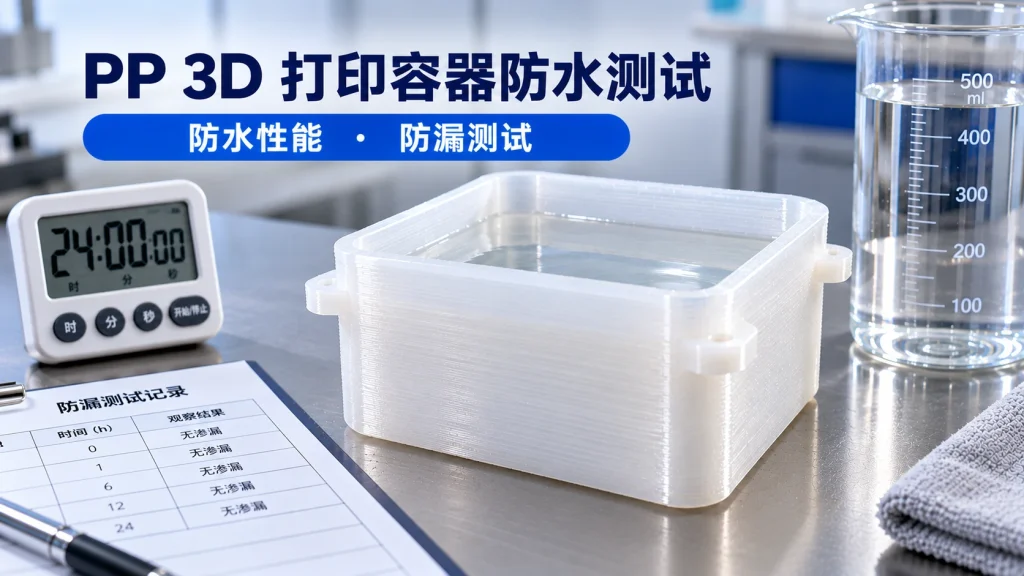
Are PP Prints Waterproof? How PP Performs in Wet and Water Environments
PP itself has very low water absorption, so its dimensional stability in humid and watery environments is generally good.
But this does not mean that all PP 3D printed parts are naturally “waterproof.”
For FDM printed parts,the water resistance of the material itself and the leak-proof performance of the finished part are two different issues.
Even if the PP material itself does not easily absorb water, if the following exist during printing:
- Micro-gaps between layers
- Under-extrusion
- Insufficient wall thickness
- Pores on top or bottom surfaces
- Local structural defects
water can still seep out through these channels.
Therefore, it can be simply understood as:
PP material itself has good water resistance, while whether a PP printed part is truly waterproof depends on the material, printing process and part structure.
Material level: What is the relationship between PP and water?
PP has very low water absorption.
This means that in general humid environments, PP printed parts usually do not show significant dimensional changes from absorbing large amounts of water, as some more hygroscopic materials might.
For applications that need to contact water, this is an important advantage.
For example:
- Water containers
- floats
- Bathroom Fittings
- Water-contact structural parts
- Functional parts in humid environments
However, it is necessary to distinguish betweenLow water absorptioncompared withfinished-part leak prevention.
Low water absorption means PP itself does not easily absorb moisture; but whether a 3D-printed container leaks also depends on whether its printed structure is dense enough.
Therefore, material data cannot directly replace the waterproof testing of the finished product.
What happens if PP is immersed in water for a long time?
PP has good resistance to water; long-term contact with water usually does not cause significant material structure changes from water absorption, as can happen with some hydrolytically prone materials.
But the specific performance still depends on:
- Water temperature
- Soaking time
- Material formulation
- Whether other chemical media are present
- The structure of the printed part itself
If the actual application involves hot water, cleaning agents or other liquids, testing should be performed against the actual use conditions, rather than judging solely based on PPâs general water resistance.
For example,100°C boiling water environmentalready constitutes a more severe temperature condition and should be verified separately.
Why do PP printed parts leak?
Water moves along the path of least resistance within the printed part.
For FDM printed parts, common potential leakage locations include:
Inter-layer bonding zones
If adjacent printed layers do not form sufficient fusion, tiny channels may be left behind.
These channels may not be easy to spot with the naked eye, but can leak under sustained water pressure.
Corners and local structures
At sharp corners, thin-wall regions or locations with large extrusion variations, local material shortage may occur.
Top and bottom surfaces
If the top or bottom layers contain pores, they can also become paths for water to seep out.
Low-density infill structures
For container-type parts, if a low infill density is used internally, the internal structure may contain a large number of voids.
Therefore,A printed part that looks “thick-walled” does not necessarily mean the entire structure is completely dense.
Material waterproofing and part waterproofing are two different things
This is one of the most important distinctions when understanding 3D-printed waterproof performance.
It can be divided into two levels:
Material level
Focus on:
Does PP easily absorb water?
PP has very low water absorption, so it has an advantage in this regard.
Part level
Focus on:
Can water seep out through the internal channels of the printed part?
This depends on:
- Wall thickness
- Number of wall lines
- Extrusion state
- Interlayer bonding
- Top and bottom layer thickness
- Print orientation
- Part structure
Therefore, a PP printed part can achieve very good leak resistance, but it cannot be considered to have complete waterproof capability simply because it uses PP.
How to make PP printed parts less likely to leak?
1. Prioritize increasing the number of wall lines
For container-type parts, increasing the outer walls is usually more direct than simply raising the internal infill density.
Because it is the continuous outer wall structure that actually provides the leak-resistant function.
Depending on actual needs, you can increase:
- Number of wall lines
- Outer wall thickness
- Top layer thickness
- Bottom layer thickness
2. Ensure sufficient extrusion and good inter-layer fusion
Under-extrusion can create gaps between adjacent lines.
Therefore, adjustments should be made according to the specific PP material:
- Nozzle temperature
- Flow rate
- Print speed
- Floor height
The goal is to allow adjacent print paths to form a sufficiently stable fusion.
But higher parameters are not always better; excessively high temperatures or over-extrusion can also bring other printing problems.
3. Optimize the container bottom and corners
For parts such as water tanks, cups and containers, unnecessary sharp corners can be reduced.
Reasonable fillet design helps reduce local stress concentration and also facilitates the formation of a more continuous print path.
4. Perform pore sealing when necessary
For parts with high leak-prevention requirements, additional surface pore sealing or coating treatment can be considered.
However, one characteristic of PP is thatsurface energy is low, ordinary coatings and adhesives may have difficulty adhering.
Therefore, if a coating is used for sealing, the following should be verified in advance:
- Adhesion of the coating to PP
- Water resistance of the coating
- Temperature resistance of the coating
- Long-term stability under actual use conditions
Do not assume that any coating can be directly used on PP.
Splash resistance and true leak-proofing are not the same standard
“Waterproof” can actually correspond to different usage requirements.
Splash resistance
For example:
- Rain
- Water droplets
- Occasional water contact
Such applications usually do not need to withstand sustained water pressure.
Holding liquid without leaking
For example:
- Water cups
- Water tanks
- Water storage containers
Such parts need to hold liquid internally for a long time, and usually require higher structural density.
Sustained water pressure
For example:
- Pipe components
- Pressurized containers
- Pump-related structures
Such applications have higher requirements for the sealing and structural strength of printed parts, and require more rigorous testing.
Therefore, before judging whether a PP printed part is “waterproof,” it is best to first clarify which category the actual application belongs to.
How to test the waterproof performance of PP printed parts?
The simplest method is to perform awater-filling test.
Step 1: Prepare the printed part
Print the complete container or actual-use part.
During testing, record:
- Material grade
- Nozzle temperature
- Floor height
- Number of wall lines
- Fill rate
- Print orientation
Step 2: Add a fixed volume of water
Fill the container with a certain amount of water and record the start time.
Step 3: Let it stand and observe
Depending on the actual application requirements, a fixed test time can be set, for example:
- 24 hours
- 48 hours
- 72 hours
Observe whether water marks appear on the outer wall, bottom and connection positions.
Step 4: Check mass change
If a more quantitative test is needed, the container or liquid can be weighed before and after the test to help determine whether slow leakage exists.
For higher-requirement applications, a sealed test under specified pressure can also be performed.
Water-contact parts can also undergo a cold-hot cycle test
If the part will experience temperature changes during actual use, a cold-hot cycle immersion test can be further performed.
For example:
Room temperature â Hot water â Cooling â Room temperature
After repeating multiple cycles, check:
- whether cracks appear
- Whether deformation occurs
- Whether leakage appears
- Whether inter-layer damage occurs
- Whether the sealing positions show problems
Temperature changes bring thermal expansion and contraction as well as internal stress, so a single static immersion test may not cover all actual usage situations.
Can PP printed parts be used directly in long-term water environments?
This needs to be judged based on the specific application.
If it is only:
- humid environments
- Occasional water contact
- Short-term immersion
- Ordinary cold-water environment
PP usually has good material adaptability.
But if it involves:
- Hot water
- Long-term water pressure
- Chemical cleaning agents
- Long-term outdoor use
- Drinking water or food contact
additional verification should be performed for the actual conditions.
Especially for food-contact and drinking-water applications,you cannot directly assume that the final 3D printed part automatically meets the corresponding regulations or safety requirements just because the base material is PP. This also involves material formulation, additives, printing equipment, nozzles, contamination control, surface condition and specific regulatory requirements.
Summary
- PP itself has very low water absorption and offers good stability in humid and general water environments.
- Material water resistance â a 3D printed part is definitely leak-proof.
- The leak-proof performance of printed parts is mainly affected by inter-layer bonding, wall thickness, number of wall lines, extrusion state and structural design.
- Increasing wall lines, ensuring sufficient extrusion, and optimizing bottom and corner structures can help improve leak resistance.
- PPâs low surface energy increases coating adhesion difficulty; pore sealing or coating should be verified in advance.
- Splash resistance, holding liquid without leaking and withstanding sustained water pressure are different levels of waterproofing requirements.
- The most reliable way to judge is toperform actual water-filling, immersion or pressure tests on the final printed part.
- If the application involves hot water, long-term water pressure, chemical media or food/drinking-water contact, verification should be performed for the specific use conditions.
PP 打印件防水吗?
材料级 PP 吸水率极低,潮湿和水环境里尺寸稳定;但零件级能不能不漏是另一回事,FDM 的层间缝隙才是关键。
为什么 PP 容器会渗水?
渗漏通常发生在层间结合区、拐角和局部结构、顶底面以及低填充区域,不是材料被水泡坏。壁厚和圆角过渡能明显减少这些薄弱点。
防溅和真正不漏是一回事吗?
不是。防溅只需要表面扛得住,长期盛液或承压要靠实液试漏。测试时按实际水位、实际时长、是否带压力来做。
怎么让涉水件更不容易漏?
增大壁厚、提高外围封闭性、避免尖角和壁厚突变、让受力方向避开层间结合面;打印时壁厚均匀、圆角过渡,也顺带减少翘边。
Related Reading
- Can 3D Printing Handle Parts That Touch Water? Tanks, Floats and Bathroom Fittings
- Can 3D printing be used for chemical vessels and piping components? Exploring corrosion-resistant parts
- Does PP Absorb Water? Moisture Absorption of PP Filament and Prints
- Why Does PP Have Good Heat Resistance?
- How Much Temperature Can PP Prints Withstand? PP’s Heat-Resistance Performance
- Which Chemicals Can PP Withstand?