Can PP 3D printed parts be used to hold hot water?
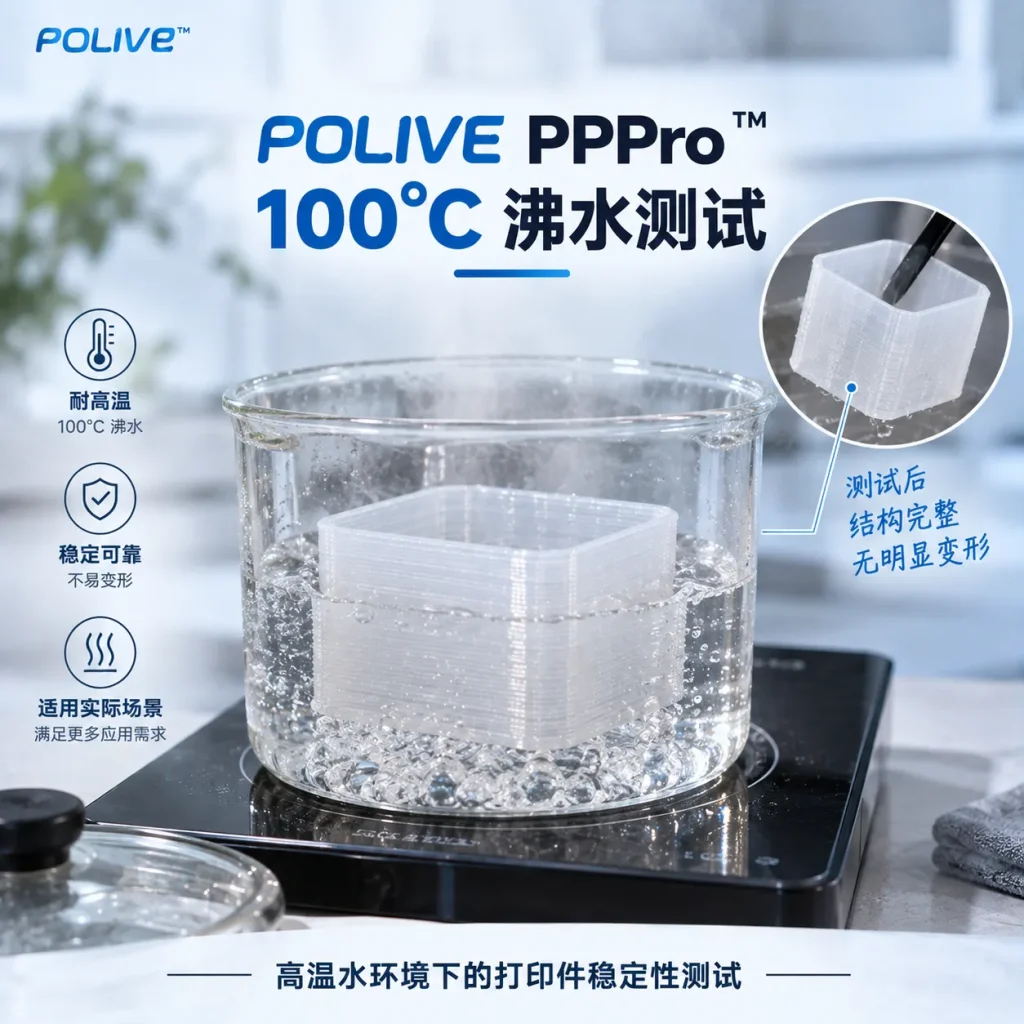
Yes. In our 100C boiling-water test PPpro parts kept their shape, making PP a practical choice for hot-water contact parts.
This is a question many people ask when trying PP 3D printing.
The answer cannot be simply summarized as “PP can withstand 100°C.”
Because for 3D printed parts,the material’s own heat resistance is only one factor. Printing temperature, part structure, wall thickness, infill density, print orientation, and actual load conditions can all affect the final part’s performance in high-temperature environments.
So,How do POLIVE PPPro™ printed parts perform when in contact with boiling water?
We conducted high-temperature water tests using actual printed parts.
Why Does PP Have Good Heat Resistance?
PP (polypropylene) is a thermoplastic polymer widely used in packaging, containers, industrial parts, and everyday products.
Compared with PLA, PP generally has better high-temperature application potential.
But a special note is needed here:
HDT (heat deflection temperature) does not equal the material’s maximum service temperature.
At the same time, the following concepts cannot be directly equated:
- glass transition temperature (Tg)
- Heat distortion temperature (HDT)
- melting temperature
- long-term service temperature
For example, a material’s HDT reaching a certain temperature does not mean that all parts printed with that material can withstand loads at that temperature long-term.
Actual performance is also affected by part design and printing process.
Therefore, for 3D printing materials, we place more emphasis on:
the performance of actual printed parts under real usage conditions.
POLIVE PPPro™ 100°C Boiling Water Test
To understand how PPPro™ printed parts perform in high-temperature water environments, we printed a test container using PPPro™ and conducted a boiling water test.
Test process
1. Print the test container
Complete the container printing using POLIVE PPPro™.
2. Add boiling water
Add approximately 100°C boiling water.
3. Observe the test status
Observe the container during contact with high-temperature water for:
- shape changes
- Size changes
- whether obvious deformation appears
- whether cracking appears
- Structural integrity
4. Repeat the test
Perform multiple cycles under the same or specified test conditions to observe performance after repeated high-temperature exposure.
Test results
Under our test conditions,POLIVE PPPro™ printed containers maintained good shape and structural integrity after repeated contact with boiling water.
Key items observed during the test include:
Shape: no obvious overall deformation observed
Structure: no obvious cracking observed
Moving structures: the hinge structure in the test specimen remained in normal condition
Here it needs to be emphasized:
The test results apply only to the materials, printing parameters, test specimens, and test conditions we used.
Different part structures and printing parameters may produce different results.
If you wish to publish the test as product performance data, it is recommended to also disclose:
- test temperature
- test time
- number of cycles
- specimen dimensions
- Wall thickness
- Fill rate
- print parameters
This way users can understand the test results more accurately.
Why Is “Boiling-Water Resistance” Important for 3D Printing?
For ordinary models, heat resistance may not be the most important metric.
But for functional parts, the situation is different.
For example:
- containers
- laboratory auxiliary parts
- industrial functional parts
- outdoor parts
- structural parts that need to contact hot water
- parts that require high-temperature cleaning
If a material easily softens or deforms at higher temperatures, then even if the part prints successfully, it will be difficult to meet actual usage needs.
This is also why we believe:
testing printed parts, not just raw materials, is an important way to evaluate 3D printing materials.
What Are the Differences in Heat Resistance Among PP, PLA, and PETG?
PLA, PETG, and PP have different thermal properties.
The glass transition temperature of PLA is usually about 55–60°C. When the temperature approaches this range, the stiffness of PLA printed parts may drop significantly, making them more prone to deformation under load.
PETG usually has higher heat resistance than PLA.
PP, in turn, generally has better high-temperature application potential.
However, these numbers cannot be simply understood as:
“it will definitely deform upon reaching this temperature”
or
“it will definitely not deform below this temperature.”
Actual performance depends on the specific material, print structure, load, and test conditions.
Therefore, rather than simply comparing a “heat-resistance limit,” it is better to test in combination with the specific application.
Boiling-Water Resistance ≠ Food-Contact Safety
This point is very important.
Even if a PP printed part can withstand boiling water, it does not directly mean:
“this printed part can be safely used for food contact.”
Food-contact safety involves a separate set of requirements.
Factors to consider:
- raw material formulation
- Additives
- color masterbatch
- material compliance
- printer and nozzle
- contamination during printing
- printed part surface
- cleaning and post-processing
- actual food-contact conditions
Different markets may also involve different regulations and standards, such as:
GB 4806.7、FDA、EU 10/2011
Therefore, if the product is used for food contact, the corresponding compliance documents and testing requirements should be confirmed based on the specific product and target market.
The boiling-water resistance test is mainly used to evaluate the performance of materials or printed parts under specific high-temperature water conditions, and cannot replace food-contact compliance testing.
Why Does POLIVE Emphasize Actual Testing?
For 3D printing consumables, material parameters are just the beginning.
What truly determines the user experience is:
whether, after printing, the part can accomplish the work it needs to do.
Therefore, the development of POLIVE PPPro™ focuses not only on the material itself but also on its performance in the actual FDM printing process.
From:
printing → forming → cooling → high-temperature environment → actual use
We hope to gain a clearer understanding of how modified PP performs in different applications through actual testing.
POLIVE PPPro™: Developed for Functional PP 3D Printing
PP itself has many characteristics worth using in functional 3D printing:
- low density
- moisture resistance
- good chemical resistance
- certain flexibility
- Good fatigue resistance
- good high-temperature application potential
The significance of modified PP is to make these material characteristics more easily transformed into actual parts through FDM 3D printing.
POLIVE PPPro™ focuses on solving the challenges of traditional PP in FDM printing, while exploring more applications of PP in functional 3D printing.
If you are looking for a modified PP 3D printing filament suitable for functional parts, feel free to learn more about POLIVE PPPro™.
Can PP Printed Parts Hold Boiling Water?
We printed a container with POLIVE PPpro™ and ran a 100°C boiling water test, which verified that the material does not immediately soften or deform in this temperature range. But whether it can actually hold boiling water also depends on wall thickness, interlayer bonding and whether it leaks, so one test cannot be taken as a general conclusion for every printed part.
What Should You Watch Out for When Making a Container for Hot Water?
The focus is not just the material's heat-resistance number but the printed part itself: keep wall thickness as uniform as possible, use rounded transitions between the base and side walls, avoid stress concentration at sharp corners, and run a water leak test after printing. FDM parts have interlayer gaps, so long-term liquid storage also means thinking about seepage and cleaning.
Is the Material Name Enough for Food or Hot Water Contact?
No. Material compliance does not equal finished-part compliance — you also have to consider the printing process, nozzle and build plate residues, and how the part will be used afterwards. For anything that genuinely comes into contact with the mouth, validate it separately under real conditions; do not judge on the two letters "PP" alone.