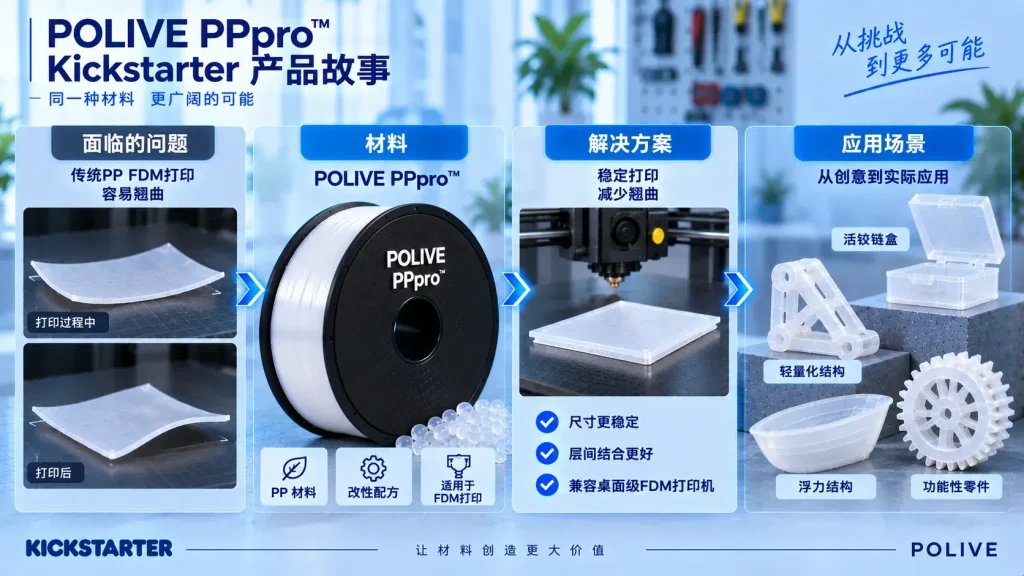
Is POLIVE PPpro™ a Good Fit for Crowdfunding? From Material Challenges to a Kickstarter Product Story
Kickstarter has long hosted 3D-printing projects—from printers and accessories to various new filaments—with many using crowdfunding to test the market.
For POLIVE PPpro™, one direction worth exploring is:
Can “PP is finally easier to print” become a new product story that users are willing to try?
This carries more substance than simply promoting “a new spool of 3D printing filament.”
Why is the PPpro™ story easy to understand?
PP itself is not a new material.
It is already widely used in traditional industrial fields such as automotive, packaging, medical, and household products.
The real question is:
Why is a material so common in industry not as easy to use as PLA and PETG in desktop FDM 3D printing?
This forms a very clear product story:
Conventional industrial material PP → difficulties in FDM printing → optimized modified material → PP enters desktop 3D printing more easily
Such a story helps users understand the meaning of product development far better than merely emphasizing color, surface effects, or formulation changes.
What can a crowdfunding page show?
If POLIVE tests Kickstarter in the future, the most important thing is not writing a catchy slogan first, but showing the product throughreal testingclearly.
For example, you can show:
1. Print comparison between ordinary PP and PPpro™
Under the same printer, same model, and similar parameters, show:
- Warping
- First-layer adhesion
- Print success rate
- Dimensional stability
This lets users directly see the difference between the materials.
2. Practical applications of PPpro™
Don’t just show a spool of filament.
You can show:
- Living hinge
- Lightweight structures
- Buoyant structures
- Functional container prototypes
- Parts for chemical environments
- Automotive functional prototypes
Help users understand:
why to use PP, not merely “because it is a new material.”
3. Printer compatibility tests
If actual tests are done, you can show specific printer models, print parameters, and models.
For example:
Open FDM printer → PEI build plate → PPpro™ → actual print result
Real tests are far more convincing than vague claims like “compatible with ordinary 3D printers.”
“Finally able to print PP” can be a communication angle, but it is best proven with tests
“Finally able to print PP” is indeed an easily understood product statement.
But what truly supports this statement is not the slogan itself, but:
Can ordinary users successfully print an actual functional part following clear parameters?
Therefore, if crowdfunding happens in the future, the most worthwhile materials to prepare may include:
- Ordinary PP vs PPpro™ comparison
- Tests on different printers
- First-layer tests
- Warping tests
- Living-hinge test
- Functional-part tests
- User trial feedback
These contents can turn “material innovation” into tangible results that users can understand.
How should PPpro™’s material selling points be expressed?
PP itself has some noteworthy material properties, for example:
- low density
- Good toughness
- Good chemical resistance
- Low water absorption
- Good fatigue resistance
- Suitable for some living-hinge structures
But these properties do not mean PP outperforms PLA, PETG, ABS, or PC in every respect.
Therefore, the crowdfunding page is better served by:
“What PP is good for → why traditional PP is hard to print → what PPpro™ does → how the actual print result looks”
such a logic, rather than simply describing PP as a “full upgrade.”
Food contact and safety need separate handling
If a future Kickstarter page touches applications like food containers or children’s products, pay special attention to this:
You cannot, just because the material is PP, directly claim that PPpro™ prints are “food safe.”
Whether food contact is compliant must be judged by combining the specific model, formulation, additives, printing process, and the relevant regulations and testing documents.
If a specific PPpro™ model has already obtained relevant testing or complies with specific regulations, you can addressthat model and its corresponding documentsin your explanation.
This is more accurate than vaguely writing “PP complies with FDA / EU / GB standards.”
What is Kickstarter better used to validate?
If POLIVE ultimately chooses Kickstarter, it can be seen as a market validation, not merely fundraising.
You can focus on validating:
Are users willing to buy filament for easier-to-print PP?
Which applications best help users understand PP’s value?
What printers do users use?
Do they care most about print stability, material performance, or price?
Such early user feedback can all help POLIVE later adjust products, packaging, tutorials, and Amazon sales strategy.
PPpro™’s crowdfunding story must ultimately return to the product itself
For 3D printing consumables, the most convincing content is usually not a slogan but something actually printed successfully.
If users see a PPpro™-printed living-hinge box that opens repeatedly;
see a lightweight structure that keeps buoyancy in water;
see models that traditional PP struggles to print completed stably;
then they will naturally understand:
why someone needs a spool of modified PP filament.
This is also the product story most worth validating if POLIVE PPpro™ tries Kickstarter in the future.
To learn how beginners can start printing PP, read:Can Beginners Print PP? The PPpro™ Five-Step Getting-Started Guide.
More PPpro™ product information:polive3d.com
把 PPpro™ 拿去做 Kickstarter,故事好讲在哪?
因为问题一句话说得清:PP 性能好但一直难打,我们把不用加热床、不用封箱这件事做出来了,用户不用改机器就能用。
众筹页最该展示什么?
别只堆材料参数,展示实测过程和实物件:开放机架打印、Bambu A1 上打出来的模型、活铰链和大底件、平台胶水一次涂抹多次打印。可复现比口号更有说服力。
宣称终于能打 PP,怎么避免翻车?
把适用条件讲清楚:什么机器、什么环境(空调房开放散热)、首层怎么处理、哪些模型需要圆角和老鼠耳朵。把边界写明白,比只放最好看的样件更能建立信任。
Related Reading
- Who Is POLIVE?
- What Is PPpro? A Modified PP 3D Printing Filament That Needs No Heated Bed and Makes Living Hinges
- How Is POLIVE PPpro™ Made? Three Key Technical Challenges of Modified PP Filament
- How to Judge the Quality of Modified PP Filament? Which Tests to Check When Buying
- What happens to PP 3D printed filament at Amazon? An emerging segment
- Is PP 3D Printing Filament Expensive? How to Calculate Material Cost