Why Is PP Unlikely to Leach Harmful Substances?
Whether a material is safe depends less on “what elements it is made of” than on its molecular form, its additives, and the real-world conditions of use.
PP happens to score well on all three.
Structure: the molecules are too large to escape
PP consists of very long hydrocarbon chains with molecular weights in the hundreds of thousands. Molecules this large are hard to volatilize, and hard to cross the skin barrier and be absorbed by the body.
Only small molecules migrate easily. Plasticizers, residual monomers and degradation products—these low-molecular-weight substances are the ones capable of escaping from the plastic into food or the human body. PP’s backbone is a high-molecular-weight long chain, simply not the kind that “gets out.”
Formulation: no plasticizers needed, and no bisphenol A
PP is inherently tough and does not require plasticizers to soften it. Its flexibility is engineered at the molecular chain level, not achieved by adding phthalate esters.
This point is often misunderstood. Plastics such as polyethylene, polypropylene, polystyrene and polycarbonate do not require plasticizers during production. In a report by CCTV.com, experts also stated explicitly that there is “no need whatsoever to add phthalates” when manufacturing polypropylene food containers.
PP also contains no bisphenol A structure. BPA is one of the raw materials for PC; PP’s hydrocarbon backbone contains no such component. These two are precisely the risk sources often discussed for PVC and PC, and PP is not involved from a formulation standpoint.
Behavior: chemically inert, slow to react with whatever it contacts
PP does not absorb water and is strongly chemically inert. Whether it holds water, oil or acid, the material itself does not readily change, and so does not readily generate new migratable substances.
Its saturated hydrocarbon backbone has no double bonds or polar groups, so it is chemically very “quiet.” In contact with food, PP does not take part in reactions and will not release substances that were not originally present as a result of reacting with food components.
But the limits need to be stated clearly
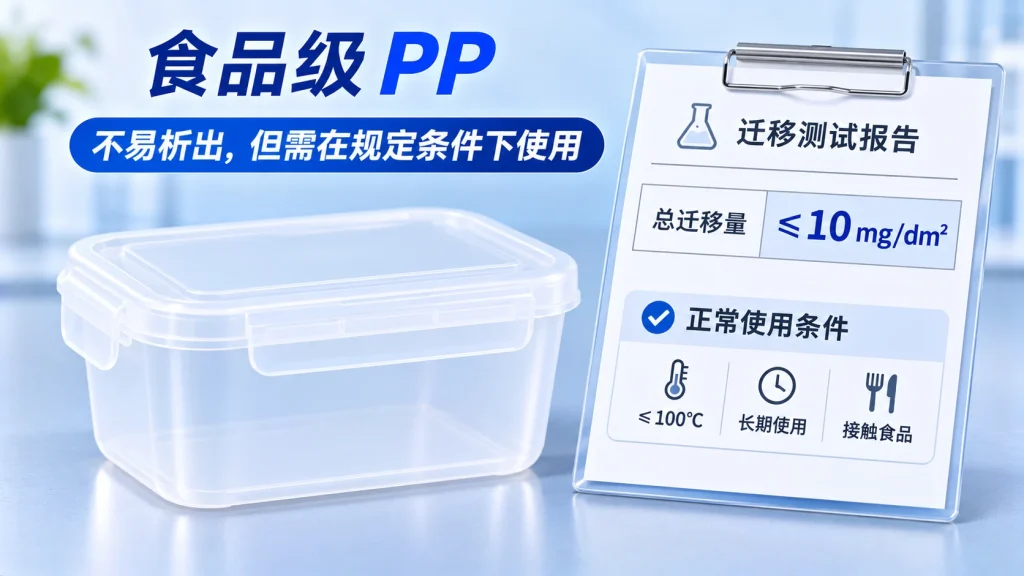
PP still contains small amounts of additives. Antioxidants are essential to prevent degradation during processing and use. Food-grade products are subject to clear limits on the types and amounts of these additives, and the GB 4806 series of standards sets requirements for both overall migration and specific migration. A compliant product being within the limits does not mean zero additives—but neither does it mean unsafe.
High temperatures change the picture. Studies have shown that PP containers release significantly more phthalate-type substances at 100℃ than at 40℃. This shows that temperature is a key variable. Normal use temperatures are fine, but prolonged contact at high temperatures calls for more caution.
Performance declines after long-term aging. After prolonged sun exposure and heat aging, PP molecular chains can break and generate more small-molecule fragments. Migration behavior at that point differs from virgin material. PP food containers are single-use items with short service lives and are affected only to a limited extent, but PP products reused over the long term deserve attention.
The accurate statement is: under normal conditions of use, PP does not readily release migratable substances. It is not “never releases anything,” but “fine under normal use, evaluate when going beyond the intended range.”
What this means for 3D printing
PPpro retains PP’s low-migration foundation, but FDM printed parts differ from injection-molded ones.
Layer lines and pores in printed parts can become pathways for substance migration, and interlayer bond strength also affects long-term performance. PPpro is suitable for auxiliary structural parts in food contact, but printed parts are not recommended for direct use as long-term, repeatedly used food containers. The earlier food-contact article already covered the cleaning difficulties, so that will not be repeated here.
If your application has strict requirements on migration, first run migration tests on small samples under actual conditions of use, confirm compliance with the standards of your target market, and then decide whether to use it.
Conclusion
PP does not readily release harmful substances for three reasons: high molecular weight, no need for plasticizers and no bisphenol A, and strong chemical inertness. Under normal conditions of use, it is relatively safe.
But the boundary is “normal conditions of use.” High temperatures, long-term aging, and non-food-grade grades all change the picture. PP is not zero-migration; rather, “within compliance and normal use, the amount of migration is controllable.” To judge whether it can be used, look at the specific grade, use temperature and contact time—do not draw conclusions from the single phrase “PP is safe.”
Common Questions
Does PP contain plasticizers?
No. PP is inherently tough enough and does not need plasticizers to soften it. Plastics such as polyethylene and polypropylene do not require plasticizers during production. A CCTV.com report also confirmed that there is no need to add phthalates when manufacturing polypropylene food containers.
Does PP contain bisphenol A?
It contains no bisphenol A structure. BPA is a raw material for PC; PP’s hydrocarbon backbone has no such component. The two are different material systems.
Can PP printed parts contact food directly?
At the material level, PPpro retains PP’s low-migration characteristics, but layer lines and pores in FDM printed parts affect cleanability and long-term performance. Using them for food-contact auxiliary parts is worth exploring; printed parts are not recommended for long-term, repeatedly used food containers. When requirements are strict, run migration tests first.
PP 为什么不容易析出有害物质?
三个原因叠加:聚合物分子太大不容易迁移出来、配方里不需要增塑剂也不含双酚 A、化学惰性强不容易与接触物反应。
安全性到底由什么决定?
不只由元素组成决定,还看分子形态、添加剂和实际使用条件。同样是塑料,添加剂和加工方式不同,结论可能完全不同。
那边界在哪?
高温、油脂、长期接触、反复使用都会提高迁移风险;另外印刷油墨、胶粘剂、回收料来源这些材料之外的因素也要算进去。
3D 打印件为什么不能直接套用?
打印引入喷嘴与平台残留、层间缝隙藏污、后处理污染等新变量。材料本身安全不代表成品安全,入口用途请按实际条件单独验证。
Related Reading
- Can 3D Printed Parts Touch Food? Key Considerations for PP in Food Contact Applications
- PP’s Chemical Stability: Why It Resists Acids and Alkalis
- PP’s Molecular Structure: Why It Consists Only of Carbon and Hydrogen
- What Is PPpro? A Modified PP 3D Printing Filament That Needs No Heated Bed and Makes Living Hinges