PP’s Chemical Stability: Why It Resists Acids and Alkalis
PP’s chemical stability comes down to its molecular structure.
Its long chains form a saturated hydrocarbon backbone, with no double bonds and no polar groups on the main chain. Chemically it is very “quiet” and does not readily react with other substances. This is the underlying reason it resists acids and alkalis.
What it resists: acids, alkalis and salts at room temperature are generally fine
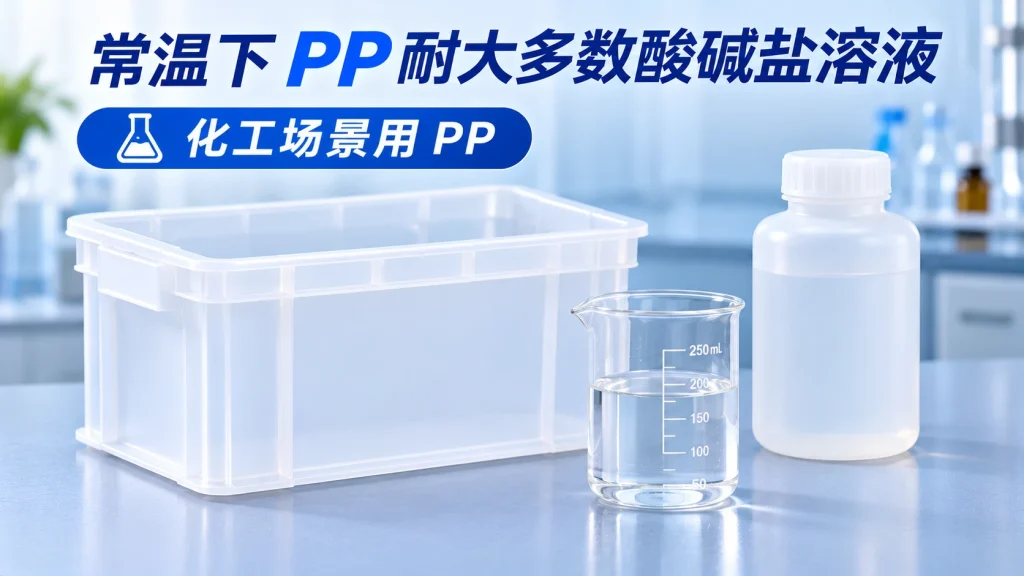
Because of this inertness, PP is stable against most acid, alkali and salt solutions at room temperature. It is unaffected by water or alcohol, and also resists many oils, greases and detergents.
According to China Science Communication, below 80℃ PP resists corrosion from acids, alkalis, salt solutions and many organic solvents. The chemical industry uses it for storage tanks, pipes and transit crates; household cleaning product bottles are often made of PP; and laboratories rely on it for holding acid and alkali reagents.
In RTP Company’s chemical resistance ratings, PP is rated “Excellent” for weak acids, weak alkalis and strong alkalis, and “Good” for strong acids, with a note that it is attacked by oxidizing acids.
What it does not resist: strongly oxidizing media and some organic solvents
PP does have things it is vulnerable to.
Strongly oxidizing media, such as concentrated nitric acid and fuming sulfuric acid, will corrode PP. RTP’s ratings explicitly note that PP is attacked by oxidizing acids. Some studies report that 3D-printed PP has a degree of resistance to nitric and sulfuric acids, but those are test results under specific concentrations and temperatures and cannot be generalized to all concentrations and temperatures. When in doubt, check the chemical resistance table for the specific grade.
Some organic solvents, at elevated temperatures, can cause PP to swell or even dissolve. PP is relatively sensitive to aromatic and chlorinated hydrocarbons. Brief contact at room temperature is generally not a problem, but prolonged immersion at high temperature calls for caution.
Prolonged UV exposure and high temperatures, accelerate PP aging. This is a different issue from chemical stability, but it equally affects part service life.
Judging whether it can be used: three variables
So when judging whether PP is suitable, you cannot simply say “chemical-resistant”; you also need to consider temperature, concentration and contact time.
The higher the temperature, the poorer the chemical resistance. Sources show PP performs excellently with acetic acid at 20℃, but its rating drops at 50℃. The higher the concentration, the greater the risk. The longer the contact time, the more pronounced the cumulative effect.
At normal temperature and pressure, PP can generally handle acids, alkalis and salts. When in doubt, first check the material’s chemical resistance table, then run immersion tests under actual working conditions.
What this means for 3D printing
PPpro modified PP 3D printing filament retains PP’s chemical-resistance foundation and can be used for chemical-resistant parts such as chemical sampling components and laboratory vessels.
But FDM printed parts differ from injection-molded parts. Layer lines and pores can become pathways for media penetration, and interlayer bond strength also affects stability under long-term immersion. Some studies report that 3D-printed PP performs well in organic solvent resistance, but those tests target specific media and printing conditions and do not mean it applies to every working condition.
Before making large parts or using them in highly corrosive environments, first run immersion tests on small samples to confirm that changes in dimensions, weight and strength stay within acceptable limits, then decide whether to move to large parts. This step cannot be skipped.
Conclusion
PP resists acids and alkalis because its saturated hydrocarbon backbone has no double bonds or polar groups, making it chemically inert. It is stable against most acid, alkali and salt solutions at room temperature, which is why it is widely used in chemical, cleaning and laboratory settings.
But it is vulnerable to strong oxidizing acids, to high-temperature immersion in some organic solvents, and to prolonged UV exposure and heat. Whether it can be used depends on temperature, concentration and contact time; you cannot conclude from the single phrase “PP is chemical-resistant.” 3D-printed parts add one more consideration: the interlayer structure can affect long-term chemical performance, so test small samples before committing to large parts.
Common Questions
Can PP hold concentrated sulfuric acid?
Not recommended. PP has limited resistance to strong oxidizing acids (concentrated nitric acid, concentrated sulfuric acid), and RTP’s ratings explicitly note that PP is attacked by oxidizing acids. Dilute sulfuric acid with brief contact at room temperature may be acceptable, but concentrated sulfuric acid or high-temperature conditions carry high risk. For specific applications, check the grade’s chemical resistance table and run tests.
Is PP resistant to alcohol?
Yes, at room temperature. PP is rated “Good” for alcohols, and brief contact is fine. However, with long-term immersion in high-concentration alcohol or at elevated temperatures, testing is still recommended to confirm.
Is the chemical resistance of PP printed parts the same as injection-molded parts?
Not exactly. The material itself is the same, but layer lines and pores in FDM printed parts can become penetration pathways, and interlayer bond strength also affects long-term performance. When making chemical-resistant parts, it is recommended to immerse small samples in the actual medium at the actual temperature and confirm that changes in dimensions, weight and strength are acceptable before use.
PP 为什么耐酸耐碱?
分子链只含碳氢、没有容易被酸碱进攻的极性基团,化学惰性强,室温下多数酸、碱、盐溶液都很难与它反应。
PP 的耐化学性怕什么介质?
强氧化性介质和某些有机溶剂仍可能侵蚀或使其溶胀,温度升高也会放大影响。判断能不能用,要同时看介质种类、浓度与温度、接触时长这三个变量。
耐化学和实际使用之间还差什么?
差零件层面:FDM 件有层间缝隙,介质可能沿层间渗入;尖角和壁厚突变处容易产生应力开裂。壁厚均匀、圆角过渡能降低这类风险。
怎么验证自己的介质?
用真实介质、真实浓度和温度做浸泡测试,测前后尺寸、重量、外观和力学性能,再打实物件盛液试漏,别只查耐化学表。
Related Reading
·PP’s Molecular Structure: Why It Consists Only of Carbon and Hydrogen
·Can 3D Printing Handle Parts That Touch Water? Tanks, Floats and Bathroom Fittings
·Can PP 3D printed parts withstand boiling water? POLIVE PPPro™ 100°C boiling water test
·What Is PPpro? A Modified PP 3D Printing Filament That Needs No Heated Bed and Makes Living Hinges