Why PP Food Containers Are Microwave-Safe
Most microwaveable food containers are made of PP because it meets three criteria: sufficient heat resistance, no plasticizers, and strong chemical inertness.
But that doesn’t mean every PP container can go straight into the microwave without a second thought. There’s a difference between “microwave-safe” and “safe to use without precautions”—and a few pitfalls to avoid.
Sufficient Heat Resistance: The Temperature Ceiling for Microwave Heating
Microwave heating works by causing water molecules to vibrate and generate heat. For foods containing water, the core temperature typically stabilizes around 100°C (212°F) and won’t climb further until the moisture is driven off.
PP has a continuous use temperature of approximately 100°C (212°F), with short-term tolerance up to around 120°C (248°F). For ordinary meals reheated for a few minutes, PP won’t soften or deform within this range.
One situation deserves attention, however: foods high in oil or sugar. Oil and sugar contain little water, so their temperature under microwave heating can far exceed 100°C, with localized hot spots reaching 150°C (302°F) or higher. PP’s heat resistance ceiling cannot withstand this, and the material may degrade. So avoid microwaving fried dough sticks, candied dishes, or oil-heavy foods directly in PP containers.
No Plasticizers: PP Doesn’t Need Them to Stay Flexible
PP is inherently tough and does not require plasticizers to soften it. Its flexibility is engineered at the molecular chain level, not achieved by adding phthalate esters.
This is where PP differs from PVC. Flexible PVC must contain plasticizers, and plasticizer migration at high temperatures has long been a subject of discussion. PP eliminates this pathway at the source, so there is no risk of “plasticizer leaching under heat.”
Strong Chemical Inertness: Unlikely to React with Food
Water, oil, and acid in food have minimal effect on PP. PP’s molecular structure is stable and resistant to acids, bases, oils, and alcohols. It does not readily participate in reactions during heating, nor is it easily dissolved by food components into harmful substances.
For holding vinegar, juice, or salted soup, PP is more stable than many alternative materials.
Microwave-Safe Doesn’t Mean Use It However You Like
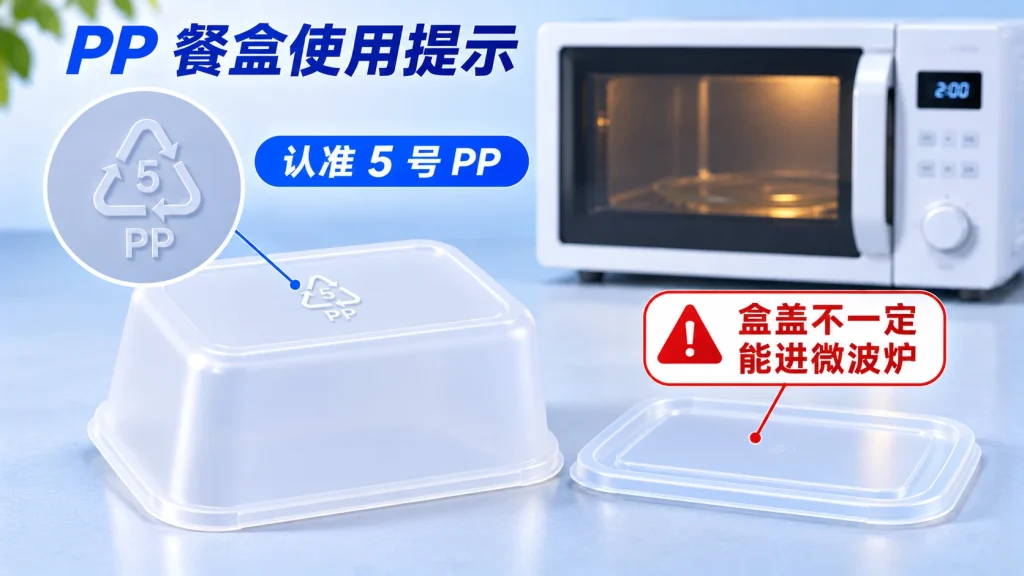
The lid may not be PP. Many containers use PP for the body but PE or PS for the lid to reduce cost. PE has a heat resistance of about 110°C (230°F), while PS only manages 70–90°C (158–194°F); in the microwave, these lids may deform or release substances. Removing the lid before heating is the simplest safeguard.
Look for a “microwave-safe” label. Not every PP container is labeled microwave-safe. Comparative testing has shown two PP containers—one came out intact, the other severely deformed—with the difference being whether the bottom carried a “microwave-safe” marking. If it only shows recycling number 5 without a microwave-safe label, don’t use it for reheating.
Non-food-grade PP must not be heated. Industrial PP containers and storage bins may be made of PP, but they are not manufactured to food-contact standards and should never be used to hold food for heating.
Limit PP use for high-fat foods. At high temperatures, oil attacks PP more aggressively than water does. Long-term use of PP containers for reheating high-fat foods accelerates material aging. An occasional instance is low-risk, but don’t make it a daily habit.
What This Means for 3D Printing
PP’s heat resistance and food-contact characteristics are also relevant to 3D-printed parts, but the context matters.
The heat resistance foundation of PPpro printed parts comes from PP itself: the approximately 100°C continuous / 120°C short-term range is inherent to the material. However, FDM printed parts have layer lines and porosity, making them harder to clean in food-contact scenarios than injection-molded parts—a point covered in our previous article on food contact. PPpro is suitable for auxiliary structural components that contact hot food, heat-resistant fixtures, and similar applications, but printed parts should not be treated as long-term reusable food containers.
Conclusion
PP food containers are microwave-safe because of three things: sufficient heat resistance (approximately 100°C continuous, 120°C short-term), no plasticizers, and strong chemical inertness.
But “microwave-safe” doesn’t mean “use it however you like.” Remove the lid, look for the microwave-safe label, avoid high-oil and high-sugar foods, and never heat non-food-grade PP. Do these four things, and you’re using it correctly.
Common Questions
Can PP food containers be reheated repeatedly in the microwave?
Check the label and the condition. PP containers labeled “microwave-safe” can be reheated repeatedly under normal use. But once a container shows noticeable scratches, cloudiness, or deformation, it’s time to replace it—don’t wait until it fails completely. Single-use takeout containers are not recommended for long-term repeated use.
Why can’t the lid go in the microwave with the container?
Because the lid material may not be PP. Many containers have a PP body with a PE or PS lid, which has a lower heat tolerance and may deform in the microwave. If you’re unsure about the lid material, taking it off is the safest option.
Can PP printed parts go in the microwave?
Not recommended. PPpro’s material heat resistance is there, but the layer structure and porosity of FDM printed parts are fundamentally different from injection-molded food containers. They are harder to clean in food-contact scenarios, and long-term microwave use lacks validation. Printed parts are better suited for heat-resistant fixtures and auxiliary structural components—not food containers.
PP 餐盒为什么能进微波炉?
三条同时满足:耐热够、不需要增塑剂就保持柔韧、化学惰性强不易与食物反应。所以微波餐盒大多用 PP。
不用增塑剂这点为什么重要?
PP 靠分子结构自带柔韧性,不像某些塑料要靠小分子添加剂变软。加热时少了这类可迁移成分,使用上更让人放心。
标了微波适用就能随便用吗?
不能。还要看标注的加热条件、是否带盖、食物含油含糖导致的局部高温,以及容器老化发雾、变形后的状态。按标签和实物状态判断。
3D 打印容器能照搬这个结论吗?
不能。材料能进微波不等于打印件能进:层间缝隙、壁厚不均、打印污染物和难清洗都要单独考虑,FDM 容器建议只做原型和短时接触用途。
Related Reading
·How High Is PP’s Heat Resistance, Really?
·Can 3D Printed Parts Touch Food? Key Considerations for PP in Food Contact Applications
·PP or Tritan for Baby Bottles: How to Choose
·What Is PPpro? A Modified PP 3D Printing Filament That Needs No Heated Bed and Makes Living Hinges