How High Is PP’s Heat Resistance, Really?
PP’s melting point is about 164–170°C, which is high among general-purpose plastics.
But the melting point is not the actual service temperature. To judge whether PP is heat-resistant, you mainly need three numbers: continuous service temperature, short-term tolerance, and heat deflection temperature.
Three numbers, don’t mix them up
Melting point: about 164–170°C: the temperature at which the material turns from solid to liquid. It is the inherent ceiling of the material, not its service limit. Treating the melting point as a service temperature is like treating a fuse’s rated current as its working current.
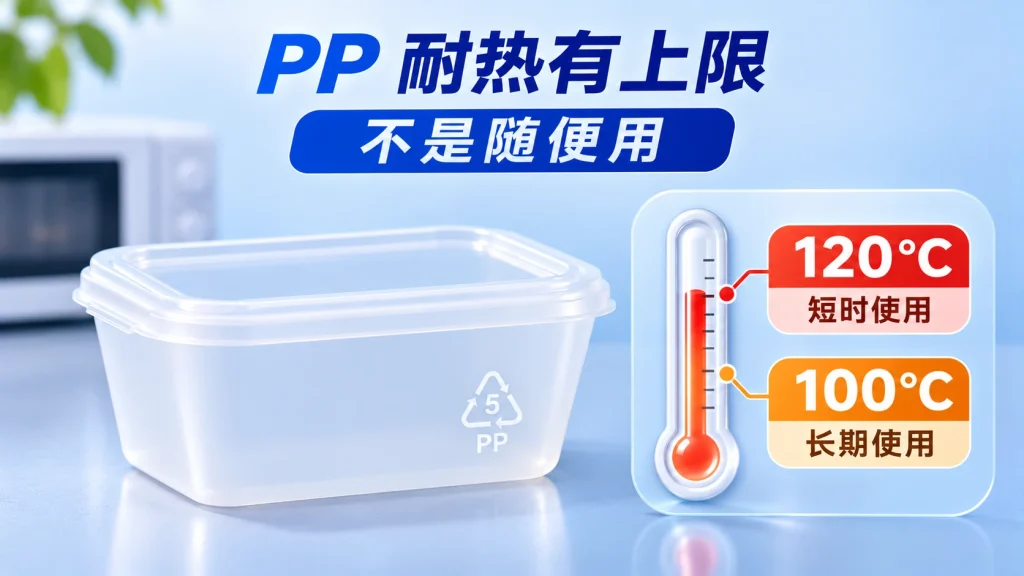
Continuous service temperature: about 100°C: fine for holding hot food or hot water day to day. This is the range in which PP products work stably.
Short-term tolerance: about 120°C: which is why many PP food containers are labeled “microwave-safe.” Short-term and long-term are two different things — a few minutes in the microwave and long-term exposure at 120°C place completely different demands on the material.
PP can also withstand 121°C high-pressure steam sterilization. Medical consumables and baby-bottle sterilization both rely on this property. But this is likewise a short-term cycle, not continuous long-term exposure.
What actually affects heat resistance: three factors
Different grades behave differently. Copolymer PP has better low-temperature toughness, while homopolymer PP is slightly higher in rigidity and heat resistance. Even among products all labeled “PP,” actual heat performance varies from grade to grade.
Thickness and load matter. Thin-walled containers deform more easily under heavy loads at high temperature. The thinner the wall and the heavier the load, the lower the temperature they can actually handle.
“Resistant to” does not mean “use it however you like.” Foods with a lot of oil, heated at high temperature for long periods, can still accelerate material aging. At high temperature, oil attacks PP more aggressively than water does — a point that is often overlooked.
What this means for 3D printing
PP’s heat-resistance figures apply to 3D-printed parts too, but with a discount.
The heat-resistance foundation of PPpro printed parts comes from PP itself: the roughly 100°C continuous / 120°C short-term range is what the material provides. But the interlayer bonding and porosity of FDM printed parts affect how they actually perform at high temperature. For printed parts used long-term in environments approaching 100°C, run your own tests first rather than relying on material data alone.
Suitable applications: auxiliary parts that contact hot food, containers that need boiling-water sterilization, heat-resistant fixtures. Unsuitable: parts that sit above 100°C for long periods, or that carry load at high temperature.
Conclusion
In daily use PP handles 100°C, tolerates 120°C short-term, and melts at about 164–170°C. The three numbers mean different things and cannot be used interchangeably. Check the manufacturer’s instructions as well — even within PP, different products vary considerably.
Grade, thickness, load, and the medium being contacted all affect actual heat performance. “Resistant to” does not mean “use it however you like.” High temperature plus high oil, or high temperature plus load, both call for extra margin.
Common Questions
Can PP hold boiling water?
Yes. PP’s continuous service temperature is about 100°C, and boiling water is 100°C, so it is within range. Note that this means “holding,” not “boiling for long periods.” Repeated boiling for sterilization will accelerate aging and clouding in PP — that is a material characteristic, not a safety issue.
Can PP go in the microwave?
Most PP food containers can, but check the manufacturer’s labeling. PP tolerates about 120°C short-term, and a few minutes of microwave heating falls within that range. Foods with a lot of oil, heated at high temperature for long periods, can still accelerate material aging, so follow the container’s instructions.
Is PPpro as heat-resistant as PP?
The material itself is the same; PPpro retains PP’s heat-resistance foundation. But the interlayer structure and porosity of FDM printed parts affect actual high-temperature performance. For printed parts used long-term near 100°C, test first rather than relying on material data alone.
PP 的耐热到底看哪个数字?
熔点、热变形温度、维卡软化点是三个不同概念,别混着用。PP 熔点在通用塑料里算高,但真正决定零件能不能用的是带载荷下的变形温度。
除了材料,还有哪三个因素影响耐热?
受力大小、受热时长、零件结构(壁厚与几何)。同一材料,薄壁带载和厚壁空载的表现可以差很远。
为什么熔点高不等于能长期高温用?
因为远低于熔点时材料就可能软化,长期使用还有氧化老化。判断要靠实际工况测试,不是看熔点数字。
打印件验证耐热要注意什么?
用真实零件、真实载荷和时长测,冷却后复测尺寸和装配;层间结合和打印方向也会改变结果,别拿注塑件数据直接套。
Related Reading
·Why PP Is Widely Used in Medical Auxiliary Products
·PP vs PET: Why Drink Bottles and Food Containers Use Different Plastics
·What Is PPpro? A Modified PP 3D Printing Filament That Needs No Heated Bed and Makes Living Hinges