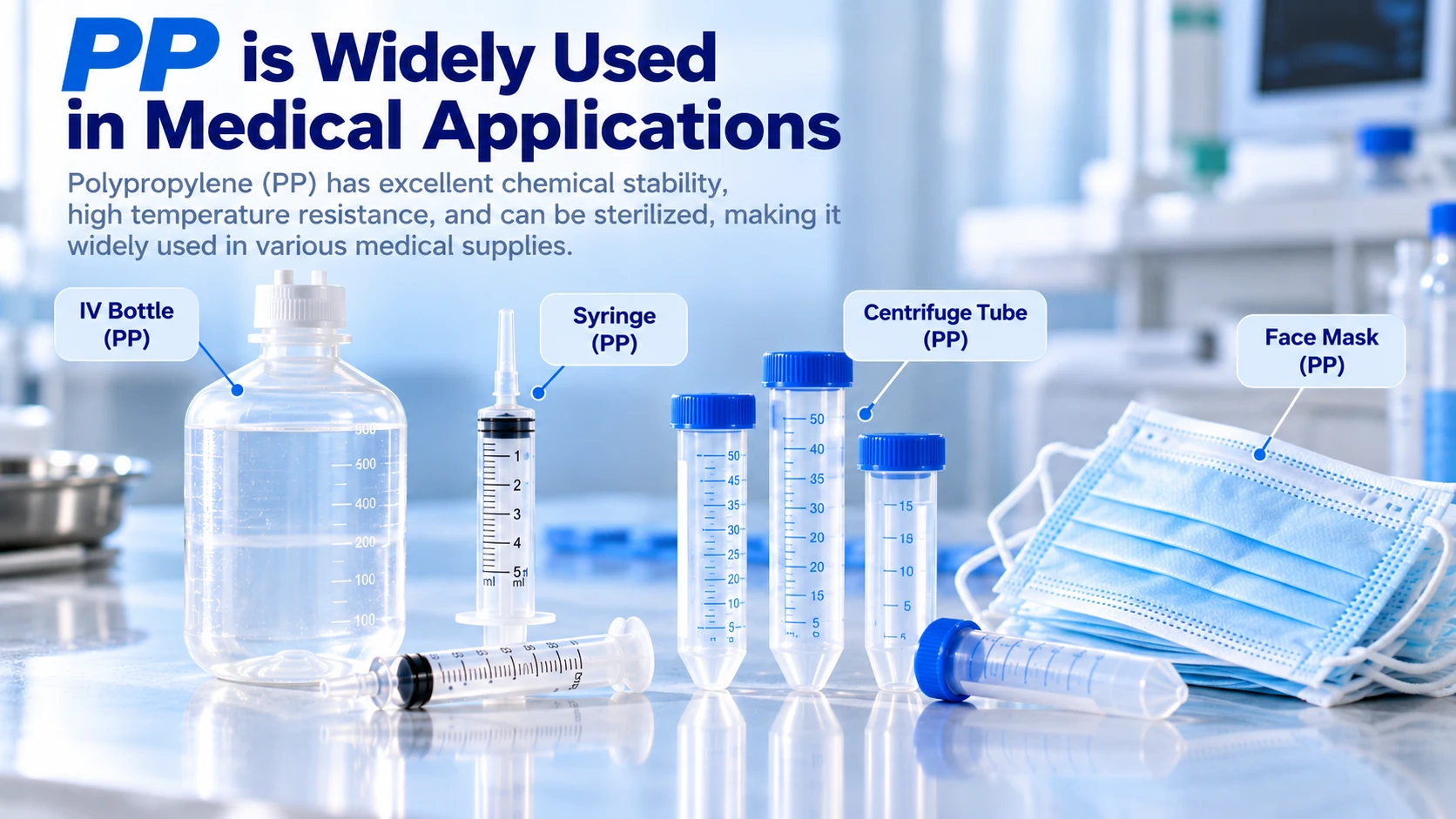
Why PP Is Widely Used in Medical Auxiliary Products
IV bottles, syringes, centrifuge tubes, petri dishes, masks, protective clothingâPP is everywhere in medical settings. There are mainly three reasons.
Withstands high-temperature sterilization
Medical consumables often undergo 121°C steam sterilization or irradiation sterilization. PP’s melting point is close to 165°C, so it retains shape and strength at 121°C and does not easily deform.
This temperature margin is critical. Autoclave steam sterilization is one of the most common methods in hospitals, holding 121°C for ten to several tens of minutesâa real test for materials. Many plastics soften, deform, or even lose sealing at this condition. PP’s melting point is far above this temperature, so it holds up through sterilization cycles.
By contrast, PVC begins to soften at just tens of degrees Celsius and can hardly follow this route.
Irradiation sterilization is another path, using gamma rays or electron beams to kill microorganisms. PP also tolerates irradiation well, which is one reason it is widely used in disposable syringes, IV bottles, and similar consumables.
Strong chemical inertness
PP resists water, acids, alkalis, and most liquid medicines. It does not easily react with drugs when filled, nor readily release impurities.
This relates to its molecular structure: only carbon and hydrogen in the backbone, with little reaction and no leachingâthe foundation for its use in drug-contact parts.
In medical settings, drug formulations are complexâsome acidic, some alkaline, some salty, some containing organic solvents. If the container material reacts with the drug, it may at best affect efficacy or at worst produce harmful substances. PP’s chemical inertness keeps it stable in such scenarios.
Add its low water absorption, and it does not easily swell, deform, or lose performance from long-term liquid contact.
Easy to process and inexpensive
PP can be injection-molded into complex shapes and made into thin-wall containers and nonwoven. Single use is no loss, helping reduce cross-infection risk.
This point is often underestimated but important in medical settings. The core logic of disposable consumables is 'use and discard,' so cost must be low enough that hospitals can afford and are willing to use them. PP's cheap raw material, mature molding process, and high yield match this need perfectly.
Thin-wall containers save material, nonwoven makes masks and protective clothing, and injection molding makes complex connectors and caps. One material covering so many forming methods also keeps the supply chain simple.
A boundary that must be clarified
Medical-grade PP belongs to specific grades that must pass biocompatibility and other tests. Ordinary PP is not the same as medical grade.
This is especially important for 3D printing. The layer lines, porosity, and cleaning difficulty of printed parts all affect their suitability in medical scenarios. Even if the material itself is medical-grade PP, the printed product must be evaluated separately.
POLIVE PPpro modified PP 3D printing filament is not for implantable, wound-contact, or diagnostic medical devices; it serves only non-device auxiliary parts. Before using it for medical-related auxiliary structures, confirm which category your part falls into.
What these advantages mean for 3D printing
PP’s three advantages in the medical field also hold for 3D printing, but should be viewed with some discount.
High-temperature sterilization resistance: PPpro printed parts can withstand a certain temperature, but the interlayer bonding and porosity of FDM parts affect their stability through repeated sterilization cycles. They suit auxiliary parts that need periodic cleaning but not strict sterility.
Chemical inertness: this one largely carries over. PP’s carbon-hydrogen backbone does not change with the printing method, and its chemical resistance remains. It suits auxiliary structures that contact cleaners and disinfectants.
Light and tough: it suits non-device parts that need to be light and durable, such as rehabilitation aids and healthcare auxiliary tooling.
What is unsuitable is also clear: implantable, wound-contact, and diagnostic categories are outside PPpro’s scope of service.
Conclusion
PP is widely used in medical auxiliary products thanks to three strengths: withstanding 121°C steam sterilization, strong chemical inertness, and easy processing at low cost. But medical-grade PP is a specific grade that must pass biocompatibility testsâordinary PP is not medical grade.
For 3D printing medical-related parts, the boundary must be held: non-device auxiliary parts are allowed, but implantable, wound-contact, and diagnostic ones are not. Within this range, PP’s heat resistance, chemical resistance, lightness, and toughness are genuinely usable.
Common Questions
How is PPpro modified PP 3D printing filament related to general-purpose PP?
PPpro is a PP filament modified for FDM 3D printing. It retains PP’s light weight, chemical resistance, and repeated-flexibility nature, and optimizes print adhesion and interlayer bonding.
Is PPpro modified PP 3D printing filament difficult to print?
PP’s difficulty lies in adhesion and warping, not temperature. PPpro follows a no-heated-bed, no-enclosure, open-cover routeâeven faster in an air-conditioned roomâand prints stably with proper bed preparation.
Can PP printed parts be used in medical scenarios?
It depends on the specific use. For non-device auxiliary partsâsuch as rehabilitation aid prototypes, healthcare auxiliary tooling, and equipment positioning partsâPPpro can be explored. Implantable, wound-contact, and diagnostic medical devices are outside the scope. Even for auxiliary parts, it is recommended to validate cleaning, heat resistance, and strength under actual use conditions.
为什么医疗辅助用品常用 PP?
能耐受高温灭菌、化学惰性强、易加工且成本低,输液瓶、注射器、离心管、培养皿、口罩防护服里都能看到它。
医疗用途的边界在哪?
材料适合不等于成品适合,灭菌方式、添加剂、洁净度和合规要求都要单独确认,不能只凭 PP 三个字下结论。
这对 3D 打印意味着什么?
做医疗与康复辅具原型很合适,但正式使用涉及载荷、长期接触和清洁消毒,需要按实际用途验证。3D 打印更适合开发阶段的快速迭代。
Related Reading
·Can 3D Printing Make Medical and Rehabilitation Aid Prototypes? Exploring PP Applications
·Can 3D Printing Make Lab Equipment? Chemical Resistance of PP