Can 3D Printing Make Lab Equipment? Chemical Resistance of PP
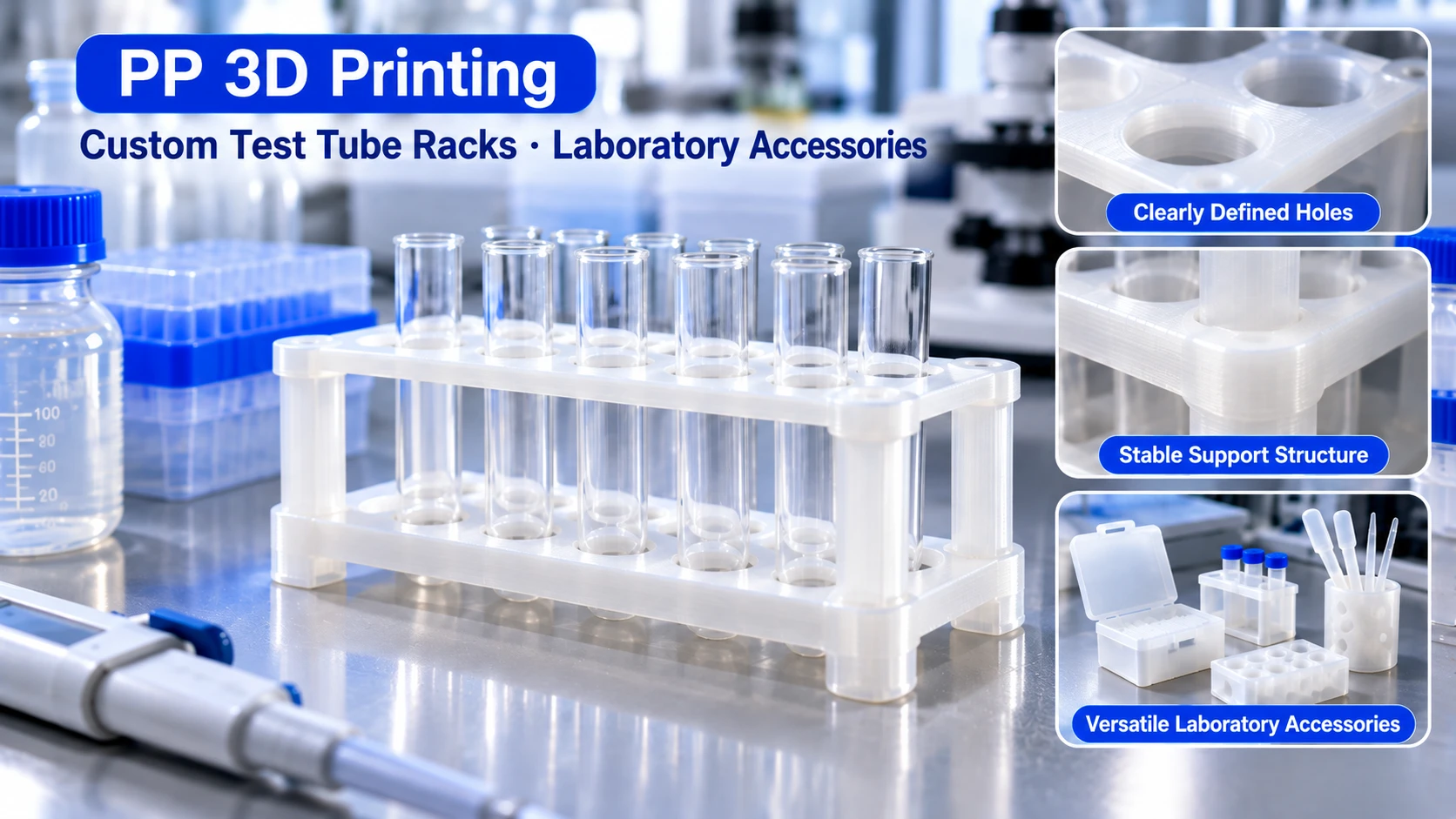
Yes. For laboratory aids such as test tube racks, sample boxes, burette clamps, and funnel stands, 3D printing can provide flexible custom solutions. This is especially useful where a holder must fit a specific tube size, sample format, or bench layout — 3D printing reduces the dependence on standardized products.
PP (polypropylene) has low density, low moisture absorption, and good chemical resistance, which makes it worth considering for some laboratory aids.
However, a material being chemically resistant does not mean a printed part is suitable for every reagent or every experimental use. If the item will contact samples directly, take part in quantitative analysis, or hold chemicals, its suitability must be assessed against the specific medium, concentration, temperature, and contact time. The layer lines, porosity, and cleaning difficulty of FDM parts also need to be taken into account.
Which items in the lab are suitable for printing?
In the laboratory, 3D printing is best suited to small items with unusual dimensions, low quantities, or a need for individual design.
Test tube and centrifuge tube racks: hole positions and spacing can be customized to the diameter, height, and arrangement of the tubes, making it easy to fit specific consumables.
Sample boxes and aliquot boxes: the body, lid, latches, and label positions can be designed around the sample format, and the overall dimensions adjusted to the bench space available.
Clamping and support parts: burette clamps, sensor mounts, and other auxiliary fixtures can all be customized to the shape of the equipment and where it is installed.
Funnels and flow-guiding aids: for non-critical liquid-transfer tasks with modest requirements, printed supports or flow guides can be considered after a suitability assessment.
The core advantage of these applications is on-demand customization, not the replacement of all precision glassware or certified laboratory consumables.
What does PP’s chemical resistance mean in a laboratory setting?
PP resists many acids, bases, salt solutions, and other chemicals well, so it is often considered for parts that must contact a specific medium.
For laboratory aids, this property may help with some of the reagent contact and cleaning demands of daily use. Actual performance, however, depends on the type of chemical, its concentration, temperature, contact time, and the material formulation.
POLIVE PPpro™ is a modified PP filament optimized for FDM printing. Its specific chemical compatibility should be judged from the corresponding material data and actual test results; PP’s general properties alone do not justify assuming that it withstands every reagent.
When assessing chemical resistance, pay particular attention to the following:
Strong oxidizing media may affect the material.
High temperature, concentrated acids, or prolonged contact may change how the material performs.
After chemical contact, the dimensions, appearance, and mechanical properties of the part may change.
Different formulations and print quality may affect the resistance of the finished part.
So if a printed part will contact a given reagent directly, check the relevant compatibility data first, and run immersion or other suitability tests under the actual conditions of use.
What should I watch out for when printing laboratory equipment?
1. Cleanability and surface structure
FDM printed parts usually show visible layer lines, and complex internal geometry and fine crevices can make cleaning harder and may trap liquid or sample residue.
When designing laboratory aids, simplify surfaces where possible, reduce hard-to-clean corners, and choose geometries that are easy to rinse and inspect.
If the item will contact analytical samples, the risk of cross-contamination should also be assessed. An ordinary printed part cannot automatically be regarded as suitable for aseptic handling or high-cleanliness work.
2. Hole accuracy and assembly dimensions
Tube racks and centrifuge tube racks usually need accurate hole diameters and spacing. Holes that are too small make tubes hard to insert; holes that are too large let tubes wobble or tilt.
The dimensions of PP printed parts can be affected by shrinkage, bed flatness, part geometry, and print parameters. It is therefore advisable to print a few samples first, measure hole diameter, hole spacing, and mating dimensions, and only then move on to batch printing.
For multi-hole items, first-article inspection matters especially. Even with a correct CAD model, there is no guarantee that the actual printed part will meet the requirement.
3. Labeling and sample management
Tube racks and sample boxes can incorporate numbering areas, label slots, or other marking features at the design stage, making it easier to identify sample positions and record experimental information.
For items that will be used long term or printed in multiple batches, the print date, material batch, and process parameters can also be recorded to support later traceability.
Markings printed as part of the item cannot, however, replace the sample coding, records, and quality-management procedures that a laboratory requires.
4. Printing conditions and process consistency
POLIVE PPpro™ needs no heated bed and prints at room temperature, and the printer may be left open or with the lid off. An air-conditioned room is preferable but not mandatory. During printing, focus on even cooling and refer to the parameter guide for the product.
If several sets of laboratory aids are to be printed in succession, verify print parameters, dimensional consistency, and finished-part quality before scaling up the quantity.
Which laboratory uses require particular caution?
Whether a printed item can be used depends on the specific application and on the laboratory’s quality requirements. Different scenarios can differ widely in their demands on material, cleanliness, accuracy, and safety.
Auxiliary support and positioning uses: test tube racks, equipment mounts, and non-critical fixtures, for example, are usually a better starting point for custom printing — but structural stability and dimensional fit still need checking.
Holding reagents or samples directly: compatibility must be assessed for the specific chemical, temperature, contact time, and part geometry. A material name alone is not enough to judge suitability.
Items involved in quantitative analysis: dimensional accuracy, residue, adsorption, and cross-contamination all warrant attention, and blank tests or other verification should be run according to laboratory practice where necessary.
Uses requiring sterility or a specified cleanliness class: whether the cleaning and sterilization methods suit the specific material and part geometry must be verified separately. Ordinary FDM printed parts cannot be assumed to meet such requirements.
For critical analytical vessels, quantitative apparatus, or uses governed by strict regulation, follow the laboratory’s quality system and the applicable standards; the chemical resistance of the material alone is not sufficient.
Summary
3D printing can give laboratories flexible custom solutions, and is especially suited to auxiliary items such as test tube racks, sample boxes, burette clamps, and equipment mounts.
PP’s low moisture absorption and good chemical resistance make it a material worth assessing for some laboratory aids. Specific chemical compatibility, cleanliness, and dimensional accuracy still need to be confirmed through the relevant data and actual testing.
If you are developing custom laboratory aids, start with structurally simple, lower-risk fixtures and verify dimensions, cleaning method, and conditions of use step by step. For items that will contact critical samples or hold reagents directly, decide whether to use them only after the relevant laboratory requirements have been met.
POLIVE PPpro™ offers a no-heated-bed material option for PP FDM printing. Whether it suits a particular laboratory scenario should still be judged on the specific product data, the quality of the printed part, and actual test results.
3D 打印能做实验室器具吗?
能,试管架、样品盒、滴定管夹、漏斗架这类辅助器具尤其适合定制,能按台面和容器尺寸快速改。
PP 的耐化学性在实验室意味着什么?
对多数酸碱和常见清洁剂耐受好,接触化学介质时不容易被侵蚀,这正好是实验室台面最常遇到的工况。
做实验室器具要注意什么?
清洁性和表面结构(层纹容易藏污)、孔径与装配尺寸、标识与样品管理、打印条件一致性。强氧化剂和特定溶剂仍需单独确认。
哪些用途要格外谨慎?
直接接触样品、承压、高温灭菌、需要可追溯合规的器具。这类用途不能因为材料耐化学就直接判定可用。
Related Reading
How Chemical-Resistant Is PP? Understanding the Chemical Resistance of PP 3D Printed Parts
Are PP Prints Waterproof? How PP Performs in Wet and Water Environments
How to Configure PP 3D Printing Settings? PPpro™ Parameter Guide