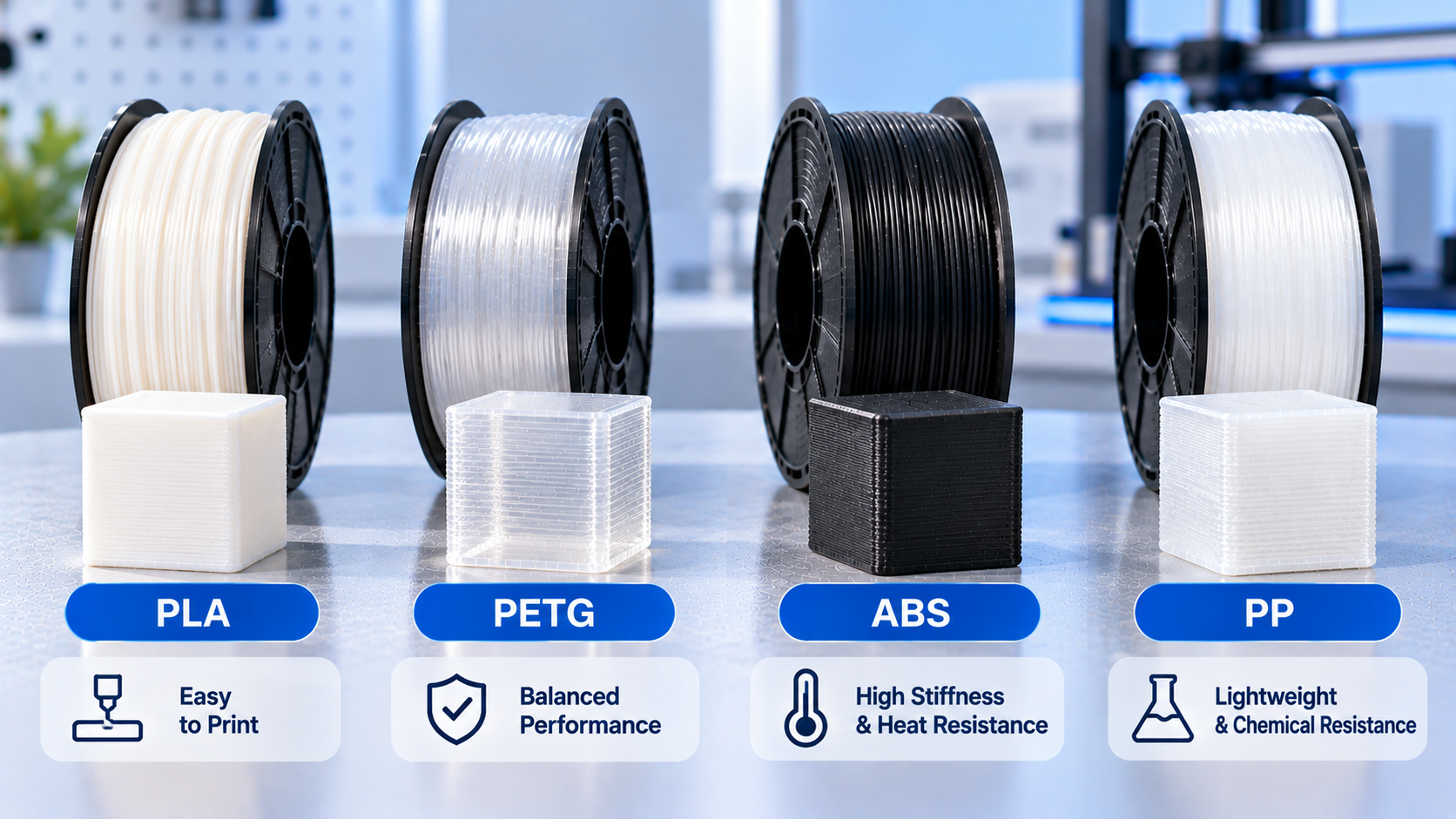
How to Choose Between PLA, PETG, ABS, and PP? A Comparison of Four Common 3D Printing Materials
PLA is easy to print, making it well-suited for visual prototypes and display models; PETG offers a good balance between ease of printing, toughness, and transparency; ABS is ideal for functional parts that require a certain degree of rigidity and heat resistance; while PP is notable for its low density, chemical resistance, and ability to withstand repeated bending.
There is no absolute superiority or inferiority among these four materials; the key is whether they suit the actual operating conditions of the part.
Before selecting materials, you can ask yourself four questions: What temperatures must the part withstand? What liquids or chemicals will it come into contact with? What types of forces will it be subjected to? And what are the requirements regarding weight?
Once these conditions are clarified, comparing factors such as printing difficulty and material parameters will generally help narrow down your options.
A one-sentence profile for each of the four materials
PLA: Suitable for beginners and visual prototyping
PLA is a common entry-level 3D printing material; it is relatively easy to print with, typically offers good dimensional detail, and comes in a wide variety of colors.
Its primary limitations are relatively low heat resistance and a susceptibility to brittle fracture under certain loading conditions.
Suitable applications: Appearance prototypes, display models, decorative parts, and components that are not subject to high temperatures or sustained mechanical loads.
PETG: Offers a well-balanced range of properties.
PETG generally offers good toughness and a moderate level of printing difficulty; some grades also exhibit excellent transparency.
Compared to PLA, PETG is generally better suited for general-purpose parts that require a degree of toughness and durability, though its actual performance will still depend on the specific material grade and printing conditions.
Suitable applications: General-purpose functional components, enclosures, brackets, parts requiring a certain degree of toughness, and transparent components that allow for the observation of internal structures.
ABS: Suitable for parts requiring rigidity and heat resistance
ABS is a common engineering plastic that typically offers good rigidity and a certain degree of heat resistance; its surface appearance can also be improved through appropriate post-processing.
The primary challenges in printing this material include shrinkage, warping, and specific requirements regarding the printing environment and ventilation. Using an enclosed printer can help manage temperature fluctuations, though you should always refer to the guidelines provided for your specific material and equipment.
Suitable applications: Functional prototypes, device enclosures, and parts requiring a certain degree of heat resistance and structural strength.
PP: Suitable for applications requiring lightweight properties, chemical resistance, and repeated flexing.
The typical density of PP (polypropylene) is approximately 0.90 g/cm³; it exhibits low moisture absorption, good chemical resistance, and—given an appropriate structural design—excellent resistance to repeated bending.
Its typical application advantages include lightweight parts, components that must come into contact with specific chemical media, and living hinge structures.
Traditional PP filaments may present challenges regarding bed adhesion and shrinkage control. While modified formulations can improve print compatibility, the actual performance of specific products still requires verification.
POLIVE PPpro™ is optimized to address the common challenges associated with 3D printing polypropylene (PP). It does not require a heated bed and can be printed at room temperature; furthermore, the printer enclosure—such as doors or lids—can be left open during the process. While an air-conditioned environment is ideal, it is not a strict requirement. The key principle during printing is to ensure uniform cooling.
Suitable applications: Lightweight functional components, structures subject to repeated bending, and parts requiring resistance to specific chemical media.
Comparing Printing Thresholds: Which Material Is Easier to Get Started With?
| Comparison Items | PLA | PETG | ABS | PP |
| Printing Difficulty | Generally lower | Generally low to moderate | Generally higher | Depends on the formulation and printing strategy |
| Risk of warping | Generally lower | Generally low to moderate | Generally higher | Traditional formulations may have higher levels; modified approaches can offer improvements. |
| Environmental Requirements | Generally more relaxed | Generally more relaxed | Generally, stricter temperature control and ventilation are required. | Depends on the specific cable |
| Platform attachment | Usually relatively easy | Attention should be paid to attachment and excessive adhesion. | A suitable attachment solution is required. | Traditional formulas typically require special attention. |
| Post-processing | Can be sanded, etc. | Can be sanded, etc. | Appropriate surface treatment may be applied. | Mechanical processing is relatively common, while bonding and coating are more difficult. |
The above represents common scenarios; it does not imply that all brands and formulations perform in the same way.
Ease of getting started
For those new to 3D printing, PLA is generally the easiest material to start with. PETG is also suitable for many general-purpose printing tasks, though it requires adjusting settings based on your specific equipment and filament.
ABS generally has more demanding requirements regarding temperature control, warpage management, and ventilation conditions.
Traditional PP may require additional fine-tuning regarding adhesion and shrinkage. Opting for optimized, modified PP filaments can help reduce some of this setup effort, though you should still follow the printing guidelines provided for the specific product.
Odors and Ventilation
PLA and PETG typically do not have as noticeable an odor as ABS under common printing conditions, but the odor does not accurately reflect the level of emissions in the air.
ABS printing can produce a noticeable odor and is accompanied by emissions of volatile organic compounds and ultrafine particulate matter. PP is not entirely emission-free either.
Regardless of the material used, appropriate ventilation should be provided based on the equipment, filament formulation, and operating environment; do not rely solely on smell to judge whether the printing environment is safe.
Post-processing
The surfaces of PLA and PETG can be improved through mechanical means, such as sanding.
Under appropriate conditions, ABS can be treated with solvents; however, the health and safety risks associated with these solvents must be considered, and relevant operational protocols must be followed.
Due to the low surface energy of PP, it can be difficult to achieve good adhesion with standard glues or coatings. When bonding or painting is required, consider using specialized PP adhesives, primers, or appropriate surface treatments.
How should performance dimensions be compared?
1. Heat resistance
The heat resistance of the four materials cannot be determined solely by their melting points; factors such as heat deflection temperature, applied load, and actual operating conditions must also be considered.
| Material | General characteristics |
| PLA | Heat resistance is generally low; for common grades, the heat deflection temperature may be around 55–60°C. |
| PETG | Generally higher than that of standard PLA, though the specific performance depends on the formulation. |
| ABS | Generally possesses good heat resistance |
| PP | It has a relatively high melting point; actual heat resistance depends on the specific grade and the design of the part. |
If a part is to be placed in a high-temperature environment—such as inside a vehicle or near a heat source—you should verify the specific material’s heat deflection temperature and operating temperature range, rather than making a decision based solely on the material’s name.
For printed parts that will come into contact with hot water, it is also necessary to verify their performance under the actual temperature, duration of contact, and applied load conditions.
2. Chemical resistance
PP generally exhibits good resistance to a wide range of acids, bases, and other chemical substances, making it a strong candidate for applications that require chemical resistance.
However, this does not mean that PP is resistant to all cleaning agents, solvents, or oils. The chemical resistance of PETG, ABS, and PLA also varies depending on the medium, concentration, temperature, and duration of contact.
If parts are expected to come into contact with oils, cleaning agents, or industrial fluids, the material compatibility should be verified against the specific substances; immersion testing should be conducted if necessary.
3. Lightweighting
The densities of typical materials can be used as a reference, as follows:
| Material | Typical density range |
| PP | approx. 0.90 g/cm³ |
| ABS | approx. 1.04–1.06 g/cm³ |
| PLA | approx. 1.24–1.27 g/cm³ |
| PETG | approx. 1.24–1.27 g/cm³ |
Specific values will vary depending on the material grade and formulation.
For a given volume, PP is generally lighter than the other three materials. This makes it an attractive choice for applications such as drone components, portable devices, and weight-sensitive functional parts.
The weight of the actual printed part is also influenced by infill density, wall thickness, support structures, and internal geometry.
4. Toughness and Repeated Bending
Different materials are suited to different types of loading.
PLA: It has good rigidity, but some grades are prone to brittle fracture under impact or conditions of stress concentration.
PETG: Generally possesses good toughness, making it suitable for many general-purpose functional parts.
ABS: Combines rigidity with a certain degree of impact resistance; its specific performance depends on the formulation and print quality.
PP: Exhibits excellent resistance to repeated bending when properly designed, making it suitable for structures such as living hinges.
It should be noted that the properties of the material itself are not equivalent to the final performance of a printed part. Print orientation, interlayer bonding, wall thickness, and geometric design all influence the actual strength and lifespan of the component.
5. Appearance and Surface Effects
PLA: Offers a wide range of color options and typically makes it easy to achieve a look with clear, sharp details.
PETG: Some grades can appear transparent or translucent.
ABS: A relatively smooth surface can be achieved through appropriate post-processing.
PP: Its appearance generally depends on the formulation and the printing process; it can be used for functional and lightweight designs.
If the final product is intended primarily for display, appearance and surface quality may be the primary considerations; if it is intended for functional applications, priority should be given to verifying mechanical properties, heat resistance, and environmental compatibility.
Four-Step Selection Method: Quickly Narrowing Down the Options
Step 1: Check the temperature
First, determine the long-term operating temperature the part will need to withstand, as well as whether it will be exposed to high temperatures for short periods.
If the operating temperature exceeds the material’s specified range, the part is not suitable for use—even if its printed appearance is perfect.
Step 2: Consider the contact medium
Will the parts come into contact with water, grease, cleaning agents, or other chemicals?
If chemical resistance is a key requirement, materials should be selected based on the specific medium and operating conditions, rather than assuming—in a general sense—that any single type of plastic can withstand all chemical substances.
Step 3: Examine the mode of force application
Is the component primarily subjected to static loads, impacts, or repeated bending?
For the appearance prototype, PLA can be considered as a primary option.
General-purpose functional parts: PETG and ABS can be compared.
For applications requiring higher rigidity and heat resistance, ABS is a primary candidate; depending on the specific operating conditions, PP may also be considered.
For applications requiring lightweight properties, chemical resistance, or living hinge structures, PP (polypropylene) is a strong candidate for evaluation.
These represent initial selection directions; final choices will still need to be reconciled with specific product grades and design verification.
Step 4: Check the weight and printing conditions
If weight is a concern, the low density of PP is a distinct advantage.
If the printer lacks an enclosed chamber, ABS may require more stringent environmental control. For PP, the focus should be on verifying specific adhesion strategies, shrinkage characteristics, and printing guidelines for the filament.
When selecting materials, one should look beyond the price per spool of filament and also consider the number of test prints required, the failure rate, the time spent on calibration, and post-processing costs.
Summary: Four types of materials, each suited for specific applications.
PLA excels in print-friendliness and aesthetic finish; PETG offers a well-rounded balance of properties; ABS is suitable for functional parts that require a degree of rigidity and heat resistance; while PP provides unique advantages in terms of low density, chemical resistance, and tolerance to repeated bending.
When selecting materials, you can begin by filtering based on four criteria: temperature, contact medium, type of mechanical stress, and weight requirements. Follow this by verifying material specifications, printing parameters, and actual test results.
If you are still uncertain, it is advisable to print a sample and verify it in an environment that closely approximates actual usage conditions. Practical testing is generally more informative than simply comparing material names.
If your needs focus on lightweight design, chemical resistance, and repeated bending, you can learn more about POLIVE PPpro™. This modified PP filament is optimized for printing on PP and supports printing in environments without heated beds, at room temperature, and in open-bed printing; however, actual results should be based on the product specification guide and test prints.
PLA、PETG、ABS、PP 怎么快速选?
先定用途再选料:外观原型 PLA,均衡通用 PETG,刚性与耐热 ABS,轻量耐化学抗疲劳的功能件 PP。
四种材料里哪个最容易上手?
PLA 最省心,PETG 次之,ABS 对环境和后处理要求高。PP 过去门槛高,但改性线材已经把加热床和封箱这两项去掉了。
比参数表更该看什么?
看卖家有没有给可复现的打印条件、实测件和边界说明。四步法:定用途 → 排掉不满足工况的 → 比打印门槛 → 小件实测再定。
PP 的位置在哪?
不是替代谁,而是补上功能件这块:不加热床、不封箱,Bambu A1 这类开放机器在空调房里就能打,首层用裙边加 PPLOCK26811。
Related Reading
- PP or PLA: Which Should You Choose? A Guide to Selecting 3D Printing Materials
- How to Choose 3D Printing Materials? Understanding Key Indicators on the Spec Sheet
- How to Configure PP 3D Printing Settings? PPpro™ Parameter Guide
- Are PP 3D-printed parts drop-resistant? A comparison of impact resistance: PP vs. PETG and ABS