
Can PP printed items be placed outdoors?
Yes, butNot all PP 3D printed parts are suitable for long-term exposure to outdoor environments.。
Outdoor environments often include factors such as ultraviolet rays, rain, humidity, and temperature changes. For 3D printed parts, the material's own properties are only one of the factors.Material formulation, color, printing process, and component structureIt will all affect the long-term performance of the device.
PP itself has low water absorption and good resistance to moisture and many common chemical media, thus it has certain advantages in some outdoor and humid environments.
But if the parts need to be exposed to strong sunlight for a long time,UV stability systems and specific material formulations are equally important.。
Why is PP suitable for some outdoor applications?
Some of the material properties of PP make it suitable for parts that require water resistance, chemical resistance, and flexibility.
1. Low water absorption
PP usually has low water absorption.
In a humid environment, this means that PP is not as susceptible to moisture as some higher-moisture-absorbing engineering plastics.
This is a strength of PP for outdoor parts and functional parts in humid environments.
2. Good tolerance to moisture and many chemical media
PP has good resistance to many common acids, alkalis, and chemical media.
Therefore, in applications where outdoor exposure to rainwater, cleaning agents, or other chemical media is possible, PP has certain material advantages.
However, the actual chemical resistance still depends onChemicals types, concentrations, temperatures, contact times, and specific material formulations。
3. Has flexibility and fatigue resistance
PP usually has good flexibility and repeated bending properties.
For outdoor functional items that require a certain degree of flexibility, impact resistance, or repeated movement, these characteristics have practical value.
Is PP resistant to ultraviolet rays?
PP is not a material that naturally has unlimited UV resistance.
After prolonged exposure to ultraviolet radiation, PP polymers may undergo aging, manifested as color changes, surface changes, and a decrease in mechanical properties.
Therefore, if the application scenario is:
- Direct sunlight for a long time
- High UV intensity areas
- Long-term outdoor fixed installation
- Has high requirements for service life
It’s not just about whether it’s PP; you also need to pay attention to other factors.Ingredient formulation and UV-stable system。
For long-term outdoor use, it is more suitable to choose materials that have been UV stabilized and have been verified through practical testing.
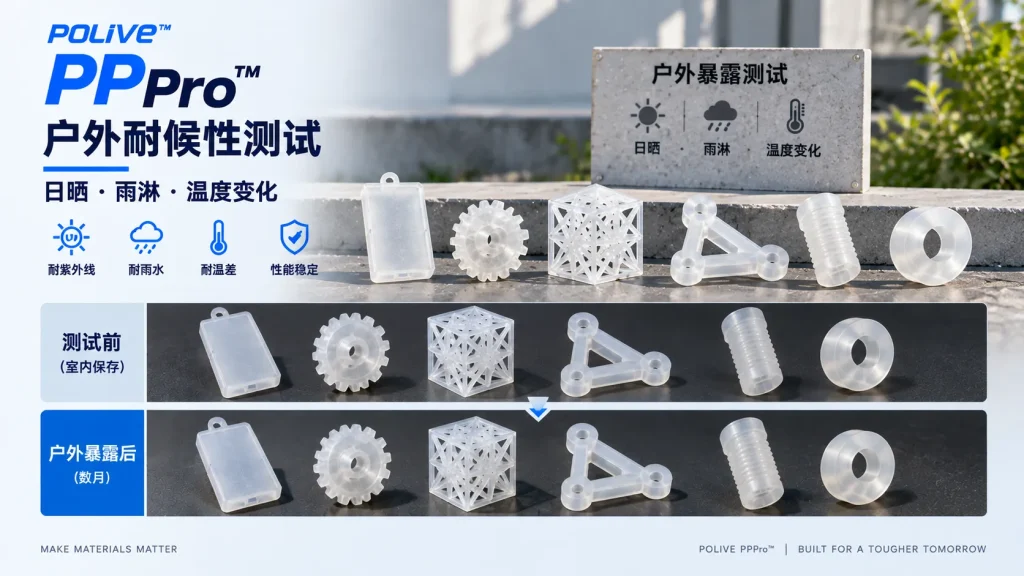
POLIVE PPpro™ outdoor testing
To observe the performance of PPpro™ in real outdoor environments, we placed the PPpro™ printed test pieces in an outdoor environment and subjected them to sunlight and rain.
During the testing process, we focused on observing the following:
- Appearance
- Color changes
- Structural integrity
- Size changes
- Changes in mechanical properties
After several months of outdoor exposure, during this test conditions and test cycle,The overall appearance and structure of the PPpro™ test pieces remain good; no significant abnormalities were observed.
It should be noted that the results of outdoor exposure testing are related to the specific environment.
The UV intensity, temperature, humidity, season, and the actual load on the parts in different regions all affect the aging performance of the material. Therefore,Months of outdoor testing cannot be directly equated with years of outdoor use life.。
For parts that require long-term outdoor use, it is still recommended to conduct verification based on the actual application environment.
Which outdoor applications can consider PP 3D printing?
Based on the material characteristics of PP, the following applications can be considered:
- Outdoor sensor housing
- Bicycle accessories
- Garden irrigation accessories
- Balcony equipment parts
- Outdoor tools accessories
- Functional prototype of outdoor equipment
- Structures that require a certain degree of flexibility
However, whether the specific parts are suitable for long-term outdoor use still needs to be comprehensively considered.Size, wall thickness, load conditions, printing direction, and actual environment。
What should be taken into consideration when using PP 3D printed items outdoors?
If the goal is long-term outdoor use, it should not be limited to just considering whether PP is weatherproof.
It is even more necessary to consider comprehensively:
Material formulation + UV stability + color + printing parameters + part structure + actual environment
For long-term exposure to sunlight, it is recommended to prioritize products that have undergone UV stabilization designThe material is tested through actual outdoor exposure tests.
Color can also affect outdoor performance, butColor itself does not directly represent the UV weather resistance rating.Ultimately, it still depends on the specific material formulation and UV stability system.
For POLIVE PPpro™, actual print piece testing can help provide a more intuitive understanding of how the material performs in real-world environments.
Summary
PP has low water absorption, good chemical resistance, and good flexibility, so it has potential in 3D printing applications in some outdoor and humid environments.
However, “PP = can be used outdoors permanently” is not accurate.
If the parts need to be exposed to extreme temperatures for a long time, it is even more important to select the appropriate material formulation and verify it by combining it with actual outdoor exposure or UV aging testing.
For POLIVE PPpro™, actual outdoor testing has helped us gain a more intuitive understanding of the material’s performance under sunlight, rain, and temperature fluctuations.
Related reading
- How is PP’s chemical resistance? Learn about the chemical resistance of PP 3D printed parts

