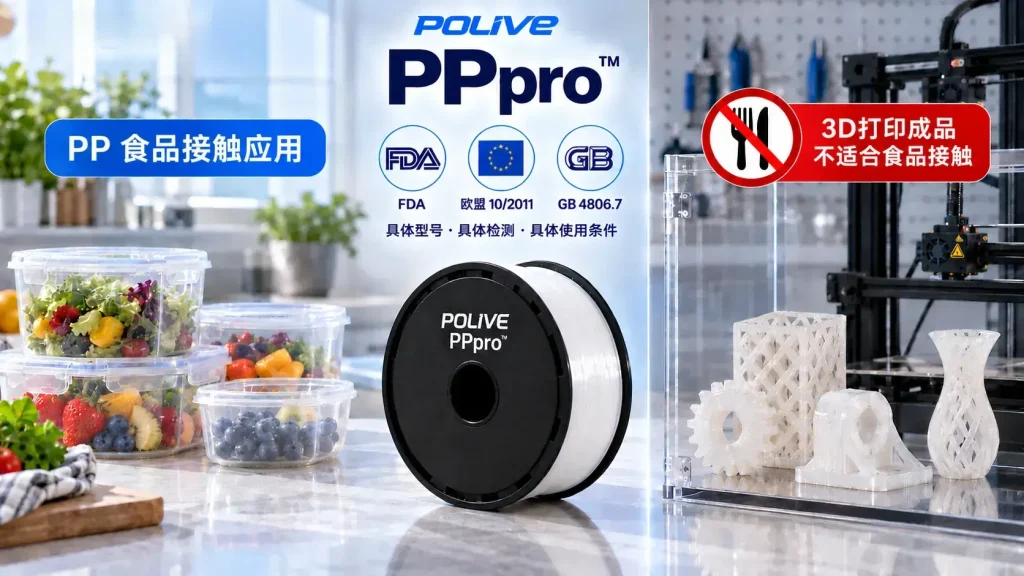
Why Is PP Commonly Used for Food Contact?
In daily life, we see many food-contact products made of PP (polypropylene), such as:
- yogurt cups
- fresh-food containers
- food packaging containers
- some microwave lunch boxes
- bottle caps
- food storage containers
Why is PP so widely used in these applications?
This relates to PP’s ownchemical stability, low water absorption, chemical resistance, and heat resistance.
However, a key caveat must be noted:
“PP can be used for food contact” does not mean “every PP product can directly contact food.”
Food-contact safety ultimately depends on the specific material formulation, additives, manufacturing process, usage conditions, and applicable regulations.
What is PP’s chemical composition?
PP’s repeating structural unit can be expressed as:
(C₃H₆)n
Its base polymer consists mainly of carbon and hydrogen.
Compared with some other common plastics, PP’s base polymer structure is relatively simple.
However, it is important to note thatYou cannot judge whether a plastic product is food-safe based solely on its chemical formula.
Besides the polymer itself, an actual product may also contain:
- color masterbatch
- stabilizers
- antioxidants
- plasticizers or processing aids
- other functional additives
Therefore, food-contact safety must be assessed forthe specific formulation and productrather than judged only by the material name “PP.”
Why is PP suitable for food-contact applications?
PP is widely used in food packaging and containers, mainly because of a range of its material properties.
1. Good chemical resistance
PP has good resistance to many common acids, alkalis, and chemical media.
For food containers, this means the material can tolerate a certain range of food and liquid environments.
Actual resistance still depends on the food type, temperature, contact time, and the specific PP formulation.
2. Low water absorption
PP has low water absorption.
This is an advantageous property for products that need long-term contact with moisture or humid environments.
3. Good heat resistance
PP’s heat resistance allows it to be used in some food containers and packaging products that require heating.
For example, some PP food containers can be used for microwave heating.
But “PP is heat-resistant” does not mean all PP products can be used under any high-temperature condition.
Each product must still be judged by the temperature range and usage specified by the manufacturer.
What are FDA, EU 10/2011, and GB 4806.7?
PP is widely used in food-contact materials worldwide, but different regions adopt different regulations and standards.
U.S. FDA
Food-contact materials in the United States are regulated by relevant FDA rules and requirements.
PP materials that meet the relevant requirements can be used in specific food-contact applications, but they must satisfy specific regulations, formulations, and usage conditions.
“FDA permits PP” does not meanany PP formulation or any PP product automatically obtains FDA food-contact certification.
EU 10/2011
The EU has established, for food-contact plastic materials, Regulation (EU) No 10/2011.
a regulation covering the permitted substances in plastic food-contact materials, migration limits, and restrictions under different foods and usage conditions.
Meeting EU 10/2011 requirements requires evaluation against the specific material and usage conditions.
China’s GB 4806.7
China’s GB 4806.7 is the national food-safety standard for plastic materials and products intended for food contact.
It addresses the safety requirements for plastic food-contact materials and products, including requirements for raw materials, additives, and migration.
It also bears emphasizing:
a specific material or product that complies with GB 4806.7 must be backed by the corresponding test reports and compliance documents.
Food-grade PP ≠ food-grade 3D-printed part
This is the point 3D printing users must pay the most attention to.
Even if a PP raw material itself can be used for food contact, you cannot directly conclude from that:
“a part printed with this PP filament can definitely hold food directly.”
A 3D-printed part introduces many additional variables.
For example:
Material formulation
The filament may contain different additives, color masterbatch, and other components.
Nozzle material
The printing nozzle may be made of brass, stainless steel, or other materials, and material contact and wear must be considered.
Printing environment
During printing, the part may be contaminated by air, equipment, and the operating environment.
Internal structure of the printed part
FDM printed parts typically have interlayer structure, porosity, and complex surface morphology.
Post-processing
Post-processing such as sanding, cleaning, and coating may also introduce new substances.
Therefore:
Food-grade resin ≠ food-grade filament ≠ automatically food-safe 3D-printed part.
POLIVE PPpro™ and food contact
POLIVE PPpro™ is a modified PP filament developed for FDM 3D printing.
For food-contact applications, you must rely onthe specific model’s test reports, compliance documents, and packaging labelsas the basis.
If a specific PPpro™ model has completed the relevant GB 4806.7 testing, it should be described according to that model’s test results and usage conditions.
You cannot extend food-contact use to all PPpro™ models or all printed parts just because PP itself is commonly used in food packaging.
For final products that need direct food contact, you should also consider the printing equipment, nozzle, production environment, cleaning method, usage temperature, and actual food-contact conditions.
What should you watch out for when 3D printing food containers?
If you use PP for 3D-printed food-related products, we recommend focusing on:
① Confirm whether the specific filament model has the corresponding food-contact compliance documents
② Confirm whether the additives and color masterbatch are suitable for the intended food-contact use
③ Confirm whether the printing equipment and nozzle are suitable for this use
④ Keep the printing environment and equipment clean
⑤ Evaluate based on the actual usage temperature and food type
⑥ Do not conflate “the material can contact food” with “the printed part is already food-safe”
Especially for products used in commercial food packaging or in long-term direct food contact, verification should be based on specific regulations and testing requirements.
Why can’t food-contact safety be judged by the material name alone?
Names like “PP,” “PLA,” and “PETG” only tell us the broad category of the material.
What truly determines whether a product fits a specific food-contact scenario is:
material formulation + additives + manufacturing process + product structure + food type contacted + temperature + contact time + regulatory requirements
Therefore, when choosing food-contact materials,the specific product’s compliance documents matter more than the material name itself.
Conclusion
PP is a plastic material widely used in food-contact products.
It offers:
low water absorption + good chemical resistance + good heat resistance + extensive food-contact application experience
The U.S. FDA, the EU’s EU 10/2011, and China’s GB 4806.7 have all established corresponding food-contact material regulations or requirements.
But the most important point is:
food-grade PP raw material does not mean any PP 3D-printed part can directly contact food.
For POLIVE PPpro™, food-contact use should be based onthe specific model’s test results, compliance documents, and specified usage conditionsas the basis.
If you are using PP to print food-related products, you should conduct a comprehensive evaluation across materials, printing equipment, production environment, and final usage conditions.
为什么食品容器常用 PP?
PP 化学组成简单、耐化学性好、吸水率低、耐热表现好,日常餐盒和微波容器大量用它。FDA、EU 10/2011、GB 4806.7 是不同市场针对食品接触材料的法规框架。
食品级 PP 线材等于食品级打印件吗?
不等于。材料合规只是起点,打印过程、喷嘴与平台残留、层间缝隙藏污、后处理都会影响成品。判断安全性要看成品和使用条件,不能只看材料名。
用 3D 打印做食品容器要注意什么?
优先做短时接触或原型用途,避免长期盛装和高温反复使用;设计上减少难清洗的缝隙与尖角,壁厚均匀、圆角过渡;真正入口的用途请按实际法规和检测要求单独验证。
Related Reading
·Where Is PP Used in Industry? From Injection Molding’s Home Turf to a Bridge to 3D Printing
·How Chemical-Resistant Is PP? Understanding the Chemical Resistance of PP 3D Printed Parts