What Is Polypropylene (PP)? PP for 3D Printing from a Materials Perspective
Polypropylene (PP) is a thermoplastic polyolefin polymerized from propylene monomers, with low density, good chemical resistance and good melt-processability, and is therefore widely used in automotive, packaging, home appliances and everyday consumer goods.
PP’s density is typically about 0.90 g/cm³, placing it among the lower-density common plastics. For 3D printing, PP’s value lies not only in lightweighting, but also in material properties such as low water absorption, chemical resistance, flexibility and repeated-bending endurance.
However, traditional PP is not a particularly easy material for FDM 3D printing. Due to PP’s semi-crystalline nature, shrinkage tendency and low surface energy, issues such as warping, bed adhesion and interlayer bonding may occur during printing.
Therefore, PP filament for 3D printing is not simply ordinary PP drawn into filament, but requires corresponding formulation and process optimization for FDM printing needs.
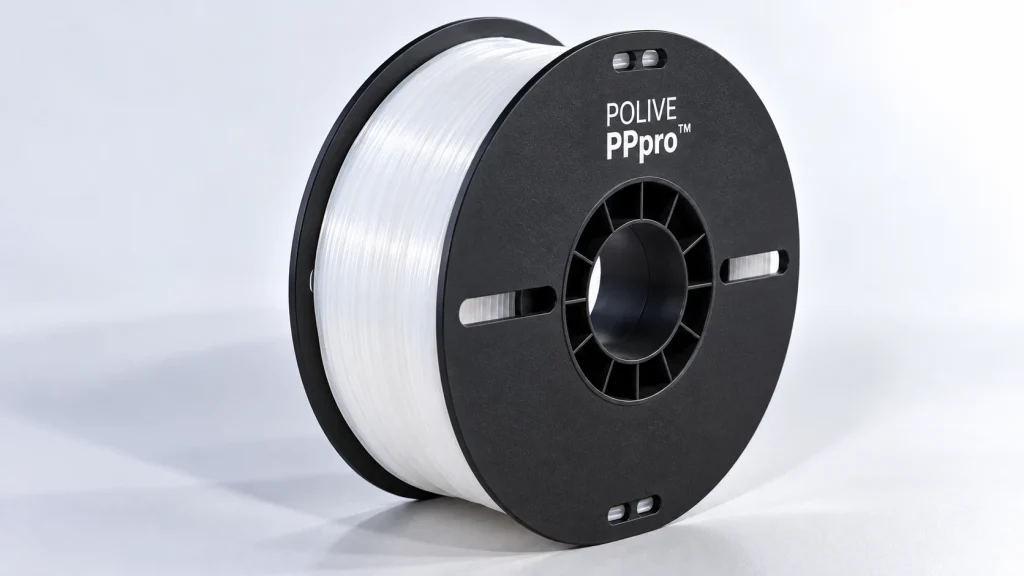
For example,POLIVE PPpro™ is a modified PP filament developed for FDM 3D printing, aimed at improving PP’s performance during printing and making its material characteristics easier to apply in desktop 3D printing. 01 Material Basics
What kind of material is polypropylene?
From a chemical-structure perspective, PP belongs to the polyolefins, consisting mainly of carbon and hydrogen. Its polymer backbone is made of carbon atoms and carries methyl side groups.
This structure gives PP low molecular polarity and low water absorption. At the same time, PP’s density is about 0.90 g/cm³, lower than the density of water, so PP products can show floating behavior under certain conditions. 01 Material Basics
From a practical application perspective, PP has good acid/alkali resistance, oil resistance and repeated-bending endurance, and is therefore widely used in food containers, automotive parts, bottle caps and other products.
PP’s melting point is usually around about 160°C, but the exact value varies with material type and grade. PP also belongs to thesemi-crystalline material, a characteristic that is very important for 3D printing, because the material undergoes volume change during cooling and crystallization, which further affects the shrinkage and dimensional stability of the printed part. 01 Material Basics
Why PP is worth using in 3D printing
For 3D printing, PP’s appeal comes from a combination of material properties:
- Lightweight: PP’s density is about 0.90 g/cm³, suitable for applications sensitive to part weight, such as lightweight structural parts and some drone-related components.
- Chemical resistance: PP has good tolerance to many common acids, alkalis, oils and some cleaning media, so it suits some laboratory utensils, container prototypes and functional parts.
- Repeated-bending endurance: PP has good toughness and fatigue resistance, and can be used in living hinges, snap fits and structures requiring repeated motion.
- Recycling foundation: PP is a thermoplastic, and from the material itself has a foundation for recycling and reprocessing, but whether it can actually enter the recycling system still depends on factors such as local recycling facilities, material purity and contamination.
Note that properties such as “chemical resistance” and “heat resistance” are not absolute. The specific performance is affected by factors such as contacting medium, temperature, time, material formulation and usage conditions.
If food contact or medical use is involved, you cannot judge whether a product meets the relevant requirements based only on the material name “PP”; you also need to confirm it in combination with specific regulations, material formulation and actual testing. 01 Material Basics
What is the difference between PP for 3D printing and ordinary PP?
Ordinary PP itself is a mature industrial plastic, butbeing usable for traditional processing does not mean it can directly become an easy-to-print FDM filament.
If ordinary PP is directly made into filament for FDM printing, several main problems are usually encountered.
shrinkage and warping
PP is a semi-crystalline material and goes through melting, cooling and crystallization during printing. The volume change during cooling may cause the printed part to shrink and develop internal stress, increasing the risk of warping and deformation.
Platform attachment
PP has low surface energy, and the molten material does not easily form good wetting and adhesion with the build platform, so the first layer may show insufficient adhesion, edge lifting or even the part detaching from the platform. 01 Material Basics
Interlayer bonding
FDM printing forms parts by extruding molten material layer by layer, so besides the adhesion between the first layer and the platform, the bonding between layers is also very important.
Factors such as material formulation, melt state, printing temperature and cooling conditions can all affect the final interlayer bonding performance.
Therefore, traditional PP usually has higher material and process requirements in FDM printing.
How do modified PP filaments solve these problems?
The idea of modified PP filament is to improve its printing behavior through formulation and process adjustments while retaining PP’s basic material characteristics.
The main goals include:
- reducing the shrinkage and warping tendency during printing;
- improving build-platform adhesion;
- improving interlayer bonding;
- improving the stability of melt extrusion.
In other words,modified PP does not simply change PP’s material attributes, but makes PP more suitable for the FDM 3D-printing process.
POLIVE PPpro™ is a modified PP 3D-printing filament developed along this line of thinking, with the goal of making PP’s original lightweight, chemical-resistant, flexible and repeated-bending characteristics easier to turn into actual printed parts through ordinary FDM equipment. 01 Material Basics
Where PP sits among common printing materials
PP is not meant to completely replace PLA, ABS or PETG.
Different materials have different advantages, and the final choice should be based on the part’s actual use.
compared with PLA Compared with them, PP has different advantages in flexibility, repeated-bending endurance and chemical resistance, but traditional PP usually has higher printing difficulty.
compared with ABS Compared with them, PP has lower density and usually better chemical resistance and flexibility; ABS has its own advantages in rigidity, heat resistance and mature engineering applications.
compared with PETG Compared with them, PP is more suitable for applications emphasizing lightweighting, flexibility, chemical resistance and repeated bending, while PETG usually has better printing ease of use and advantages in transparency and appearance.
Therefore,No single 3D-printing material can dominate across all performance dimensions.
When choosing a material, the more important question is not “which material is best,” but:
“which material is more suitable for this part?” 01 Material Basics
Summary
PP is a widely used thermoplastic polyolefin withlow density, good chemical resistance, low water absorption, flexibility and repeated-bending enduranceand other material properties.
These characteristics give PP some potential in functional 3D-printing applications.
But at the same time, PP’s semi-crystalline nature, shrinkage tendency and low surface energy also make traditional PP more prone to encounterwarping, platform adhesion and interlayer bondingand other problems during FDM printing.
Therefore, PP filament for 3D printing is not simply ordinary PP drawn into wire, but requires material formulation and process optimization for the FDM printing process.
The value of modified PP filament lies in making PP’s original material advantages easier to convert into actual 3D-printing performance.
POLIVE PPpro™ is a modified PP 3D-printing filament developed precisely around this direction.
If you want to further understand PP’s semi-crystalline characteristics, how the crystallization process affects printed parts, or why traditional PP tends to suffer warping and adhesion problems in FDM printing, you can continue reading the related articles below.
聚丙烯(PP)到底是什么材料?
由丙烯单体聚合而成的热塑性聚烯烃,密度低、耐化学性好、熔融加工性能好,是日常和工业里用量最大的通用塑料之一。
3D 打印用 PP 和普通 PP 有什么不一样?
材料本体是同一类,差别在 FDM 适配。普通 PP 半结晶收缩大、表面能低,逐层打印时会翘边、粘不住、层间弱;打印用改性 PP 是把这三件事一起解决。
改性 PP 让 PP 变得容易打,靠的是什么?
材料配方和打印方案配套:PPpro™ 不加热床、不封箱,靠空调房开放散热定型,首层用裙边加 PPLOCK26811,零件端做圆角与均匀壁厚,入门开放机器也能打。
Related Reading
- Is PP a Semi-Crystalline Material? What Crystallinity Means for 3D Printing
- 为什么 PP 以前这么难打?收缩、翘边、粘不住的三大难题
- PP or PLA: Which Should You Choose? A Guide to Selecting 3D Printing Materials
- Who is POLIVE? A company that makes high-performance materials more accessible