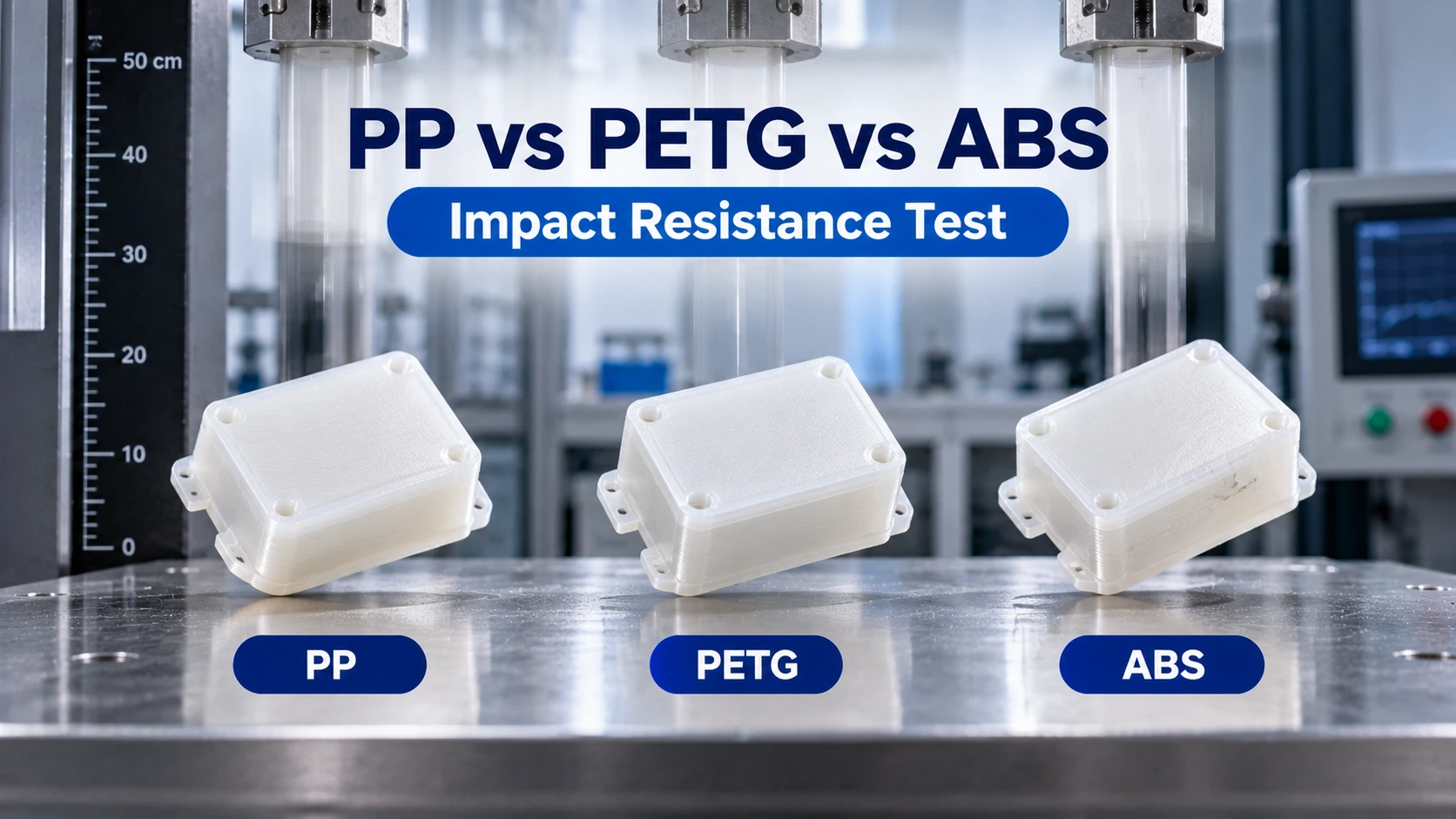
Are PP 3D-printed parts drop-resistant? A comparison of impact resistance: PP vs. PETG and ABS
PP is one of the common 3D-printing materials with relatively good toughness and impact-resistance potential.
Under impact, PP can, under certain conditions, absorb part of the impact energy through plastic deformation rather than failing by brittle fracture immediately. Therefore, for parts that may experience drops, collisions or repeated impacts, PP offers certain application advantages.
However, being “drop-resistant” is not determined by the material alone.
part geometry, wall thickness, fillets, print orientation, interlayer bonding, print quality and drop postureall affect the final result. With the same material, different part designs can lead to very different drop-resistant performance.
Therefore, instead of simply asking “is PP drop-resistant?”, it is better to judge from three aspects together: material, printing process and structure.
“Drop resistance” quantified in testing?
In materials laboratories, impact resistance is usually evaluated through standardized impact tests.
Common methods include:
- Cantilever beam impact (Izod)
- Simply supported beam impact (Charpy)
Such tests measure the energy absorbed by a specimen of specified dimensions and conditions when subjected to an instantaneous impact, and are used to evaluate the material’s ability to resist impact failure.
In addition, in real product development, it is also common to usefree-fall drop testing.
For example, performing a fixed-height drop test on an enclosure allows you to observe:
- whether cracks appear
- whether fracture occurs
- whether obvious whitening appears
- whether the snap fits are damaged
- whether the screw bosses fracture
- whether the enclosure is permanently deformed
It should be noted thatMaterial impact testing and full-product drop testing are not the same test.
Notched impact testing mainly evaluates the material’s ability to resist instantaneous impact failure under standard specimen conditions, whereas product drop testing is also affected by factors such as part shape, wall thickness, structure, internal stress and landing posture.
Therefore, data from the two types of tests cannot be directly substituted for one another.
What are the differences in impact performance between PP and PETG or ABS?
The impact performance of different materials cannot be simply ranked by “which is best.”
PP: emphasizes toughness and deformation capability
One characteristic of PP is its good ductility and toughness.
Under impact, under suitable material and structural conditions, PP may first undergo relatively obvious plastic deformation, thereby absorbing part of the impact energy.
This is advantageous for:
- protective enclosures
- Snaps
- containers
- flexible structures
- parts that experience repeated minor impacts
and may offer certain advantages.
But this does not mean that every PP formulation or every PP printed part is necessarily more drop-resistant than PETG or ABS.
PETG: a relatively balanced trade-off between toughness and rigidity
PETG usually has better toughness than PLA, so it is often used for functional printed parts.
However, actual impact performance is still affected by:
- Material formulation
- Printing temperature
- Interlayer bonding
- Print orientation
- Part structure
and other factors.
Therefore, you cannot judge whether a PETG part is necessarily drop-resistant based solely on the material name.
ABS: has a solid engineering application foundation
ABS has good overall mechanical properties and impact resistance, and has long been used for enclosures and functional parts.
But ABS tends to suffer from warping and shrinkage during 3D printing. If the internal stress during printing is high, or interlayer bonding is poor, the actual drop performance may also be affected.
Therefore, the material’s own performance does not equal the performance of the final printed part.
Why might PP printed parts be more drop-resistant?
The drop process can be simply understood as:
impact -> part deformation -> absorb part of the energy -> stress redistribution
If the material can undergo a certain amount of deformation without immediately fracturing, it has a chance to absorb part of the impact energy through deformation.
This is also why, in some drop scenarios, a material with better toughness may perform better than a highly rigid but more brittle material.
But it must be emphasized that:
being flexible does not mean unlimited impact resistance.
If the impact on a part exceeds what the material and structure can withstand, PP can likewise suffer permanent deformation, cracks or even fracture.
Structural design determines the upper limit of a printed part’s drop resistance
Even using the same PP, changing the part structure can significantly affect drop-resistant performance.
1. Fillets are better than sharp corners for stress dispersion
Right angles and sharp corners easily create stress concentrations.
Adding reasonable fillets at enclosures, brackets and connection points allows loads to be transferred more smoothly and reduces local stress concentrations.
Therefore, for parts subject to impact, fillets are usually more reasonable than completely sharp corners.
2. Uniform wall thickness reduces weak areas
If the wall thickness varies too much across different regions of a part, the thinner regions may become the first to deform or fail.
Therefore, when designing enclosures and structural parts, unnecessary local thin walls should be avoided as much as possible.
Of course, increasing wall thickness also brings:
- increased weight
- increased material usage
- Increased print time
- changes in shrinkage and deformation
so thicker is not always better; a balance must be struck based on the actual load.
3. Snap fits and screw bosses need focused reinforcement
Many parts fail not at the main enclosure first, but at local structures first.
For example:
- snap-fit fracture
- screw-boss cracking
- failure at thin-wall joints
- cracking around holes
- cracks at sharp corners
For these areas, impact resistance can be improved by adding fillets, locally thickening, or optimizing the connection structure.
Print orientation also affects drop-resistant performance
FDM printed parts are anisotropic.
The material is not formed in one shot, but built up layer by layer from molten material. Therefore, the relationship between the direction of the impact load and the print layers affects how the part fails.
If a critical load-bearing location happens to lie in the weaker interlayer direction, even if the material itself has good impact performance, the part may still fail at the interlayer location.
So, for parts that need to resist drops, you should not only focus on the material’s impact strength, but also consider:
impact direction + print orientation + interlayer bonding + part structure
Want to verify whether your PP printed part is drop-resistant? Here is how to test it
If you are developing an actual product, you can first design a simple, repeatable drop test.
For example:
Step 1: Standardize the test specimens
Prepare multiple specimens with identical dimensions and structure.
If comparing PP, PETG and ABS, it is best to use:
- identical outer shape
- identical wall thickness
- identical structure
- print parameters as close as possible
This reduces the influence of structural differences.
Step 2: Fix the drop height
You can choose a clear test height, for example:
- 1 m
- 1.2 m
The key is not the height itself, butall specimens using the same test conditions.
Step 3: Fix the drop posture
You can test separately:
- landing flat on the front face
- landing on the side
- landing on a corner
Because the same part dropped from different angles can generate completely different local stresses.
Step 4: Repeat the test
Do not drop it just once.
You can perform multiple tests for each condition and record:
- whether cracks appear
- whether it fractures
- whether it whitens
- whether it is permanently deformed
- whether the snap fits are damaged
- whether the screw bosses are damaged
Only then does the resulting data become more meaningful as a reference.
Testing in low-temperature environments is also worthwhile
If the part’s actual use environment may experience lower temperatures, low-temperature drop testing is especially worth attention.
A polymer’s impact performance is affected by temperature.
Therefore, a printed part that performs well at room temperature does not mean it has the same impact performance under all temperature conditions.
If the product needs to be used in different environments, it is best to verify under the corresponding temperature conditions respectively.
Why can’t you just look at the material datasheet?
The impact strength in the material datasheet is an important reference, but it does not directly equate to “how many times this 3D-printed part can be dropped.”
The reason is simple:
Material testing != 3D-printed part testing.
Standard material specimens usually have specified dimensions, notches and test conditions, while actual printed parts are also affected by:
- Print orientation
- Interlayer bonding
- Wall thickness
- infill structure
- Fillets
- internal stress
- printing defects
- part geometry
and other factors.
So, if you want to verify a real product, you should ultimately performactual part drop testing.
Summary
- PP has good toughness and ductility, and offers advantages in some drop and impact scenarios.
- The impact performance of PP, PETG and ABS cannot be simply ranked apart from specific formulations, print parameters and test conditions.
- Izod/Charpy notched impact testingand actual product drop testing belong to different types of tests.
- Fillets, reasonable wall thickness and local structural optimization can improve a part’s impact resistance.
- Print orientation and interlayer bonding affect the actual drop performance of FDM parts.
- If comparing different materials, you should standardize the specimens, drop height, drop posture and test environment.
- For actual products,material performance is only the foundation; the final drop-resistant capability still depends on the printing process and structural design.
Are PP Prints Drop-Resistant?
PP's toughness stands out among common 3D printing materials: under impact it tends to deform and absorb energy rather than fracture brittlely like PLA, so its drop-resistance potential is good.
How Does It Compare with PETG and ABS?
PP leans towards toughness and deformation; PETG is more balanced between toughness and stiffness; ABS has a mature base of engineering applications. But on a real part, structural design and print orientation often matter more than the material ranking.
What Design Changes Make a Part More Drop-Resistant?
Rounded corners beat sharp ones, avoid sudden wall-thickness changes and stress concentrations, keep the load direction away from layer-bond planes, and thicken critical areas modestly. These work better than switching to a harder material.
How Do You Test Drop Resistance Yourself?
Drop the real part repeatedly from a real height onto a real floor, and record the drop count and location of the first crack. Test once at low temperature too, since cold reduces toughness. Keep the same printing parameters throughout or the results are not comparable.
Related Reading
- Are PP Prints Strong? How to Assess PP’s Mechanical Properties
- How Strong Are the Interlayer Bonds of PP Prints? How to Improve Z-Direction Strength