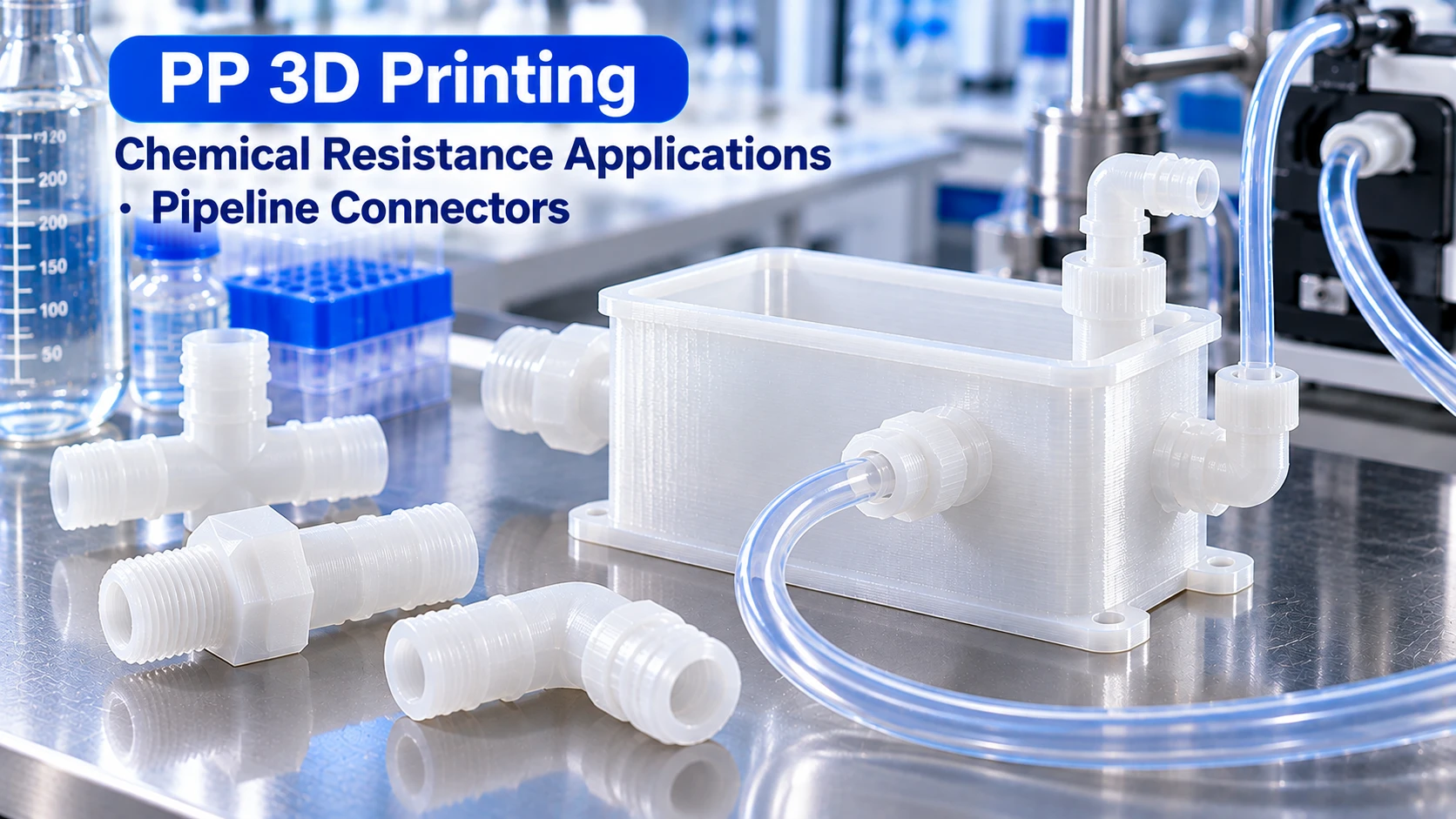
Can 3D printing be used for chemical vessels and piping components? Exploring corrosion-resistant parts
Can 3D printing be used to produce chemical containers and piping components?
Exploration is possible, but the boundaries of application must be clearly defined.
PP (polypropylene) offers excellent chemical resistance. By using modified PP filament, one can attempt to print items such as small liquid-containment boxes, dosing accessories, pipe connectors, and protective components for equipment.
However, since FDM 3D printing builds objects by stacking material layer by layer, the bonding between layers and the presence of internal voids can affect the density of the part. Consequently, the fact that a material is inherently corrosion-resistant does not guarantee that a printed component will be leak-proof, pressure-resistant, or suitable for the direct containment of hazardous chemicals.
Suitability must be determined by considering the chemical medium, concentration, temperature, duration of contact, operating pressure, and actual test results.
What role can 3D-printed parts play in chemical industry settings?
For applications in the chemical industry, it is advisable to prioritize the exploration of non-pressurized, non-critical auxiliary components.
Small-scale liquid containment and dispensing accessories: Examples include sampling trays, waste collection containers, and non-critical dispensing aids. If these items are intended for direct contact with liquids, both material compatibility and the leak-proof integrity of the finished components must be verified.
Piping auxiliary components: Examples include non-pressure-retaining flow nozzles, hose coupling sleeves, and flange alignment tools. Such components may be used for structural verification, installation positioning, or protection, but they must not be used in actual pressure-bearing piping systems without prior validation.
Equipment protective components: For example, splash guards, drip trays, and non-critical protective parts around the equipment. Specific suitability depends on the media in contact, temperature, and the function performed by the component.
Tooling and inspection fixtures: Examples include installation positioning blocks, templates for checking prefabricated piping, and auxiliary clamps. Such applications often best leverage the advantages of 3D printing, namely on-demand customization and ease of modification.
The primary value of these scenarios lies in combining material properties with rapid customization capabilities, rather than serving as a direct replacement for all conventional chemical processing equipment components.
The chemical resistance of PP is the foundation for this direction.
PP exhibits good resistance to many acid, alkali, and salt solutions, making it a frequent candidate for parts that will come into contact with specific chemical media.
Compared to certain metals prone to corrosion, PP offers advantages in suitable chemical environments. However, chemical resistance is not a fixed metric that applies to all operating conditions.
Actual performance depends on the following factors:
Chemical media: Different chemicals have different effects on materials.
Concentration: The same chemical may exhibit different compatibility characteristics at different concentrations.
Temperature: An increase in temperature may alter a material’s chemical resistance and accelerate changes in the performance of a part.
Duration of contact: Results from short-term contact cannot be directly taken to represent performance during long-term use.
Material Formulation and Print Quality: The specific filament formulation and the internal structure of the printed part can also influence the final performance.
POLIVE PPpro™ is a modified polypropylene (PP) filament optimized for FDM printing. When evaluating its suitability for chemical-handling components, it must be verified against the specific media and actual operating conditions; one cannot assume it is compatible with all chemicals based solely on the general chemical resistance of polypropylene.
Why do 3D-printed containers develop leaks?
FDM-printed parts are formed by stacking multiple layers of material; inadequate interlayer bonding, internal voids, or localized defects can create pathways for liquid penetration.
Therefore, even though the PP raw material itself has low water absorption and good chemical resistance, the printed containers may not necessarily be reliable for holding liquids.
If you plan to print small liquid-containing components, you may want to focus on the following factors.
Wall thickness and structural design: Appropriate wall thickness and a well-conceived geometric structure help reduce localized weak areas. Incorporating suitable radii at corners also helps to lower stress concentrations.
Extrusion and Interlayer Bonding: Parameters such as extrusion conditions, material temperature, layer height, and print speed all influence interlayer fusion and the presence of internal voids. Adjustments should be made based on the specific guidelines provided for the filament in use, rather than simply applying settings intended for other materials.
Cooling Uniformity: When printing with PP, ensure uniform cooling; uneven temperature fluctuations can increase dimensional deviations and the risk of warping. For POLIVE PPpro™, a heated bed is not required—printing can be performed at room temperature, and the printer’s doors and top cover may be left open. An air-conditioned environment is ideal, though not strictly mandatory.
Leak Testing of Finished Parts: Even when printing parameters have been optimized, it cannot be assumed that the parts are fully dense. Appropriate leak testing is required to verify the performance of specific components.
It is important to note that adjusting print parameters does not automatically render FDM-printed parts reliably pressure-resistant. For applications involving pressure, hazardous chemicals, or scenarios that could result in personal injury, validated design and manufacturing solutions must be employed.
How can the chemical resistance and leak-proof capability of PP printed parts be verified?
Testing should be developed based on the intended use of the part. The following aspects can serve as a starting point.
1. Chemical medium immersion test
Based on actual usage conditions, specify the chemicals, concentrations, temperatures, and contact durations to be tested.
Before and after the test, you can check:
Whether the appearance has changed.
Whether there is a noticeable change in dimensions.
Whether the weight changes.
Check whether the parts exhibit cracking, deformation, or other abnormalities.
Whether there is a significant change in mechanical properties, when necessary.
The absence of noticeable changes in weight or appearance does not necessarily mean that a material has retained its original performance in all respects. Therefore, test metrics should correspond to the actual functions of the part.
2. Liquid Containment and Leakage Testing
For non-pressurized liquid-containment components, appropriate liquid-containment tests can be designed based on their intended use to check for any leakage or deformation.
Test records should include the specimen structure, printing parameters, test liquid, temperature, duration, and inspection results.
The test conclusions apply only to the tested specimens and the specific test conditions under which they were evaluated. Any changes to material formulations, printing parameters, structural design, or media may necessitate re-validation.
3. Verification for Pressure-Bearing Applications
If pipe joints and vessels are required to withstand pressure, their structural strength, sealing methods, pressure variations, and failure risks must be evaluated individually.
A simple water-holding test cannot prove that a part is capable of withstanding pressure. FDM-printed parts that have not been specifically designed and validated for such purposes should not be used directly in pressurized piping or systems containing hazardous media.
These tests can help determine whether a sample meets expectations, but they cannot replace applicable product certifications, engineering verifications, or regulatory requirements.
Summary
3D printing can be used to explore customized solutions for auxiliary components in the chemical industry; potential applications include small auxiliary containers, flow-guiding components, equipment protective guards, and installation jigs.
The chemical resistance of PP provides a material basis for such applications; however, specific compatibility still depends on the chemical medium, concentration, temperature, and duration of contact.
For printed parts, additional considerations must be given to interlayer bonding, internal porosity, and the risk of leakage. Corrosion resistance and leak-tightness are distinct issues; material compatibility testing cannot serve as a substitute for verifying the density (or hermetic integrity) of the finished product.
If you are exploring the use of 3D-printed PP (polypropylene) components for chemical applications, consider starting with non-pressurized, low-risk auxiliary parts to gradually validate dimensions, material compatibility, and performance in use. POLIVE PPpro™ can serve as a candidate material for PP-based FDM printing; however, the feasibility of any specific application should be determined based on product documentation and actual test results.
3D 打印能做化工容器和管道件吗?
可以探索,但边界要划清:适合做原型、夹具、非承压的容器和导流件;承压、长期盛装强腐蚀介质的应用要单独验证。
为什么打印容器会漏?
渗漏主要来自层间结合区、拐角、顶底面和低填充结构,不是 PP 不耐化学。壁厚均匀、圆角过渡、提高外围封闭性能明显改善。
怎么验证耐化学和不渗漏?
分三步:化学介质浸泡测试、盛液试漏、承压应用单独验证。100°C 沸水测试能说明短时耐热,但不能外推到所有介质和压力工况。
Can PP 3D Printed Parts Hold Boiling Water? POLIVE PPpro™ 100°C Boiling Water Test</a>
Related Reading
- How Chemical-Resistant Is PP? Understanding the Chemical Resistance of PP 3D Printed Parts
- Can 3D Printing Make Lab Equipment? Chemical Resistance of PP
- Are PP Prints Waterproof? How PP Performs in Wet and Water Environments
- How Strong Are the Interlayer Bonds of PP Prints? How to Improve Z-Direction Strength
- Can PP 3D Printed Parts Hold Boiling Water? POLIVE PPpro™ 100°C Boiling Water Test