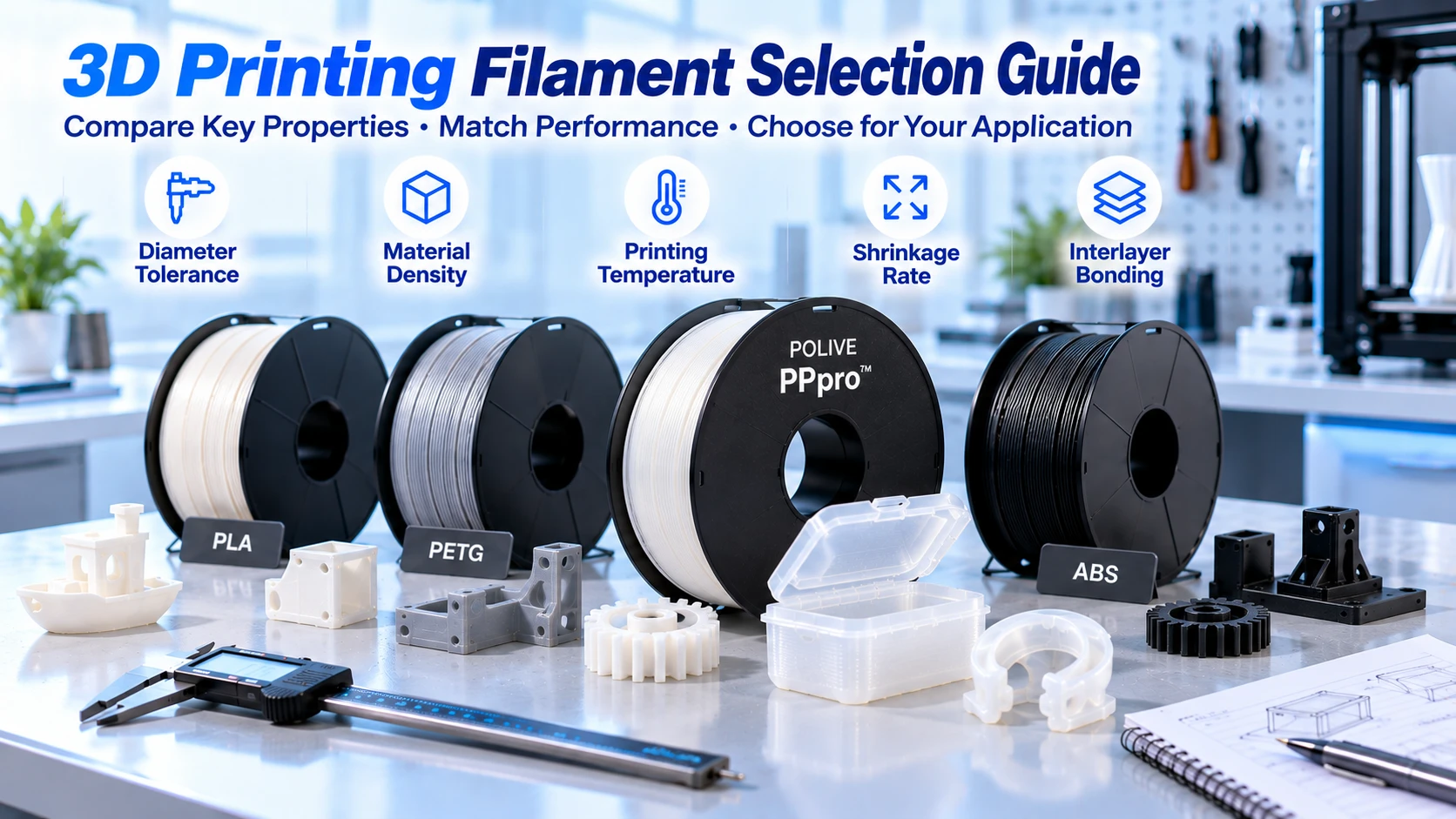
How to Choose 3D Printing Materials? Understanding Key Indicators on the Spec Sheet
Read past headline numbers: check test conditions, whether shrinkage and adhesion data exist, and whether the supplier shows real print tests.
First Define the Part’s Purpose, Then Read the Spec Sheet
When buying 3D printing filament, don’t compare only on price, and don’t judge by the material name alone. Two filaments may both print an object, yet their weight, toughness, chemical resistance, dimensional stability and surface finish can differ dramatically.
Before you start comparing, first clarify three questions:
- What loads will the part bear? Tension, bending, impact, repeated opening/closing, or sustained load.
- What environment will the part be used in? Contact with water, grease, cleaners, or prolonged exposure to elevated temperatures.
- What appearance must the part achieve? Transparent or translucent, a specific surface texture, or needs for painting and bonding.
These requirements determine which parameters matter most for material selection. For example, when making snap fits or living hinges that open and close repeatedly, the material’s toughness, fatigue resistance and structural design all matterâtensile strength alone cannot tell you whether it is suitable.
The Five Metrics Most Worth Watching on the Spec Sheet
1. Diameter Tolerance: Affects Extrusion Stability
Filament diameter affects how much material enters the extruder. Too much diameter variation makes the actual extrusion unstable, undermining surface quality, dimensional accuracy and interlayer bonding.
Common spec notations are ±0.05 mm, ±0.03 mm and ±0.02 mm. A smaller tolerance range means a smaller allowed diameter deviation, but that does not automatically mean better print results. Extruder condition, filament roundness, material formulation and print parameters also affect the final outcome.
When shopping, check these points:
- Whether the supplier clearly states the diameter tolerance.
- Whether the measurement method and inspection standard are explained.
- Whether the diameter stays stable across positions and batches.
If the part demands high dimensional accuracy, diameter consistency deserves special attention.
2. Density: Affects the Weight of Equal-Volume Parts
Density is usually given in g/cm³ and is a key metric for comparing the weight of different materials. For parts of the same volume, the lower the density, the lighter the theoretical material weight.
PP’s typical density is about 0.90 g/cm³, with the exact value varying by grade and formulation. Compared with common higher-density printing materials, PP helps reduce part weight and suits lightweight enclosures, containers, brackets and other non-critical load-bearing parts.
However, low density does not mean the printed part is necessarily lighter or stronger. Actual weight also depends on infill, wall thickness, structural design and support material. When comparing materials, use the same part model and print settings wherever possible.
3. Print Temperature Range: Understand the Process Window and Equipment Needs
The print temperature on a spec sheet usually refers to the nozzle temperature range. The right temperature depends on the material formulation, print speed, nozzle geometry and the part’s shape.
Beyond nozzle temperature, you must also confirm the material’s requirements for a heated bed, printing environment and cooling method. These conditions affect equipment compatibility, operating difficulty and print stability.
When comparing different filaments, focus on these items:
- Recommended nozzle temperature and applicable conditions.
- Whether a heated bed is required, and the corresponding equipment requirements.
- Notes on the print enclosure, door/cover state and cooling uniformity.
- Whether parameter recommendations are given for different print speeds.
A wide temperature range does not automatically mean the material is easier to print. More valuable is whether the supplier can provide clear, reproducible parameters and whether the material stays stable in real printing.
4. Shrinkage and Warp Tendency: Watch Stability for Large Parts
Volume changes can occur as a material cools. For semi-crystalline materials, crystallization also affects shrinkage behavior. If different regions of a part cool unevenly, corners may lift, the base may warp, or dimensions may deviate.
Shrinkage rate is a useful reference, but data from different test methods, sample shapes and test conditions are not necessarily directly comparable. Some filaments may not have a single uniform shrinkage value from the supplierâin that case, look further into actual print performance.
If you are printing large flat areas, long parts, thin-wall structures or precision assemblies, it is worth watching:
- Whether there is test data on shrinkage or dimensional change.
- Whether there are print recommendations for large-size parts.
- Warp behavior under different geometries.
- Whether post-print dimensions meet expectations.
The material’s own properties, the part structure and the printing process together determine final dimensional stability; do not judge solely from a single shrinkage number.
5. Interlayer Bonding: Determines Real-World Performance
FDM 3D printing builds parts by stacking material layer by layer. How well the layers bond affects the part’s overall strength, especially noticeable when force is applied along the Z direction.
For functional parts, snap fits, thin-wall parts and structures that bend repeatedly, interlayer bonding deserves close evaluation. Even with high tensile strength data, insufficient interlayer bonding can still cause the part to crack along the layer lines in use.
When comparing, check whether the supplier provides tensile, bending or other mechanical test data, and confirm the print orientation, test standard and conditions of the test specimens. Different test orientations and specimen structures affect results, so prioritize comparing data from similar test conditions.
Beyond the Spec Sheet, Also Check These Three Aspects
Batch-to-Batch Consistency
A single successful print only shows the material performs well under one set of conditions. For continuous production or repeat purchasing, stability between batches matters just as much.
Check whether the supplier has a clear quality-inspection process and whether diameter, appearance and key properties are batch-checked. For high-volume or performance-critical projects, keep test records for each batch to make later traceability easier.
Chemical and Temperature Resistance
A material's chemical resistance cannot be reduced simply to 'acid/alkali resistant' or 'solvent resistant.' Actual performance depends on the type, concentration and temperature of the substance contacted, the contact time, and the stress the part bears.
Temperature-resistance metrics must also be read separately. Melting point, heat-deflection temperature and long-term service temperature reflect different properties and cannot substitute for one another. A brief hot-water soak does not by itself prove the part can be used long-term at the same temperature.
If the part will contact cleaners, chemical liquids or high-temperature media, choose a material with corresponding test data, then verify it against your actual operating conditions.
Post-Processing and Assembly Compatibility
Filament choice also affects post-print processing. Different materials differ in painting, bonding, welding and surface treatment.
For example, PP has low surface energy, so conventional glues and paints may not bond well. For bonding or painting, confirm in advance whether a special primer, adhesive or surface-treatment process is needed.
If the part must assemble with other components, also consider snap-fit clearance, screw connections, dimensional tolerance and repeated disassembly needs. Bringing post-processing and assembly requirements into the material-selection stage saves a lot of later rework.
A Buying Checklist to Compare Filaments Side by Side
After defining the purpose, use the checklist below to screen candidate materials. First judge whether the necessary conditions are met, then compare price and total cost of use.
| Purchase Item | What to Confirm |
|---|---|
| Material type | Whether it meets the part’s functional and environmental requirements |
| Diameter Tolerance | Tolerance range, measurement method, batch stability |
| Density | Whether it meets the part’s weight requirement |
| Printing conditions | Nozzle temperature, heated-bed requirement, environment and cooling conditions |
| Dimensional Stability | Shrinkage, warpage and large-format print performance |
| Interlayer bonding | Mechanical data, test orientation and test conditions |
| Chemical and Temperature Resistance | Whether test data matching the actual operating conditions exists |
| Post-Processing and Assembly | Whether it suits bonding, painting, welding and assembly |
| Procurement Cost | Unit price, print success rate, scrap rate and processing cost |
| Supply Stability | Batch inspection, delivery capability and continuous supply status |
When two materials differ in unit price, compare their actual printing costs too. Material price is only part of it; print failures, extra supports, post-processing and rework all add to the final cost.
For projects with ongoing purchasing, first test candidate materials with the same model and unified print conditions, then record weight, dimensions, surface quality, print time and real-world performance. The resulting data is more useful than comparing a single number on a spec sheet.
Summary: Choosing Filament Means Matching the Material to the Actual Use
There is no single ranking of 3D printing filaments that fits every scenario. The key to material selection is aligning material properties, printing conditions and part requirements.
- Diameter tolerance affects extrusion stability; density affects the theoretical weight of equal-volume parts.
- Print temperature, shrinkage and warpage affect process adaptability and dimensional stability.
- Interlayer bonding, chemical resistance and temperature resistance must be evaluated against the actual operating conditions.
- Batch consistency, post-processing compatibility and overall cost also affect the long-term usage experience.
If your direction is modified PP, you can learn more about POLIVE PPpro⢒s product parameters and corresponding test data, and combine the part’s purpose, printing conditions and actual verification results to judge whether it suits your project.
Related Reading
- PP or PLA: Which Should You Choose? A Guide to Selecting 3D Printing Materials
- What is Modified PP? What Exactly Does POLIVE PPpro™ Change?
- How to Configure PP 3D Printing Settings? PPpro™ Parameter Guide
- How to Judge the Quality of Modified PP Filament? Which Tests to Check When Buying
Which Specs Should You Check First When Buying Filament?
Define what the part is for before reading the datasheet; do not compare price alone, and do not judge by the material name alone. Two filaments may both produce a decent sample, yet behave very differently over the long term.
What Else Matters Beyond the Datasheet?
Check whether the seller provides reproducible print conditions, real printed parts, stated limits and batch-to-batch consistency. A supplier that spells out whether a heated bed or an enclosure is needed, and how to handle the first layer, is more trustworthy.
How Do You Compare Several Filaments Side by Side?
Make a table covering fit for purpose, how demanding the printing setup is, real test parts, supply consistency and price. Print each one on the same machine with the same test model before judging — do not rely on marketing pages alone.
What Deserves Extra Attention on a PP Filament Datasheet?
Check whether the printing setup is clearly explained. PPpro™ states it explicitly: no heated bed, no enclosure, open cooling, used with PPLOCK26811 and a brim. Actionable guidance like this is more useful than a pile of isolated numbers.