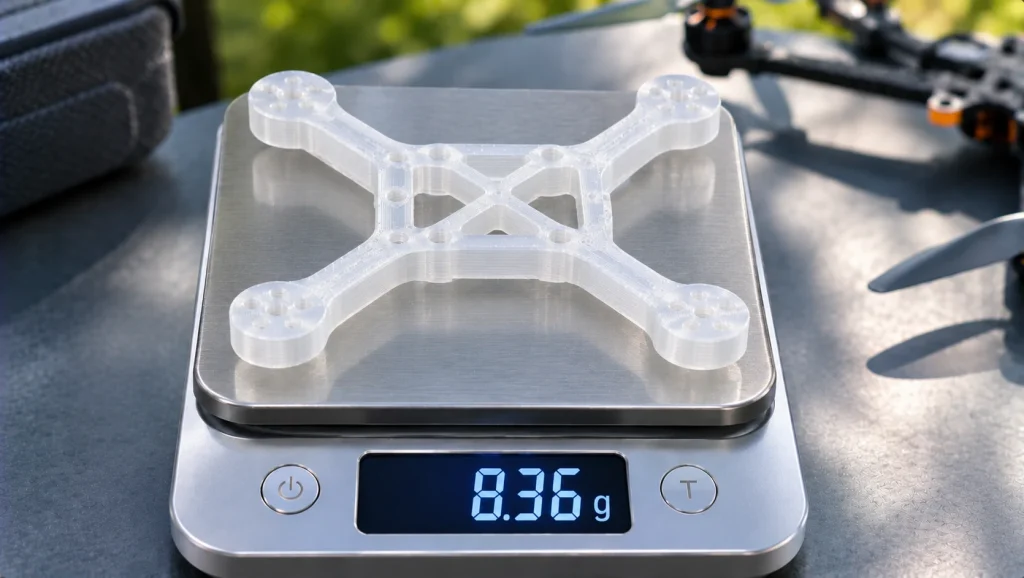
Less Weight, More Flight Time: Why PP Is the First Choice for 3D-Printed Drone Parts
In the drone and RC model community there is a well-known saying: “weight loss is endurance gain.”
With motor and battery technology approaching its limits today, lightweighting the airframe and accessories has become the most effective way to extend flight time. That is why more and more makers and R&D teams have started using 3D printing for drone parts.
Why Do Drone Parts Favor PP?
Extremely light: PP (polypropylene) has a density of only about 0.90 g/cm³, a full 27% lighter than PLA. A propeller guard or sensor bracket of the same volume weighs noticeably less when printed in PP.
Crash-proof and durable: bumps and knocks during takeoff and landing are routine for drones. PLA is too brittle and cracks at the first crash, while PP offers excellent toughness and fatigue resistance — after a light impact it springs back quickly instead of snapping.
Good damping: PP’s natural damping gives flight controllers and video-transmission modules mounted on the frame a kind of built-in physical shock absorption.
Key Details for Printing Drone Parts with PPpro
People used to avoid printing PP because of its high shrinkage, warping and printing difficulty. PPpro modified PP filament solves that pain point.
When printing parts this weight-sensitive, a few design tricks help:
Thin walls with ribs: parts do not need to be printed thick; keep the wall thickness around 1.2 mm-1.5 mm. To maintain stiffness, favor openwork “thin wall + ribs” structures.
Lower the infill: an infill of 10%-15% is usually enough for the loads drone parts see, and sealed cavities can shave off even more weight.
No enclosure needed: on an ordinary FDM printer PPpro prints right away with no heated bed and no enclosure, which greatly lowers the trial-and-error barrier for R&D teams.
Got it — I’ve added the summary for you. You can insert this paragraph right above the “Related Reading” section:
Summary
Weight reduction in drones is a systems engineering job where every gram from motor to frame counts. PPpro brings PP’s natural strengths — ultra-light, tough, vibration-damping — into FDM printing. Get the thin-wall-and-rib design right and control cooling during printing, and it is easily one of the most cost-effective materials for hand-built models and lightweight upgrades.