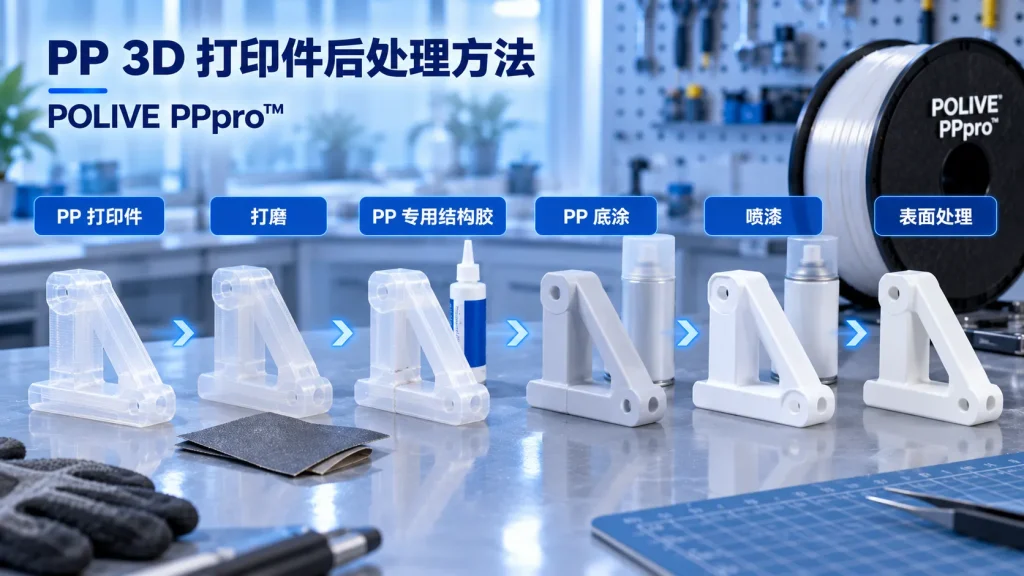
How to post-process PP prints? Sanding, bonding, and painting all differ from other materials.
How to Post-Process PP Prints? Sanding, Bonding, Painting — PP’s Finishing Approach Differs from Other Materials
After a PP 3D-printed part is finished, if it is only used as a regular functional part, complex post-processing is usually unnecessary.
But if you want to go further andbond, paint, surface-finish, or improve its appearance,PP will show some characteristics that differ from PLA, ABS, and PETG.
One of the most important reasons is:
PP is a low-surface-energy material, so many ordinary adhesives and coatings do not easily form a good bond on its surface. 3M also lists polypropylene as a typical low-surface-energy plastic.
Therefore, the key to PP post-processing is not simply “applying more glue,” but choosing the right surface treatment for the specific application.
1. How to bond PP? First choose an adhesive suited to low-surface-energy plastics
Ordinary glue often does not bond PP well.
For structural bonding, you can choose adhesives specifically designed for low-surface-energy plastics.
For example, 3M Scotch-Weld DP8005 is a structural adhesive developed for low-surface-energy plastics including various PP and PE. According to 3M’s official information, in many applications this product can bond PP without additional primer or flame/plasma surface treatment.
Therefore, not all PP bonding must be preceded by flame treatment.
A more practical approach is:
First confirm the adhesive is suitable for PP → clean the surface per the product instructions → apply surface treatment only if necessary.
If you use ordinary epoxy or other adhesives not designed for PP, you cannot directly assume they will form a reliable structural bond.
2. Can PP be sanded?
Yes.
PP printed parts can be surface-finished with sandpaper.
If you only want to remove obvious layer lines, start with coarser sandpaper and gradually move to finer grits.
For example, you can try:
400 grit → 600 grit → 800 grit → 1000 grit
The specific grit should be adjusted based on the final surface requirement.
However, PP is relatively flexible; if sanding generates too much heat from friction, the surface may soften, smear, or develop new texture.
Therefore, we recommend:
light pressure, low speed, sanding in stages, and avoiding sustained local friction.
3. Can PP be painted?
Yes, but surface treatment requires more attention than with PLA, ABS, and similar materials.
PP’s low surface energy affects how coatings wet and adhere to the surface.
Therefore, if you want a stable painting result, consider:
cleaning → surface treatment / PP-specific primer → topcoat
Primer products specifically for PP and other low-surface-energy plastics are available on the market.
In practice, follow the compatibility guidance provided by the primer and paint manufacturers.
4. Can a heat gun be used to treat layer lines on PP?
It can be tried, but with great caution.
PP is a thermoplastic, so localized heating can change the surface state.
However, we do not recommend simply assuming “a heat gun set to a fixed 200°C will always work.”
Because the temperature shown on the heat gun is not exactly the same as the actual surface temperature of the part, and nozzle distance, movement speed, part thickness, and heating time all affect the result.
If heat-gun treatment is needed, you can use:
greater distance → faster movement → multiple light passes
rather than dwelling in one spot for a long time.
Local overheating can cause surface deformation, loss of detail, or even melting.
5. The core of PP post-processing: solve the surface-energy issue first
To summarize PP post-processing simply:
print → clean → choose surface treatment by purpose → then bond or paint
Different purposes call for different methods:
| Purpose | Methods you can try |
| Remove obvious layer lines | Sand gradually with progressively finer grits |
| Bond two PP parts | Structural adhesive for PP / low-surface-energy plastics |
| Spray painting | PP-specific primer + topcoat |
| Improve surface condition | Appropriate mechanical or surface treatment |
| Local smoothing | Apply heat treatment with caution |
No single post-processing method suits all PP prints.
Especially for parts under structural load, bond strength must be verified through actual testing.
Does PPpro™ require complex post-processing?
One focus of PPpro™’s development is improving PP’s performance in FDM printing.
With suitable print parameters, ordinary functional parts usually do not need complex treatment just to “remove layer lines.”
For parts needing a finer appearance, you can choose sanding, painting, or other surface treatments based on the final use.
This is also what makes PP 3D printing interesting:
the material’s own properties determine the post-processing method, rather than simply copying the workflow used for PLA or ABS.
If you want to reduce layer lines during printing, start with the print parameters:
PP 3D Printing Parameters Explained
More PPpro™ application information:polive3d.com
PP 打印件能打磨吗?
可以,但 PP 韧性好、偏软,打磨容易起毛和发热粘砂纸。建议从细目开始、轻压、避免局部过热,必要时配合表面热处理收敛层纹。
PP 件怎么粘接和涂装?
低表面能是核心难点,普通胶和漆附着力差,要选针对低表面能塑料的胶粘剂并做好表面处理。平台端我们配套的是 PPLOCK26811 专用胶水,涂一次可多次打印,清洁用酒精擦。
热风枪能处理 PP 的层纹吗?
可以尝试,但 PP 对热敏感,局部过热容易变形或发白。务必小范围先试,保持距离、移动均匀,别对着一个位置吹。
后处理麻烦,能不能从设计上少做点?
能。壁厚均匀、圆角过渡、避免截面急剧变化,既能减少收缩凹凸也能减少翘边。零件设计到位,很多打磨和补土其实可以省掉。
Related Reading
- How Good Is the Surface Quality of PP Prints?
- What Is Surface Energy? Why PP’s Low Surface Energy Makes Printing Difficult
- How to Remove PP Prints from the Build Plate? Demolding Tips and Plate Protection
- How to Design PP Parts for 3D Printing? Wall Thickness, Fillets, Snap Fits and Warp Prevention
- Which Chemicals Can PP Withstand?
- Are PP Prints Strong? How to Assess PP’s Mechanical Properties