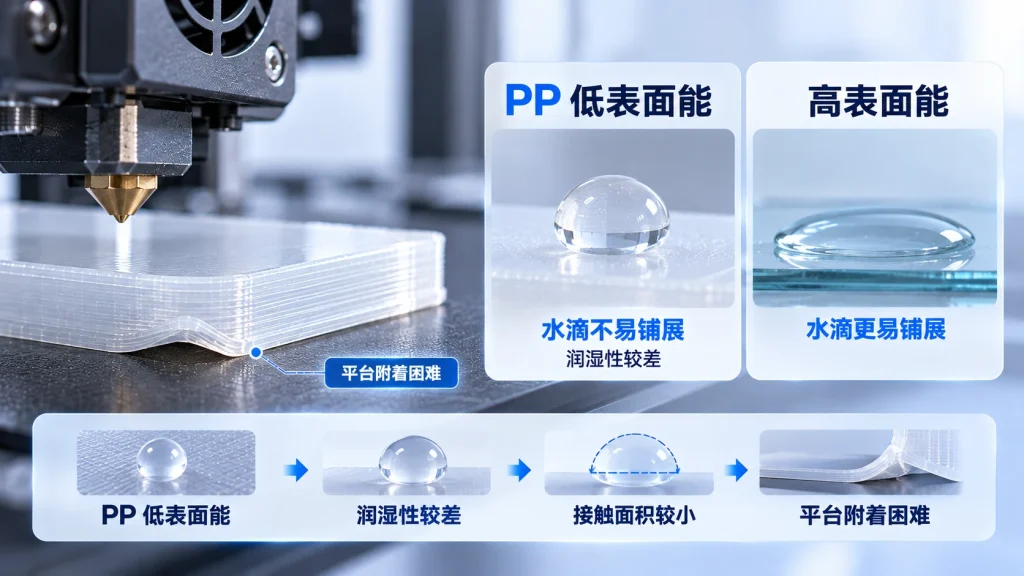
What Is Surface Energy? Why PP’s Low Surface Energy Makes Printing Difficult
Surface Energy is an important physical concept describing a solid surface’s ability to interact with other substances, usually expressed in mN/m .
PP is a typical low-surface-energy material. Common data are roughly around 29–31 mN/m .
For 3D printing, this means it may be difficult to form good wetting and adhesion between molten PP and the print bed; in post-processing, bonding between PP and ordinary adhesives or coatings may also be difficult.
Therefore, several common problems in PP printingâweak first-layer adhesion, warping, and difficult post-processing bondingâare all related to PP’s surface characteristics.
However, it should be noted that surface energy is not the only factor affecting adhesion. Bed material, surface cleanliness, temperature, contact area, and the material’s own formulation all affect the final adhesion performance.
What is surface energy?
Simply put, surface energy helps us understand:
how easily one material’s surface interacts with another material.
For example, placing a drop of water on a solid surface:
- If the water spreads easily, it usually indicates stronger interaction between the liquid and the surface;
- if the water remains a relatively obvious spherical shape, it usually indicates poor wetting.
This phenomenon can be observed through thecontact angle.
Generally speaking:
High-surface-energy materials
such as glass and some metal surfaces, where liquids usually spread more easily and the contact angle is relatively small.
Low-surface-energy materials
such as PP and PE, where liquids more easily remain contracted and the contact angle is usually larger.
Therefore, surface energy is an important reference factor when judging whether a material is easily wetted by glue, coating, or molten plastic.
However,Surface energy should not be simply understood as “surface stickiness”.
It is not directly equal to the final bond strength, but is one of the important factors affecting wetting and interfacial interaction.
How low is PP’s surface energy?
PP’s surface energy is usually at a relatively low level.
Common materials can be roughly compared:
| Material | Approximate surface-energy level |
| Glass, some metals | Higher |
| ABS, PC | Usually higher than PP |
| PP | About 29-31 mN/m |
| PE | Also usually a low-surface-energy material |
Specific values are affected by factors such as material grade, surface condition, test method, and surface contamination, so these data are more suitable as a reference for understanding material differences rather than as absolute fixed values.
For PP, low surface energy means a very practical problem:
Many common adhesives and coatings do not easily form good wetting and bonding on PP surfaces.
This is also one of the reasons PP is called a “difficult-to-bond material.”
For POLIVE PPpro™, and the actual bed adhesion performance still needs to be tested in combination with the specific print bed, printing parameters, and material formulation.
PPpro⢠bed adhesion test results: data to be added
Why does low surface energy make PP printing difficult?
In FDM 3D printing, the first layer needs to go through a very critical process:
Molten material â contacts the print bed â spreads â cools â sets
If the molten material cannot wet the bed surface well, the actual contact area may be affected.
This further affects first-layer adhesion.
1. The first layer easily fails to stick
If the wetting and interfacial bonding between the PP melt and the bed are insufficient, the edges of the print are more likely to experience:
- First-layer detachment
- Corner lifting
- Long-edge deformation
- Local detachment of large flat areas
For large flat parts and elongated parts, this problem is usually more pronounced.
2. Low surface energy and PP shrinkage act together
PP itself is a semi-crystalline material that shrinks during cooling.
If the adhesion between the first layer and the bed is insufficient, and the print also has noticeable shrinkage, the following process may form:
cooling shrinkage â internal stress â edges lift up â bed adhesion further decreases
Therefore, PP’s warping problem cannot be simply attributed to “insufficient temperature.”
It is often:
material shrinkage + surface energy + bed adhesion + temperature and cooling
acting together.
3. Post-processing is also affected
PP’s low surface energy affects not only the printing process but also the treatment after printing.
For example:
- Spray painting
- Coating
- Bonding
- Labeling
- Compositing with other materials
If ordinary glue or ordinary coating is used directly, problems such as insufficient wetting and low adhesion may occur.
Therefore, when post-processing PP prints, it is usually necessary to consider surface treatment methods and adhesive systems specifically for PP.
Which prints are more easily affected?
Not all PP prints exhibit the same degree of adhesion problems.
The following types of structures are usually more sensitive:
Large flat areas
The larger the printing area, the more pronounced the cumulative effect of cooling shrinkage may be.
Elongated structures
Long edges are prone to producing noticeable shrinkage stress during cooling.
Sharp-corner structures
Sharp-corner positions usually lift more easily from the bed edge.
Thin-wall structures
The heat dissipation speed and temperature changes of thin-wall structures may differ from those of solid structures, so they need to be considered separately.
In contrast, small parts, parts with a smaller bottom area, or models that use Brim a model that increases contact area are usually easier to control.
How to deal with PP’s low surface energy?
In practical engineering, it is usually not relying on a single method, but combining different solutions according to the application scenario.
1. Choose a suitable print bed
Different bed surfaces show different adhesion performance for PP.
You can choose a bed surface designed for PP or low-surface-energy materials, while combining:
- Brim
- Raft
- Appropriate first-layer settings
This increases the actual contact area and improves first-layer stability.
2. Keep the print surface clean
Oil, dust, and other contaminants on the bed affect the actual interfacial condition.
Therefore, keeping the bed clean before printing is very important.
At the same time, avoid exposing the filament to environments where it can easily pick up dust and oil over the long term.
Note:
Cleaning does not necessarily solve PP’s adhesion problem.
It only ensures the bed is in a more stable baseline state.
3. Perform surface activation
For PP surfaces that need bonding or coating, surface activity can be improved through some surface treatment methods.
Common methods include:
- Flame treatment
- Corona treatment
- Plasma treatment
These methods can change the state of the PP surface and improve its interaction with adhesives or coatings.
However, the surface activation effect is not permanent.
The treated PP surface may change again over time, so subsequent processes usually need to be carried out as soon as possible after treatment.
4. Use adhesives or primers suitable for PP
If you need to bond PP prints, ordinary glue is not necessarily suitable.
Bonding systems for PP usually use:
- PP-specific adhesive
- Primer
- Matching surface treatment
The specific choice needs to be based on:
PP formulation + bonded material + usage environment + loading mode
for testing.
For structural parts, the actual bond strength should be the ultimate focus, rather than just looking at whether the product name says “suitable for PP.”
5. Improve from the material side
Besides changing the print bed and post-processing techniques, you can also start from the material itself.
For modified PP specifically for FDM 3D printing, the formulation design can target:
- Wetting behavior
- Platform attachment
- Shrinkage behavior
- Melt flow
- Interlayer bonding
for adjustment.
POLIVE PPpro™ is a modified PP filament developed for the PP FDM 3D printing scenario.
Its approach is not simply to turn ordinary PP into filament, but to improve PP’s processing performance in FDM printing from the perspective of matching material formulation with the printing process.
What is the relationship between surface energy and printing temperature?
Surface energy and temperature are two different concepts, but they jointly affect printing adhesion.
When the temperature rises, the fluidity of molten PP usually changes, thereby affecting how the material spreads on the bed.
Therefore, when optimizing printing parameters, you can pay attention to:
Material temperature â melt flow
Bed temperature â bottom cooling
Surface condition â wetting and interfacial bonding
But do not attribute all adhesion problems to temperature.
If the bed surface itself is not suitable for PP, even continuously raising the heat-bed temperature may not achieve ideal adhesion.
What does surface energy ultimately tell us?
Understanding PP’s surface energy, the most important significance is not to memorize a 29–31 mN/m number.
What really matters is understanding:
PP’s low surface energy is one of the important reasons it is difficult to wet and bond.
This can explain why PP often requires special attention to first-layer adhesion in FDM printing, and also why PP prints usually require additional surface treatment in subsequent coating, bonding, and compositing processes.
When you encounter PP print warping, first-layer detachment, or poor post-processing bonding, you can troubleshoot step by step from the following directions:
Bed â surface cleaning â temperature â cooling â contact area â material formulation
rather than adjusting only one parameter.
Summary
- PP is a typicalLow-surface-energy materials, with common surface-energy data approximately 29–31 mN/m.
- Low surface energy affects the wetting and adhesion of molten PP to the print bed.
- PP’s low surface energy is also one of the important reasons its subsequent coating and bonding are relatively difficult.
- PP warping is usually not caused by a single factor, but is the result of the combined action of shrinkage, bed adhesion, temperature, and cooling.
- A suitable bed, Brim/Raft, a clean surface, and PP-specific surface treatment can all serve as improvement measures.
- Surface activation methods such as flame, corona, and plasma treatment can be used to improve the processability of PP surfaces, but the effect changes over time.
- For FDM 3D printing, PP’s wetting and adhesion performance can also be improved from the material formulation side.
- POLIVE PPpro™ a material designed for adhesion, shrinkage, and processing stability in PP FDM printing.
What Is Surface Energy, and Why Is PP's So Low?
Surface energy describes how readily a solid surface interacts with other substances, and is usually expressed in mN/m. PP's molecular chains contain only carbon and hydrogen and have very low polarity, making it a low-surface-energy material — so adhesives, coatings and most build plates do not wet it easily.
How Does Low Surface Energy Make PP Hard to Print?
The most direct consequence is poor first-layer adhesion; combined with semi-crystalline shrinkage, corners lift more easily. Gluing and painting in post-processing are affected too. This is a material property, not a tuning mistake.
Without a Heated Bed, What Makes the First Layer Stick?
A dedicated adhesive, not temperature. Coat the build plate with a thin layer of PPLOCK26811, let it dry for a few minutes and print directly on it; one application lasts for multiple prints and cleaning is a wipe with alcohol. Add a brim for support and even an entry-level open-frame machine stays reliable.
Does Low Surface Energy Have Any Upside?
Yes. It resists staining, stands up to chemical wiping and repels water, which actually makes containers and chemical-related parts perform better. The same property that is a nuisance for adhesion becomes an advantage in service.
Related Reading
- How to Prevent PP Warping? How to Choose Between Brim, Raft, and Skirt
- PP 打印件能粘接吗?PP 胶水选择与表面处理
- 为什么 PP 以前这么难打?收缩、翘边、粘不住的三大难题
- What Print Bed Should Be Used for PP 3D Printing? A Comparison of Common Bed Materials