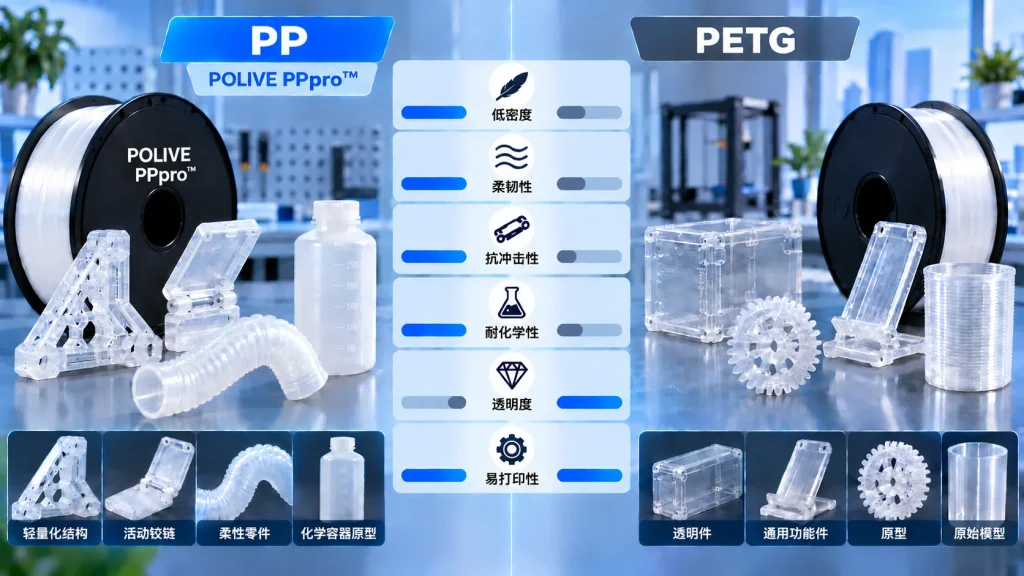
PETG is one of the more common engineering plastics in 3D printing. It is more heat-resistant than PLA and generally easier to print than ABS, so it is widely used for general features and prototyping.
But the advantages of PETG do not mean that it is suitable for all applications.
PP also has its own material characteristics. How to really choose between the two, the key is not “which is better”, but:
What is the final function of your print?
What are the main differences between PP and PETG?
| Performance Dimension | PP | PETG |
| Density | approx. 0.90 g/cm³ | Approximately 1.27 g/cm³ |
| Weight | Lighter under the same volume | Relatively heavier |
| Resilience & Flexibility | Good flexibility for parts that need to be bent | Better toughness, but more rigid overall |
| Chemical resistance | Good tolerance to many chemical media | Somewhat chemically resistant, depending on the medium |
| fatigure durability | Suitable for partially repeatedly bending structures | Not suitable as a typical living hinge material |
| Heat resistance | Depends on the brand and recipe | Depends on the brand and recipe |
| Transparency: | Often not a major advantage | More choice of transparent and translucent products |
| Printing Difficulty | Typically more control over print conditions than PLA/PETG | Usually relatively easy to get started |
| Typical Applications | Live hinges, lightweight structures, chemical-resistant features, etc. | Prototypes, transparency, general features, etc. |
Remarks: HDT, heat resistance temperature and long-term use temperature are not the same concept, and the actual upper limit of use of all PP or PETG products cannot be judged by only one temperature number. Data for different grades and formulations may also vary significantly.
What are the main advantages of PP?
1. Lower density
PP’s density is typically about 0.90 g/cm³, significantly lower than PETG.
This means that under the same volume, the PP print can achieve a lower weight.
This may be of practical value for drone structures, portable equipment, buoyancy structures, and other weight-sensitive parts.
2. More suitable for some repeatedly bent structures
PP’s fatigue resistance makes it particularly suitable for explorationLiving Hinges and Repeatedly Bent Structures.
For example:
- One-piece flip box
- Folding structure
- FLEXIBLE CONNECTIONS
- Functional parts that are repeatedly opened and closed
However, whether the living hinge can reach thousands or even tens of thousands of cycles cannot be judged only by the name of the material, but also depends on the thickness of the hinge, the printing direction, the layer height, the bending angle and the printing parameters.
3. Chemical resistance
PP has a good tolerance to many common chemical media, so it has a large number of applications in chemical containers, laboratory supplies and industrial parts.
PETG is also chemically resistant, so a more accurate comparison should beSpecific Chemicals, Concentrations, Temperature and Exposure Timeto make a judgment, rather than simply saying that a material is “fully resistant to acid and alkali”.
4. Low water absorption
The water absorption of PP is low.
This is also a material property to consider for parts that need to be exposed to moisture, humid environments, or that need to maintain low hygroscopicity.
What are the advantages of PETG?
One of the biggest advantages of PETG is thatSomewhat easy to use.
For many common features and prototypes, PETG can provide a relatively simple printing scheme.
In addition, it has several distinctive features:
- The print threshold is relatively low
- Transparent and translucent effects are easier to achieve
- Variety of colors and product choices
- Suitable for a large number of regular features and prototypes
If you just need a material that is easy to print, balanced in strength and toughness, PETG has often been able to meet the demand.
So what is PPpro™ for?
If your print is primarily:
Generic prototypes, displays, transparent enclosures, or generic features
PETG may be sufficient.
If your design is more focused:
Low weight, flexibility, repeated bending, chemical resistance, low water absorption
Then PP can be a material worth considering.
The focus of the poly PPpro™ is to further reduce the threshold for the use of traditional PP in FDM printing.
By modifying the material design, PPpro™ targets PP commonWarpage, first-layer adhesion and interlayer bondingand other issues to make it easier for users to try PP.
PP and PETG are not substitutes for each other
When choosing a 3D printed material, it is not necessary to first decide which material is the best.
A more effective approach is to first determine the working conditions of the print:
How light does it need to be? Does it need to be bent? Will I be exposed to chemicals? Is there a need for transparency? Prolonged exposure to water? Do you need to open and close repeatedly?
Then select the material.
Both PETG and PP have their own application space.
PETG is more suitable for many conventional features and prototypes, while PP has different material advantages in low density, flexibility, fatigue resistance and partial chemical resistance applications.
If you want to learn more about PP in action, you can read:PP for Printing What? 8 Real Scenes.
More PPpro™ product information:polive3d.com
PP 和 PETG 哪个好?
各有擅长,关键看打印件要做什么。PETG 在刚性和通用性上比较均衡、容易上手;PP 更轻、耐化学和抗疲劳更好、韧性更强,适合反复弯折和抗跌落的功能件。
PP 的主要优势是什么?
密度低、耐化学、抗疲劳、吸水率低,受力时倾向变形卸能而不是脆断,特别适合活铰链、卡扣、容器和需要轻量化的零件。
PPpro™ 在这组对比里解决的是什么?
不是把 PP 改成 PETG,而是把 PP 的打印门槛降下来:不加热床、不封箱,开放机架在空调房里就能打,首层用裙边加 PPLOCK26811,零件端做圆角与均匀壁厚。
Related Reading
- What are the differences between PP and PETG? How should you choose materials for 3D printing?
- How to Choose Between PLA, PETG, ABS, and PP? A Comparison of Four Common 3D Printing Materials
- What’s the Difference Between PP and ABS? Performance and 3D Printing Difficulty Compared
- What are the differences between PP and nylon (PA)? A comparison of materials for functional parts
- What Is PPpro? A Modified PP 3D Printing Filament That Needs No Heated Bed and Makes Living Hinges
- How to Choose 3D Printing Materials? What Is PP’s Overall Performance Like?